Despite that opportunity, many founders stall out before they even open their doors. Between the Secretary of the State (SOTS), the Department of Revenue Services (DRS), and the Department of Labor, it's easy to lose track of which agency wants what — and when.
This guide breaks Connecticut business registration into a clear sequence: structure decisions, filing steps, real costs, and the compliance calendar you'll need to stay in good standing.
Key Takeaways
- LLCs and corporations must file with SOTS via business.ct.gov; sole proprietorships and general partnerships usually skip state-level formation
- LLC formation costs $120, while a stock corporation's Certificate of Incorporation runs $250 for up to 20,000 shares
- Tax registration (DRS) and employer registration (Department of Labor) are separate steps, each with its own portal and fee
- Only corporations file an Organization and First Report within 90 days; LLCs move straight to annual reporting
Choosing the Right Business Structure in Connecticut
Your structure determines your liability exposure, how you're taxed, and how much paperwork lands on your desk every year. Get this decision right before you file anything, because changing structures later means starting over with new filings and fees.
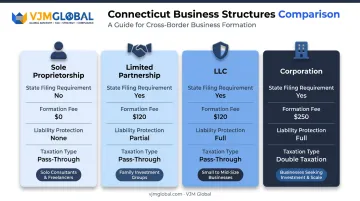
Sole Proprietorship
This is the default structure if you start working without filing anything. There's no state registration requirement through SOTS.
- No liability protection — your personal assets are exposed to business debts
- If you operate under a name other than your own legal name, you'll need a Certificate of Trade Name (DBA), filed with the town clerk where you conduct business, for $20
- Fastest and cheapest way to start, but risky for anything beyond a small side venture
General & Limited Partnership
General partnerships follow the same rule as sole proprietorships: no default state registration, though a trade name filing may still apply if you're operating under a business name.
Limited partnerships work differently. They must file a Certificate of Limited Partnership with SOTS for $120. This structure suits situations where some partners want limited liability and a passive role, while general partners retain management control and full liability.
Limited Liability Company (LLC)
LLCs are the most common formation choice for small and mid-sized businesses, since they combine liability protection with simple, pass-through taxation.
To form one in Connecticut:
- File a Certificate of Organization with SOTS for $120
- Draft an Operating Agreement (not filed with the state, but essential for internal governance and banking purposes)
- Appoint a registered agent with a Connecticut street address
LLC members report profits and losses on their personal tax returns. The business itself doesn't pay a separate corporate income tax, which avoids the double-taxation problem corporations face.
Corporation (C-Corp and S-Corp)
Corporations require more setup but offer advantages for businesses planning to raise outside capital or issue stock.
- File a Certificate of Incorporation with SOTS ($250 covers up to 20,000 authorized shares)
- Draft corporate bylaws and appoint a registered agent
- C-Corps pay corporate tax on profits, and shareholders pay tax again on dividends, creating the classic "double taxation" scenario
- S-Corps avoid that by electing pass-through taxation, but you'll need to file IRS Form 2553 to make that election
Choosing between C-Corp and S-Corp status often comes down to how you plan to reinvest profits versus distribute them to owners.
Step-by-Step Process to Register Your Business in Connecticut
Regardless of the structure you land on, the registration mechanics follow a similar sequence. Here's the checklist.
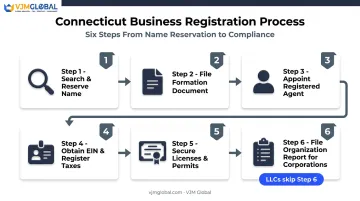
Step 1: Search and Reserve Your Business Name
Use the business records search tool on business.ct.gov to confirm your desired name isn't already taken. If you're not ready to file immediately, you can reserve the name for 120 days for a $60 fee, which helps if you're still finalizing your operating agreement or waiting on financing.
Step 2: File Your Formation Document with the Secretary of State
LLCs submit a Certificate of Organization; corporations submit a Certificate of Incorporation. Both filings happen online through business.ct.gov.
- Most online filings are processed without significant delay, though the Secretary of State's office doesn't guarantee a fixed turnaround
- Need it faster? Expedited processing costs $50 per transaction and targets completion within 24 hours
Step 3: Appoint a Registered Agent
Connecticut requires every LLC and corporation to name a registered agent: the point of contact for legal correspondence and service of process.
- An individual agent must be a Connecticut resident, at least 18 years old
- A business acting as agent must be authorized to transact business in Connecticut
- The agent's address must be a physical street address — no PO boxes accepted
Step 4: Obtain an EIN and Register for State Taxes
Apply for a free Employer Identification Number (EIN) directly through the IRS website. Most applicants receive their number immediately online.
From there, register separately with DRS through the myconneCT portal for any tax obligations that apply to your business:
- Sales and use tax permit: $100 registration fee, required if you sell taxable goods or services. Connecticut's general sales tax rate sits at 6.35%
- Employer withholding tax: no registration fee, needed once you have employees
Step 5: Secure Required Licenses and Permits
There's no single, universal statewide business license in Connecticut, but plenty of industries need one anyway.
- Food service establishments license through their local health department
- Construction, home improvement, and specific professional services register through the Department of Consumer Protection
- Some municipalities layer on their own local permit requirements, so check with your town as well as the state
Step 6: File Your Organization and First Report (Corporations Only)
Here's a detail that trips up a lot of new founders: the Organization and First Report applies to corporations, not LLCs. Stock and nonstock corporations must file this report within 90 days of incorporation, listing directors, officers, and the principal business address.
- Stock corporations pay $150
- Nonstock corporations pay $50
LLCs skip this step entirely and move straight into the annual report cycle instead.
Connecticut Business Registration Costs at a Glance
Here's how the core fees stack up:
| Filing | Fee |
|---|---|
| LLC Certificate of Organization | $120 |
| Corporation Certificate of Incorporation (up to 20,000 shares) | $250 |
| Limited Partnership Certificate | $120 |
| Business name reservation (120 days) | $60 |
| Trade name / DBA (town clerk) | $20 |
| Organization and First Report — stock corp | $150 |
| Organization and First Report — nonstock corp | $50 |
| Annual report — LLC/LLP/LP | $80 |
| Annual report — stock corporation | $150 |
| Expedited processing (per transaction) | $50 |
Beyond SOTS filings, budget for these additional costs:
- Registered agent services — self-designation is free if you or a co-owner meets the residency requirement
- Professional registered agent services typically charge an annual fee if you'd rather keep your home address off public record
- Sales tax registration with DRS runs a separate $100, distinct from any SOTS formation fee
What to Do After Registering Your Business in Connecticut
Getting your Certificate of Organization or Incorporation approved starts the real work. A few tasks demand your attention right away.
Open a dedicated business bank account. Bring your EIN, formation certificate, and any relevant licenses. Mixing personal and business finances is one of the fastest ways to undermine the liability protection your LLC or corporation is supposed to provide.
Set up bookkeeping from day one. Tracking income, expenses, and tax obligations gets harder the longer you wait. Many US business owners outsource this task rather than handle it in-house. Firms like VJM Global support 500+ American business owners with accounting, compliance, and back-office services—freeing founders to focus on running the business instead of reconciling it.
Calendar your compliance deadlines. At minimum, track:
- The 90-day Organization and First Report deadline (corporations)
- Annual report due dates going forward
- Quarterly estimated tax payments
- Sales tax filing frequency once you're registered with DRS
Missing any of these can put your business out of good standing, which complicates everything from opening a new bank account to securing financing later.
Why Connecticut Is a Strong State for Registering Your Business
Beyond the paperwork, Connecticut offers real structural advantages for founders willing to plant roots there.
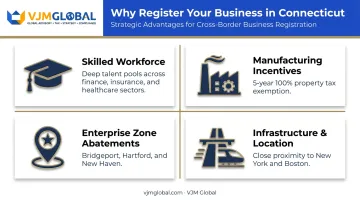
- Skilled workforce concentration in finance, insurance, and healthcare, sectors employing hundreds of thousands of workers and offering deep talent pools for related industries
- Manufacturing incentives, including a five-year, 100% property tax exemption on qualifying machinery and equipment purchases
- Enterprise Zone tax abatements in Bridgeport, Hartford, and New Haven, providing an 80% property tax abatement for five years plus added corporate tax credits
- Infrastructure and quality of life, with proximity to New York and Boston, coastal access, and established transit corridors that support regional operations
None of these incentives are automatic. Most require applying through the relevant program and meeting specific eligibility criteria, so confirm current requirements before assuming eligibility.
Frequently Asked Questions
Do you have to register your business in CT?
LLCs and corporations must register with the Secretary of the State. Sole proprietorships and general partnerships generally don't need state registration unless they're operating under a trade name.
How to check if a business is registered in CT?
Use the free business records search tool on business.ct.gov. It shows registration status, entity type, and whether the business is in good standing.
How much does it cost to register a business in Connecticut?
An LLC costs $120 to form; a corporation costs $250 for up to 20,000 shares. Add optional costs like name reservation ($60) or a registered agent service if you don't self-designate.
How long does it take to register a business in Connecticut?
Online filings are typically processed without lengthy delays. If you need certainty, expedited 24-hour processing is available for an extra $50 per transaction.
Can a foreign national or non-resident register a business in Connecticut?
Yes, non-residents can form a Connecticut entity, though they'll need a registered agent with a Connecticut address. Immigration and visa requirements are separate matters and should be confirmed independently.
Do I need a business license in addition to registering my business?
Possibly. Connecticut doesn't require one universal statewide license, but many industries (such as food service and construction) need permits from the state or local municipality on top of Secretary of the State registration.