The rule is straightforward but easy to miss: if you're making taxable supplies in a state where you have no fixed place of business, you need to register as a Casual Taxable Person (CTP) before you start. Miss this, and you risk penalties or a stalled event booth.
Here's the real problem — incomplete or incorrectly formatted documents are the single biggest reason CTP applications get stuck in queries or outright rejected. This guide walks through the full 2026 document checklist, the application process, validity rules, and the mistakes foreign applicants make most often.
Key Takeaways
- CTP registration applies to foreign companies, NRIs, and OCIs doing time-bound business without a fixed India office
- Applications require PAN-based identity, incorporation proof, authorized signatory details, and address evidence for temporary premises
- Registration validity runs for the requested period or 90 days, whichever is earlier, with a one-time extension available
- Advance tax deposit equal to estimated liability must clear before the officer processes your application
- Notarization gaps and missing local address proof cause most rejections among foreign applicants
What Is Temporary GST Registration and Who Needs It
A Casual Taxable Person (CTP) is defined under Section 2(20) of the CGST Act as someone who occasionally supplies goods or services in a state or union territory where they have no fixed place of business. This status typically applies to:
- Exhibition or trade fair stalls set up temporarily
- Seasonal pop-up sales events
- Short-term consulting contracts, such as a three-month engagement in Mumbai for a company headquartered in London or Sydney
Section 24 makes registration compulsory for CTPs the moment they make a taxable supply — there's no turnover threshold exemption here, unlike regular businesses. The application must be submitted at least five days before the activity starts.
Regular Taxpayer vs. Casual Taxable Person
| Comparison Point | Regular Taxpayer | Casual Taxable Person |
|---|---|---|
| Place of business | Fixed principal place required | No fixed place; temporary address with right-to-use proof |
| Return filing | GSTR-3B monthly or quarterly | GSTR-1 by the 11th, GSTR-3B by the 20th of the following month |
| Registration validity | Ongoing, no expiry | Application period or 90 days, whichever is earlier |
| Advance deposit | Not required | Mandatory, based on estimated tax liability |
This distinction matters for foreign entities. A UK manufacturer exhibiting at a Delhi trade fair doesn't need a full Indian subsidiary, but skipping CTP registration entirely isn't an option either. Getting this category right from the start saves weeks of back-and-forth with GST officers later.
Complete Document Checklist for Temporary GST Registration in 2026
This is where most applications succeed or fail. Documents must be uploaded digitally through the GST portal in specific formats.
CBIC's Instruction 03/2025-GST now directs officers to stick strictly to the documents prescribed in Form REG-01 rather than demanding extras. That's good news for applicants, but only if you get the prescribed list right the first time.
Identity and Address Proof Documents
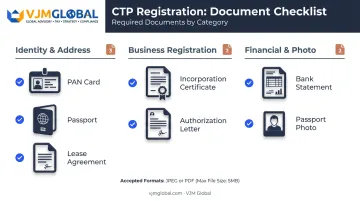
- PAN card for the applicant entity or Indian promoter, mandatory in Part A of REG-01 regardless of nationality
- Passport details for foreign promoters or stakeholders, entered as a separate identity field alongside the PAN requirement
- Address proof for the principal place of business: rent or lease agreement plus the lessor's ownership document, or an allotment letter if you're operating from an exhibition venue
- Consent letter from the property owner where premises are shared, along with the owner's identity proof
Business Registration and Authorization Documents
- Certificate of Incorporation, LLP agreement, or equivalent foreign registration certificate proving business constitution
- MOA/AOA or similar constitutional documents where applicable
- Letter of Authorization or board resolution appointing the authorized signatory — critical when a foreign entity operates through a local representative
- Acceptance letter from the appointed signatory confirming their role
Foreign incorporation documents don't currently carry a stated apostille requirement in official GST portal guidance, but many applicants still get theirs legalized as a precaution, since state-level GST officers sometimes request additional verification during scrutiny.
Financial and Photograph Documents
- Bank account proof: first page of a passbook, a recent bank statement, or a cancelled cheque showing account holder name, IFSC, and branch details
- Photographs of the applicant/promoter and authorized signatory in JPEG format, maximum 100 KB each
- Supporting documents in PDF or JPEG, generally capped at 1 MB per upload
Getting this checklist right the first time avoids costly resubmission delays. VJM Global's registration team cross-checks each document against the latest REG-01 requirements before filing, helping foreign entities and NRIs skip the back-and-forth of officer queries.
Step-by-Step Process to Apply for Temporary GST Registration
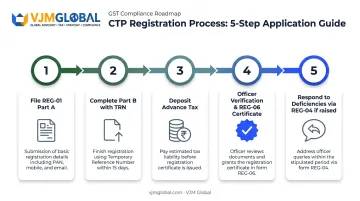
- File Form GST REG-01, Part A. Enter legal name, PAN, mobile number, and email, then select "Casual Taxable Person" as the registration type. Once PAN and OTP validation clear, the portal generates a Temporary Reference Number (TRN).
- Complete Part B using the TRN. Log back in, then fill in business details, estimated turnover, promoter and signatory information, and upload every document from the checklist above.
- Deposit advance tax. This is where CTP registration diverges sharply from regular GST registration. Section 27(2) requires you to deposit tax equal to your estimated tax liability for the registration period before the application even gets processed.
- Wait for officer verification. If everything checks out, you'll receive acknowledgment in Form REG-02, followed by the registration certificate in Form REG-06 — typically within 7 working days when documents are in order.
- Respond to deficiencies if raised. Officers issue Form REG-03 when clarification is needed, and you get 7 working days to reply via REG-04. Unsatisfactory responses can lead to rejection in Form REG-05, so respond promptly and address every point raised.
Validity, Extension, and Advance Tax Deposit Rules
Temporary GST registration doesn't run indefinitely. It's valid for the period stated in your application or 90 days from the effective registration date, whichever is earlier. Plan your event or contract timeline before applying — you can't simply extend on a whim later.
Need more time? File Form GST REG-11 electronically before your existing validity expires. There's no fixed number of days you must file in advance, but waiting until the last minute is risky.
- Extensions cap at an additional 90 days beyond the original period
- You must deposit additional advance tax matching your estimated liability for the extension window
- REG-11 requires updated turnover estimates and a full breakdown of expected IGST, CGST, SGST/UTGST, and cess
One point that trips up businesses planning ongoing India operations: CTP registration cannot convert into regular GST registration. If your short-term project turns into a long-term presence, you'll need to file a fresh regular registration application separately. Partnering with an experienced advisor like VJM Global ensures your REG-11 filing and tax calculations are accurate the first time.
Common Documentation Challenges Faced by Foreign Companies and NRIs
Foreign applicants run into a specific set of obstacles that domestic businesses rarely face:
- Notarization and legalization delays for incorporation certificates issued abroad, especially when courier timelines don't match the five-day pre-application window
- Passport and portal formatting mismatches, where name order, spelling variations, or date formats don't align with what the GST portal expects
- No local signatory readily available — many foreign entities need to formally appoint someone in India, which takes time if that relationship isn't already established
- Address proof gaps when the entity has no physical office and must rely on an allotment letter, hotel arrangement, or a consent letter for shared premises instead
Each of these is fixable, but only if you catch it before submission rather than after a deficiency notice lands. Firms like VJM Global that work daily with foreign entities typically run a pre-verification check on these documents, catching mismatches before they cost you the application window.
Why Foreign Businesses Choose VJM Global for GST Registration Support
VJM Global has spent over 30 years in tax, audit, and advisory work, and that experience shows up most clearly when foreign companies hit unfamiliar GST paperwork. The firm's Chartered Accountants and CPAs handle indirect tax and cross-border compliance daily, not occasionally.
The client base reflects that focus: 500+ American businesses, 250+ UK businesses, and 250+ Australian businesses have worked with VJM Global on India market entry and compliance needs. That volume matters because CTP (Casual Taxable Person) applications aren't one-size-fits-all — a UK exhibitor's paperwork looks different from a US consultancy's short-term contract.

Where VJM Global adds practical value:
- Preparing and reviewing documents against current portal requirements before submission
- Coordinating directly with authorities when queries or deficiency notices arise
- Helping arrange authorized signatory appointments and address documentation for entities with no existing Indian office
- Working toward registration within the shortest realistic timeframe given document readiness
For a foreign company juggling trade fair logistics from another time zone, having someone local handle the GST portal mechanics often determines whether a booth opens on schedule or sits delayed waiting on paperwork.
Frequently Asked Questions
What documents are required for GST registration for casual taxable person?
You'll need PAN or passport-based identity proof, business incorporation documents, authorized signatory authorization, address proof for the temporary premises, bank account details, and photographs. See the full checklist above for format specifications.
What is a temporary ID in GST registration?
A temporary ID is a provisional identifier some unregistered entities use to complete limited GST compliance actions, such as one-off payments. It's distinct from full CTP registration and doesn't authorize ongoing taxable supplies.
How long is temporary GST registration valid?
It's valid for the period stated in your application or 90 days from the effective registration date, whichever is earlier. You can extend once via Form GST REG-11 before expiry.
Can a foreign company or NRI apply for temporary GST registration in India?
Yes. Foreign companies, NRIs, and OCIs can apply using passport-based identity proof alongside PAN where applicable. Non-resident applicants should plan extra time for notarization and signatory appointment steps.
What is the advance tax deposit required for casual taxable person registration?
The deposit equals your estimated GST liability for the requested registration period. It's credited to your electronic cash ledger and must clear before the officer processes your application.
Can temporary GST registration be converted into regular GST registration?
No. There's no conversion mechanism between CTP and regular registration. If your business activity continues beyond the temporary period, you'll need to file a fresh regular registration application.