Introduction
Singapore stands as India's second-largest source of FDI, contributing USD 171.92 billion between January 2000 and December 2024 — representing nearly 24% of India's total FDI equity inflow. This strong bilateral investment relationship means hundreds of Singapore businesses establish a legal presence in India each year, with the Certificate of Incorporation (COI) from India's Ministry of Corporate Affairs serving as the critical first step.
Unlike domestic Indian incorporations, Singapore applicants face requirements that catch many international businesses off guard: document apostillation, registered office addresses, and post-incorporation FEMA compliance all add layers that domestic filings simply don't have.
This guide covers everything Singapore-based owners, directors, and entrepreneurs need to navigate the process:
- What a COI is and which business structure fits your situation
- Exact documents required, including apostille requirements for Singapore-issued papers
- Step-by-step process through India's MCA portal
- Post-COI compliance obligations that trigger penalties if missed
Key Takeaways
- The COI is the legal document from India's MCA confirming a company is registered and authorized to operate
- Singapore businesses typically incorporate as a Wholly Owned Subsidiary (Private Limited Company) under India's FDI automatic route, with no prior government approval needed for most sectors
- Foreign applicants must submit apostilled or notarized identity and address documents from Singapore
- The process covers four steps: obtaining a Digital Signature Certificate, reserving a company name, filing the SPICe+ form, and receiving the COI digitally
- With proper preparation, the full process typically takes 10–15 business days
- After receiving the COI, companies must complete FEMA/RBI reporting (Form FC-GPR) within 30 days of share issuance
What Is a Certificate of Incorporation in India?
The Certificate of Incorporation is a legal document issued by the Registrar of Companies (RoC) under Section 7 of the Companies Act, 2013. It recognizes a company's formation and grants the legal right to commence business operations in India — the closest Indian equivalent to Singapore's Business Registration Certificate (BRC), though governed by an entirely different statutory framework.
The COI contains:
- Company name
- Corporate Identification Number (CIN) — a unique 21-character alphanumeric code
- Date of incorporation
- Registered office address
- Company type (Private/Public)
- PAN and TAN details
India's Ministry of Corporate Affairs issues the COI digitally — a certified PDF with a QR code and digital signature for authentication. This certificate is legally valid for opening bank accounts, GST registration, regulatory filings, and entering into contracts.
The moment the RoC issues your COI, your company becomes a separate legal entity under Indian law. For Singapore businesses, that's the critical threshold: once you have it, you can operate, hire, and transact in India with full legal standing.
Business Structures Available to Singapore Companies Entering India
Singapore businesses have three primary options for establishing operations in India:
Entry Structure Comparison
| Feature | Wholly Owned Subsidiary | Branch Office | Liaison Office |
|---|---|---|---|
| Legal status | Separate legal entity | Extension of parent | Extension of parent |
| Receives COI? | Yes | No (receives UIN from RBI) | No (receives UIN from RBI) |
| Approval authority | RoC/MCA | RBI via authorized bank | RBI via authorized bank |
| Tax rate | ~25.17% (Section 115BAA) | 40% + surcharge + cess | Nil (no income permitted) |
| FDI limit | 100% in most sectors | N/A | N/A |
| Permitted activities | All lawful business | 8 specified categories | 4 representational categories |
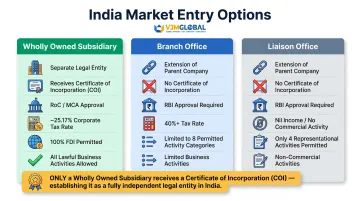
Critical distinction: Only incorporated entities (Private Limited Companies) receive a Certificate of Incorporation. Branch and Liaison Offices require RBI approval and receive a different registration certificate with a Unique Identification Number.
Why Singapore Businesses Choose the Private Limited Company Structure
The Wholly Owned Subsidiary (WOS) structure is the default choice for most Singapore investors. According to DPIIT data, the top sectors receiving Singapore FDI — including services (18.19%), computer software (16.74%), and trading (13.32%) — operate primarily through subsidiaries.
Key advantages:
- 100% foreign ownership permitted under the automatic route in most sectors (no government approval needed)
- Limited liability — parent company liability is restricted to its shareholding amount
- Profit repatriation — dividends can be repatriated to Singapore after applicable taxation
- Lower tax rates — approximately 25.17% compared to 40%+ for branch offices
- Separate legal entity — protects the Singapore parent from Indian operational liabilities
Important note for Singapore investors: Press Note 3 (2020), which requires government approval for FDI from countries sharing a land border with India, does not apply to Singapore. Singapore businesses can proceed through the automatic route in most sectors.
India-Singapore CECA Context
The Comprehensive Economic Cooperation Agreement (CECA) between India and Singapore provides investment protections for companies from both countries, including national treatment and market access commitments — a practical advantage when structuring equity stakes or negotiating sector-specific approvals.
The India-Singapore Double Taxation Avoidance Agreement (DTAA), modified by the Third Protocol signed December 30, 2016, shifted from residence-based to source-based taxation of capital gains on share transfers. For investments made after April 1, 2019, full Indian domestic tax rates apply — a factor Singapore investors should weigh when deciding on their entry structure and holding arrangements.
Documents Singapore Businesses Need to Obtain a COI in India
Document requirements for foreign applicants differ significantly from domestic registrations — and missing even one item causes costly delays. Here's exactly what Singapore businesses need to prepare.
Identity and Address Documents for Directors and Shareholders
For Singapore nationals serving as directors:
- Valid Singapore passport (primary identity document)
- Proof of address (utility bill or bank statement not older than 2 months)
- Critical requirement: All documents must be apostilled by the Singapore Academy of Law or notarized by a practicing Indian consular officer
The apostille requirement catches many Singapore businesses off guard. Since both Singapore and India are members of the Hague Apostille Convention, documents certified with an apostille are legally recognized across both countries.
The Singapore Academy of Law serves as Singapore's Competent Authority for document legalization, not ICA or MFA directly.
Arriving in India with non-apostilled documents causes delays of 2-3 weeks. Complete apostillation before your team travels.
Documents for the Proposed Indian Entity
- Memorandum of Association (MoA): Must clearly state business objects
- Articles of Association (AoA): Must align with the Companies Act, 2013
For foreign-owned companies, the MoA must specify all intended business activities. Operating outside your stated objects requires a formal MoA amendment later, which is a time-consuming process worth avoiding from the start.
The AoA should include provisions for foreign director appointments and Board composition. Both documents are drafted and filed electronically via the SPICe+ form, not prepared as separate submissions.
Registered Office Proof in India
Singapore businesses cannot use an overseas address for the registered office. You must provide a valid Indian address, which can be owned or rented.
Required documents:
- Utility bill (electricity or water) not older than 30 days
- Either ownership document or No Objection Certificate (NOC) from the property owner
Many Singapore companies lease serviced office space initially to meet this requirement without committing to long-term commercial real estate.
Digital Signature Certificate (DSC) for Proposed Directors
All proposed directors, including Singapore nationals, must obtain a Class 3 DSC from an authorized Indian certifying agency before filing. Foreign nationals cannot use Aadhaar-based DSCs since they don't have Aadhaar numbers; instead, DSCs are passport-based.
Authorized certifying authorities include eMudhra and Capricorn, both licensed by India's Controller of Certifying Authorities. Processing times range from under an hour to a few business days. You'll need the same apostilled passport and address proof documents used for director registration.
Once individual director documents are in order, you'll also need to establish the corporate authority linking your Singapore parent company to the new Indian entity.
Parent Company Documents (for Subsidiary Structure)
To establish the foreign shareholding structure, you'll need from the Singapore parent company:
- Certificate of Incorporation (apostilled)
- Board resolution authorizing establishment of the Indian subsidiary and naming the authorized representative
- Memorandum and Articles of Association
These documents prove the corporate structure and authority for the investment into India.
How to Get a Certificate of Incorporation in India: Step-by-Step for Singapore Businesses
The entire COI process runs online through India's MCA21 V3 portal. Foreign applicants, however, must complete several preparatory steps that domestic applicants skip — and those extra steps are where most timeline delays occur.
Step 1: Obtain DSC for All Proposed Directors
Each proposed director (including Singapore nationals) must apply for a Digital Signature Certificate from eMudhra, Capricorn, or another authorized certifying agency. For foreign nationals, the application requires:
- Passport copy (apostilled)
- Address proof (apostilled)
- Completed application form
Processing typically takes 2-3 business days. The DSC is mandatory for digitally signing all MCA filings.
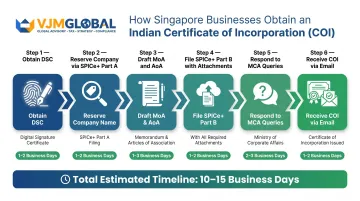
Step 2: Reserve the Company Name via SPICe+ Part A
Submit your proposed name through SPICe+ Part A on the MCA portal. Names must comply with the Companies (Incorporation) Rules, 2014:
- Cannot be identical or deceptively similar to existing registered names
- Cannot infringe on trademarks
- Must include appropriate suffix ("Private Limited" for a private company)
Pro tip: Check the MCA name availability tool and trademark registrations before filing. Name rejections add 3-5 days to your timeline.
The government fee for SPICe+ Part A is INR 1,000. Name approval typically takes 3-5 working days.
Step 3: Draft and Finalize MoA and AoA
Once your name is approved, draft the Memorandum of Association and Articles of Association. Note that these documents link directly to your SPICe+ filing — they are not submitted separately. For a foreign-owned subsidiary, ensure your AoA includes:
- Provisions for foreign director appointments
- Board composition requirements
- Sector-specific FDI conditions (if applicable)
Step 4: File SPICe+ Form with All Required Attachments
Fill out SPICe+ Part B on the MCA portal. This integrated form covers multiple registrations simultaneously:
- DIN allotment for new directors
- Company incorporation
- PAN (Permanent Account Number)
- TAN (Tax Deduction Account Number)
- GST registration (optional)
- EPFO (Employees' Provident Fund)
- ESIC (Employees' State Insurance)
Required attachments include:
- Apostilled foreign director identity and address documents
- Registered office proof (utility bill + ownership/NOC)
- MoA and AoA (via linked forms INC-33 and INC-34)
- Parent company authorization documents
- Proof of payment for government fees and stamp duty
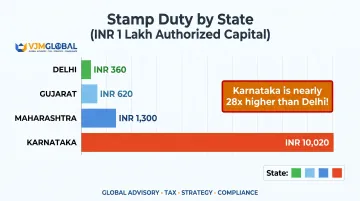
Government fees and stamp duty vary by state. For example, with authorized capital of INR 1 lakh:
| State | Total Stamp Duty (MoA + AoA + SPICe+) |
|---|---|
| Delhi | INR 360 |
| Maharashtra | INR 1,300 |
| Karnataka | INR 10,020 |
| Gujarat | INR 620 |
Step 4 carries the highest rejection risk for Singapore businesses because of the volume of foreign-specific attachments. VJM Global's business setup professionals manage this filing end-to-end for Singapore clients, verifying all documents meet MCA requirements before submission.
Step 5: Respond to MCA Queries (If Any)
After filing, the MCA may raise queries or request additional clarifications. For foreign company incorporations, queries are more common due to apostilled document verification requirements.
Common query types:
- Unclear scans of apostilled documents
- Address proof date issues
- Missing parent company authorizations
- Registered office documentation gaps
Most queries must be responded to within the specified window (typically 7-15 days). Failure to respond in time results in application rejection, requiring you to start over.
Step 6: Receive COI via Email
Once the MCA verifies all documents and approves the application, the Registrar of Companies issues the COI digitally via email to the directors and filing professional. The COI includes:
- CIN (Corporate Identification Number)
- Company name
- Date of incorporation
- Registered office address
- Digital signature and QR code linking to the official MCA record
Total timeline: DSC to COI takes 10–15 business days when all documents are correctly prepared. Pre-filing preparation — DSC issuance, name reservation, apostille processing — adds another 5–7 days. Budget 3–4 weeks total for the full process.
Post-COI Compliance and Common Pitfalls for Singapore Companies
Receiving your COI is a milestone, but it's not the finish line. Singapore companies face several immediate compliance obligations that carry penalties if missed.
FEMA and RBI Reporting Obligations Post-Incorporation
After receiving the COI and upon receiving the first equity investment from the Singapore parent company, your Indian subsidiary must report the FDI inflow to the RBI.
Form FC-GPR (Foreign Currency - Gross Provisional Return):
- Must be filed within 30 days from the date of allotment of shares
- Shares must be allotted within 60 days from receipt of foreign remittance
- Filed on the RBI FIRMS portal under the Single Master Form workspace
- Requires two-level registration (Entity User + Business User)
Penalties for delayed FC-GPR filing:
- Late Submission Fee: INR 7,500 + (0.025% × amount involved × years of delay)
- LSF capped at 100% of the amount involved
- LSF facility available only for delays up to 3 years
- Beyond 3 years: compounding application required under Section 13 of FEMA, 1999
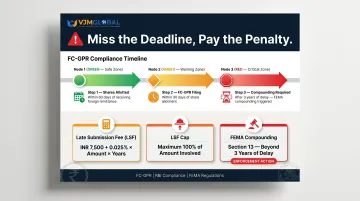
This filing sits outside the COI process itself — which is exactly why it gets missed. Missing the 30-day deadline triggers penalties that compound quickly, so calendar this obligation the moment shares are allotted.
Immediate Post-COI Registrations Required Before Commencing Business
INC-20A (Declaration of Commencement of Business):
- Legal basis: Section 10A of the Companies Act, 2013
- Timeline: Must be filed within 180 days from date of incorporation
- Requirements: Declaration that every MoA subscriber has paid the full value of shares agreed, plus certified bank statement proving subscription money was deposited
- Penalties:
- Company: INR 50,000 fixed penalty
- Directors: INR 1,000 per day per officer in default (maximum INR 1,00,000 per director)
- Operational restriction: Cannot legally commence business until INC-20A is filed
Other immediate requirements:
- Open a current bank account (needed for INC-20A proof)
- Apply for GST registration (if annual turnover expected to exceed INR 40 lakh for services, INR 20 lakh for goods)
- Set up accounting and payroll systems
Common Mistakes Singapore Businesses Make
- Skipping apostillation before travel: Documents sent back to Singapore for apostillation add 2-3 weeks of delay. Get this done before leaving.
- Ignoring trademark checks on the company name: MCA screens against registered companies — not trademarks. A name that clears initial MCA review can still be rejected for trademark infringement, adding 5-7 days to your timeline.
- Using the Singapore parent's address as the Indian registered office: Not permitted. You need a valid Indian address with recent utility bills and ownership or NOC documentation.
- Underestimating state-level stamp duty: Delhi charges INR 360 and Maharashtra INR 1,300 for INR 1 lakh authorized capital. Karnataka charges INR 10,020 for the same amount — nearly 28x more. Factor this into your state selection.
- Missing the FC-GPR filing deadline: The 30-day clock starts from share allotment, not COI issuance. Many companies lose track of this after incorporation and face avoidable FEMA penalties.
How to Verify an Indian COI
Once incorporated, you can confirm registration details — or run due diligence on a potential Indian partner — directly on the MCA21 portal:
- Navigating to MCA Services → Company/LLP Master Data → View Company/LLP Master Data
- Searching using the CIN or company name
- Reviewing publicly available information including incorporation date, directors, and filing history
The COI itself includes a QR code that links directly to the official MCA record — a quick scan confirms authenticity without logging into the portal.
Frequently Asked Questions
What is a Certificate of Incorporation in India?
The Certificate of Incorporation is a legal document issued by the Registrar of Companies under the Companies Act, 2013, that officially confirms a company's registration and grants it the right to operate in India. It's comparable in function to Singapore's Business Registration Certificate but governed by Indian law.
How to get a Certificate of Incorporation in India?
The process involves four key steps:
- Obtain a Digital Signature Certificate (DSC) for all directors
- Reserve a company name via the MCA portal
- File the SPICe+ integrated form with all required documents and fees
- Receive the COI digitally via email upon RoC approval — typically within 10–15 business days for foreign applicants with correctly prepared documents
How to verify a Certificate of Incorporation in India?
A COI can be verified on the MCA21 portal (mca.gov.in) by searching for the company using its CIN or name under MCA Services → Company/LLP Master Data. The COI contains a QR code that links to the official MCA record, confirming its authenticity.
Can a Singapore company register as a Wholly Owned Subsidiary in India without government approval?
Yes, under India's FDI automatic route, Singapore companies can hold 100% equity in an Indian Private Limited Company in most sectors without requiring prior approval from the Government of India. Only a post-investment filing with the RBI (Form FC-GPR) is required within 30 days of share issuance.
How long does it take for a Singapore business to receive a COI in India?
Filing to COI issuance typically takes 10–15 business days, provided all documents — especially apostilled foreign director documents — are correctly prepared. Pre-filing steps (DSC issuance and name reservation) add another 5–7 days, bringing the total to roughly 3–4 weeks.
What must a Singapore company do after receiving its COI in India?
Four post-COI steps are required before commencing operations:
- Open a current bank account in India
- Receive the FDI remittance from the Singapore parent company
- File Form FC-GPR with the RBI within 30 days of share issuance
- File INC-20A (Commencement of Business declaration) with the MCA within 180 days of incorporation