Introduction
Ask most UK business owners about their "registration number," and you'll get a confident answer. Ask a partnership owner the same question, and you'll often get a pause.
That hesitation makes sense: unlike a limited company, which gets a single Company Registration Number (CRN) from Companies House the moment it's incorporated, partnerships don't follow one universal rule. Some have a registration number, others never will.
This creates real friction. Banks ask for a CRN that doesn't exist. Suppliers confuse a UTR with a VAT number. International partners assume every UK business is "registered" the same way a company in their own country would be.
This guide breaks down exactly which UK partnership structures have registration numbers, which only have tax references, how to find yours, and what changes if you're expanding your partnership into a market like India.
Key Takeaways
- General partnerships never register with Companies House and have no CRN — only a UTR from HMRC
- Limited Partnerships (LPs) and LLPs must register with Companies House to receive a CRN
- A UTR, VAT number, and CRN each serve a different purpose and aren't interchangeable
- Partnerships expanding into India face a separate registration framework entirely
What Is a Business Registration Number in the UK?
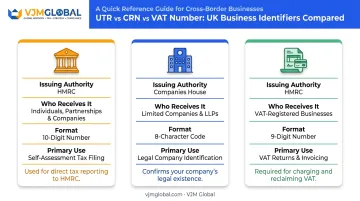
Here's the part that trips people up: the UK has no single, universal business registration number. Which reference applies to your business depends entirely on your legal structure and tax status.
Compare that to Australia, where every business, regardless of structure, can obtain one Australian Business Number (ABN) to simplify dealings with government and other businesses. The UK splits this responsibility across three separate systems: HMRC, Companies House, and VAT registration. Each issues its own number, for its own purpose.
Unique Taxpayer Reference (UTR)
A UTR is a 10-digit number issued by HMRC when someone registers for Self Assessment. Every UK partnership needs one, and critically, so does every individual partner. HMRC's own guidance is explicit that the partnership and each partner must hold separate UTRs. One doesn't substitute for the other.
You'll use your UTR to:
- File the partnership's Self Assessment tax return
- File each partner's personal Self Assessment return
- Correspond with HMRC on tax matters
Company Registration Number (CRN)
A CRN comes only from Companies House, and only to entities that incorporate there. That means limited companies and LLPs get one. A general (ordinary) partnership never receives a CRN, because it's never incorporated in the first place, and legally, it doesn't exist separately from the partners themselves.
VAT Registration Number
Any partnership (general, LP, or LLP) must register for VAT once its taxable turnover passes the compulsory threshold. Since 1 April 2024, that's taxable turnover exceeding £90,000 over a rolling 12-month period, up from the previous £85,000.
Once registered, the VAT number must appear on every full VAT invoice you issue. It's separate from your UTR and, where applicable, your CRN, since each number serves a distinct regulatory purpose.
Does a Partnership Have a Registration Number? Breaking It Down by Type
The honest answer is: it depends which type of partnership you're running. Here's how each one stacks up.
General (Ordinary) Partnerships
This is the default structure when two or more people go into business together without formal incorporation. Key facts:
- Not a separate legal entity: the partners are the business
- Not registered with Companies House, so no CRN exists
- Registered with HMRC instead, using form SA400 for the partnership and form SA401 for each individual partner
- Only tax reference: the partnership UTR, plus each partner's personal UTR
This absence of a CRN means the business itself has no separate legal existence, which is why general partners can't limit their exposure by pointing to a company number the way LLP members can.
Limited Partnerships (LPs)
LPs, formed under the Limited Partnerships Act 1907, sit in a middle ground. They must register with Companies House and receive a registered number, but they're a less common structure, mostly used for investment funds and private equity vehicles rather than everyday trading businesses.
Limited Liability Partnerships (LLPs)
LLPs are the closest partnership equivalent to a limited company. They're separate legal entities, incorporated at Companies House, and issued a registered number (commonly called a CRN) exactly like any incorporated company. This also means LLPs carry ongoing filing duties: annual accounts and a confirmation statement, just like a limited company.
Here's a quick reference table:
| Structure | Registered with Companies House? | Registration number issued? | Tax identifier |
|---|---|---|---|
| General Partnership | No | No CRN | Partnership UTR + each partner's UTR |
| Limited Partnership (LP) | Yes | LP registered number | Partnership UTR + tax identifiers |
| LLP | Yes | LLP registered number (CRN) | UTR + VAT number if registered |
One thing worth flagging: liability protection differs just as much as registration obligations do. General partners carry personal liability; LLP members generally don't. If you're unsure which structure fits, get advice before you register — converting later is far more complex than starting correctly.
How to Register Your Partnership and Get Your Reference Numbers
The registration path splits early, depending on which structure you're running.
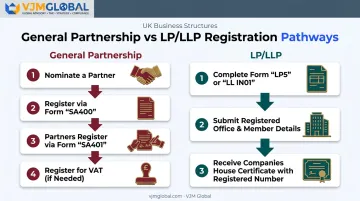
For a general partnership:
- Nominate one partner to handle registration and record-keeping (HMRC calls this the nominated partner)
- The nominated partner registers the partnership itself using form SA400
- Every other partner separately registers for Self Assessment using form SA401
- Register for VAT separately if turnover exceeds £90,000, or is expected to exceed it shortly
For an LP or LLP:
- LPs register with Companies House using form LP5 under the 1907 Act
- LLPs incorporate using form LL IN01, submitting details on the registered office, jurisdiction, and designated members
- Once approved, Companies House issues the certificate showing the registered number
Deadlines matter here. HMRC requires registration by 5 October following the end of the relevant tax year (or the partnership's second tax year, depending on when trading started).
Miss this deadline, and you risk a failure-to-notify penalty if tax remains unpaid by 31 January. HMRC's current guidance puts this at 20% to 30% of the unpaid tax for a prompted, non-deliberate late disclosure — not a flat fee, but one that adds up fast on a partnership with real trading income.
How to Find or Verify a Partnership's Registration Number
Lost your UTR, or need to check someone else's number before signing a contract? The process differs depending on which number you're after.
Finding your own UTR:
- Log into your HMRC Personal Tax Account or the HMRC app
- Check previous Self Assessment returns or HMRC letters
- Remember: your UTR and the partnership's UTR are different numbers, so don't mix them up
Verifying an LP or LLP's registration number:
- Use the free Companies House search service by entity name or number
- Check registered office, filing history, officer details, and current status before entering any contract
- Apply the advanced search filters (entity type, incorporation date, status) if the name alone returns too many results
Displaying numbers correctly:
- LLPs must show their registered number, jurisdiction, and registered office on business letters, order forms, and websites
- VAT-registered partnerships must show their VAT number on every full invoice
- General partnerships have no CRN to display: only their VAT number, if registered
Expanding Your UK Partnership to India? What You Need to Know
If your UK partnership or LLP is eyeing India as a growth market, brace yourself: the registration logic starts over from scratch. India runs an entirely different framework, and your UK UTR or CRN carries no weight there.
What you'll typically need to navigate:
- PAN (Permanent Account Number): a tax identifier required for most Indian financial and regulatory dealings
- GST registration: required depending on the nature and scale of your business activity in India
- Choosing the right entity: an Indian LLP, subsidiary, joint venture, or branch/liaison office, each carrying different investment rules
The right structure depends on your purpose. A liaison office suits market exploration only. It can't trade commercially. A wholly owned subsidiary or Indian LLP suits businesses ready to invest and operate fully. A branch office sits somewhere in between, subject to Reserve Bank of India approval routes.
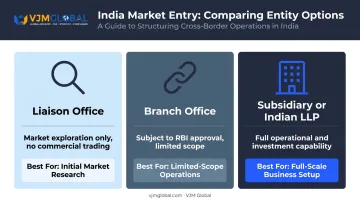
Whichever structure you choose, the real complexity often starts with compliance. Running dual processes across HMRC, Companies House, and Indian authorities simultaneously is where most UK partnerships get stuck: differing deadlines, unfamiliar terminology, and separate filing portals. VJM Global has worked with 250+ UK businesses navigating exactly this kind of cross-border setup, helping structure Indian operations correctly from the outset rather than untangling problems after incorporation.
If you're weighing up entity options for your Indian expansion, it's worth speaking with a specialist before filing anything. The structure you choose shapes your compliance workload for years afterward.
Frequently Asked Questions
Do partnerships need to be registered?
Yes. General partnerships must register with HMRC for tax purposes using form SA400. LPs and LLPs have an additional requirement to register with Companies House and receive an official registration number.
Does a partnership need an EIN (Employer Identification Number)?
No. An EIN is a US federal tax identifier and has no application in the UK. The closest UK equivalent for a partnership is the UTR issued by HMRC.
How can I find my business registration number?
You can find your UTR through your HMRC online account, the HMRC app, or previous correspondence. Search the Companies House register to find an LP or LLP's registered number.
What's the difference between a UTR and a Company Registration Number (CRN)?
A UTR is an HMRC tax reference used by all partnerships and their partners. Companies House issues a CRN only to incorporated entities, such as LLPs and limited companies.
Is an LLP treated the same as a general partnership for registration purposes?
No. An LLP is a separate legal entity that must incorporate with Companies House and receive a registered number. A general partnership has no such incorporation requirement.
Do all partners need to register individually with HMRC?
Yes. Alongside the partnership's own SA400 registration, each individual partner must separately register for Self Assessment using form SA401.