Introduction
India has emerged as one of the most attractive investment destinations for Singapore businesses. With Singapore ranking as the largest source of FDI into India in FY 2024-25 (over USD 14 billion invested) and accounting for approximately 24% of all cumulative FDI equity inflows since 2000, the bilateral economic corridor is both mature and expanding. The India-Singapore Comprehensive Economic Cooperation Agreement (CECA) eliminates tariffs on 81% of Singapore's exports to India, creating a preferential framework that many Singaporean firms are already leveraging.
For Singapore businesses, the most consequential early decision is how to register in India. The wrong structure can create compliance headaches, restrict revenue generation, or block future capital raises. Most investors underestimate just how much these five registration types differ from one another in operational scope and regulatory obligations.
This guide explains the five main types of company registration available to Singapore investors in India, how each one works, and which scenarios each is best suited for.
Key Takeaways
- India offers multiple registration structures suited to different business objectives and entry strategies
- The five main options: Private Limited Company, LLP, Branch Office, Liaison Office, and Project Office
- Private Limited Company is the most preferred route for long-term, full-scale operations
- Branch and Liaison Offices require RBI approval under FEMA and cannot generate revenue in India
- Choosing the right structure requires matching your revenue intent, FDI rules, and growth horizon
What Is Company Registration in India, and Why Does the Type of Entity Matter?
Company registration in India is the legal process of incorporating a business entity under the Companies Act, 2013 — which covers private limited companies and LLPs — or through RBI approval under FEMA for branch and liaison offices. The structure chosen becomes the legal identity through which a foreign investor operates in India.
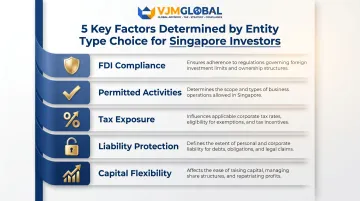
For Singapore investors specifically, entity type determines:
- FDI compliance: some structures qualify for the automatic route; others require government approval before investment
- Permitted activities: certain entities (branch offices, liaison offices) cannot generate revenue in India, while subsidiaries and LLPs can
- Tax exposure: the India-Singapore DTAA caps withholding tax at 10% on dividends (for 25%+ ownership), royalties, and technical service fees — but only for eligible entity types
- Liability protection: a wholly owned subsidiary shields the Singapore parent from Indian liabilities; a branch office does not
- Capital flexibility: only incorporated entities (private limited companies, LLPs) can issue equity, attract investors, or execute a structured exit
Choosing the wrong structure carries real consequences — FEMA penalties, blocked invoicing, or a costly exit. The sections below break down each registration type so Singapore investors can match their business purpose to the right legal form.
Types of Company Registration in India for Singapore Investors
India's regulatory framework offers distinct structures for different investor objectives — full business operations, partnership-based ventures, exploratory presence, or project-specific engagement. Each carries different compliance requirements under Indian law.
Private Limited Company (Indian Subsidiary)
This is the most widely used structure for Singapore businesses entering India: a separate legal entity incorporated under the Companies Act, 2013, where the Singapore parent company holds shares in an Indian subsidiary. 100% FDI from Singapore is permitted under the automatic route in most sectors, meaning no prior government approval is needed.
How it differs from other types:
Unlike a Branch or Liaison Office, a Private Limited Company is an independent Indian legal entity. It can generate revenue from Indian clients, sign contracts in its own name, hire employees, and hold assets — making it a full-scale operational presence.
Best suited for:
- Singapore companies building long-term operations in India — selling products or services, setting up development centres, or serving the Indian market as a separate profit centre
- Startups seeking investor funding
Key strengths:
- Limited liability protection for the Singapore parent
- Ability to raise equity capital from Indian and foreign investors
- Eligible for Startup India benefits including three-year tax holidays under Section 80-IAC
- Perpetual existence independent of the parent
Key limitations:
- Requires at least one Indian resident director (182 days in India in the preceding calendar year)
- Mandatory annual compliance: ROC filings, statutory audit, board meetings, GST returns
- Higher setup and ongoing compliance cost compared to simpler structures
VJM Global has extensive experience incorporating Private Limited Companies for foreign investors, typically completing the process within 13 days when all required documents are submitted promptly.
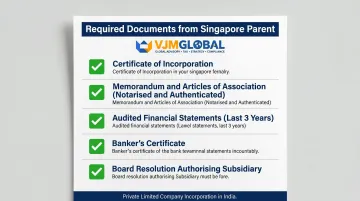
Required documents from the Singapore parent include:
- Certificate of Incorporation
- Memorandum & Articles of Association (notarised and authenticated)
- Audited financial statements for the past three years
- Banker's certificate
- Board resolution authorising the subsidiary
Limited Liability Partnership (LLP)
An LLP is a registered entity under the LLP Act, 2008 that combines elements of a partnership and a company — partners have limited liability, and the LLP is a separate legal entity with its own PAN and registration.
Key distinction for Singapore investors:
FDI into an LLP is allowed only via government approval route (not automatic route) in sectors where 100% FDI is permitted. Singapore investors cannot invest in LLPs in sectors that require government approval. This makes LLPs more restrictive for foreign investors compared to Private Limited Companies.
Best suited for:
- Singapore-based professional services firms (consulting, accounting) entering India through a joint venture with Indian partners
- Service-oriented businesses with low capital requirements and no plans to raise external equity
Limitations:
- Cannot issue shares or raise venture capital
- Profit distribution is treated differently from dividends
- FDI approval requirement adds time and regulatory complexity
- Less preferred than Private Limited Company for most Singapore investors
Branch Office
A Branch Office is an extension of the Singapore parent company in India — not a separate legal entity — registered under FEMA and requiring prior RBI approval. It can undertake activities identical to those of the parent company and can generate revenue in India, but cannot expand beyond the parent's approved scope of activities.
Eligibility requirements:
- Profit-making track record in the preceding five financial years
- Net worth of at least USD 100,000
Permitted activities:
Export/import of goods, professional or consultancy services, research, promoting technical/financial collaborations, representing the parent as buying/selling agent, IT services and software development, technical support for parent products. Branch Offices cannot engage in retail trading directly.
Best suited for:
Singapore companies in sectors like manufacturing, trading, or financial services that want to conduct business in India under the parent brand without creating a separate Indian entity.
Limitations:
- The parent company bears full liability for the branch's obligations
- Activities are restricted to those approved at the time of RBI registration
- Requires annual activity certificate (AAC) filing with RBI
- Winding up requires RBI approval
VJM Global manages the complete RBI approval process for Branch Offices, including Form FNC filing, documentation preparation, and post-approval compliance. The typical RBI approval timeline is 3-4 weeks from submission of a complete application.
Liaison Office
A Liaison Office (also called a Representative Office) is a non-revenue-generating presence: it is permitted only to act as a communication channel between the Indian market and the Singapore parent.
Permitted activities:
- Market research
- Promoting the parent's products/services
- Facilitating import/export
- Attending trade events
Strictly prohibited:
- Undertaking commercial, trading, or industrial activity
- Generating revenue in India
- All expenses must be funded by the parent company via inward remittances
Eligibility:
- Profit-making track record in preceding three financial years
- Net worth of at least USD 50,000
- Initial approval for 3 years (extendable)
Best suited for:
Singapore businesses exploring the Indian market before committing to full incorporation — understanding local demand, building distributor relationships, or preparing for a future subsidiary launch.
Limitations:
- All funding must come from the parent via inward remittances
- RBI imposes strict compliance including annual activity certificates
- Operationally limits a company's ability to respond to commercial opportunities, making it unsuitable as a long-term structure
VJM Global assists foreign companies in establishing Liaison Offices, ensuring compliance with RBI guidelines and managing annual reporting to authorities. Services include:
- Obtaining RBI approval and CIN
- RoC registration
- Maintaining financial books and annual audits
- Ongoing statutory compliance
Project Office
A Project Office is a temporary establishment permitted to execute a specific project in India — such as an infrastructure, construction, or EPC contract awarded to the Singapore company. It is registered under FEMA and can repatriate profits earned from the project back to Singapore.
General permission (no prior RBI approval needed if):
- The foreign entity has secured a contract from an Indian company
- Funding comes from inward remittance, bilateral/multilateral financing, appropriate authority clearance, or term loan from a Public Financial Institution or Indian bank
Best suited for:
Singapore engineering, construction, or technology companies that have secured a contract with an Indian client and need a legal presence to execute it. The office exists only for the duration of the project and is dissolved upon completion.
Limitations:
- Activity is strictly limited to the contracted project
- Cannot be used for general business operations
- Must close after project completion, requiring a new registration for any future engagement
How to Choose the Right Structure as a Singapore Investor
The right structure is not determined by what is simplest or most common, but by the specific purpose the Singapore investor has in India — and getting this wrong creates expensive restructuring costs later.
Purpose and Revenue Intent
If the goal is to generate revenue from Indian clients, hire employees, and operate at scale, a Private Limited Company is the only viable choice. If the purpose is purely exploratory, a Liaison Office may suffice temporarily. Project-specific contracts are best handled through a Project Office.
FDI Sector Eligibility
Singapore investors should verify whether their industry falls under the automatic FDI route or requires government approval. Most sectors allow 100% automatic route FDI, but sectors like defence (up to 74% automatic), multi-brand retail (up to 51% government route), and print media (up to 26% government route) have caps and approval requirements that affect whether an LLP or Private Limited Company is structurally permissible.
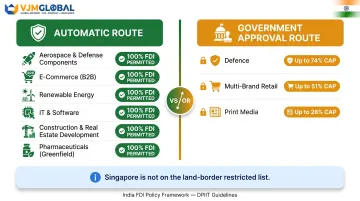
Check the current FDI policy under DPIIT for the relevant sector before deciding. Singapore is not on the land-border restricted list, so automatic-route FDI requires no government approval in most sectors.
Long-Term vs. Short-Term Presence
Long-term operations — hiring a team, serving Indian customers, building a brand locally — call for a Private Limited Company. If you're testing the market first, a Liaison Office buys time without triggering full compliance obligations.
Liability and Governance Preferences
Singapore investors who want to limit their liability exposure and protect the parent company's assets should choose a separately incorporated entity (Private Limited Company or LLP). Branch Offices carry direct parent liability and should only be used when the parent is comfortable assuming that exposure.
Scalability and Exit
Consider whether the business may seek external investment, list in India, or need to exit in 3–5 years. The two structures differ significantly on this front:
- Private Limited Companies can raise equity, transfer shares, and convert to public limited status
- Liaison and Branch Offices cannot raise capital locally and require RBI approvals to close
VJM Global's India entry team helps Singapore investors map these factors to the right structure before incorporation — covering industry analysis, FDI eligibility, and compliance requirements from day one.
What to Check Before You Register Your Company in India
Verify Sector-Specific FDI Restrictions
Some sectors — including multi-brand retail, print media, and certain financial services — require government approval or have equity caps. Singapore investors have been caught off-guard by restrictions that are not applicable in their home market.
Confirm the Indian Resident Director Requirement
All Private Limited Companies in India must have at least one director who has been resident in India for at least 182 days in the preceding calendar year. As a Singapore-based investor managing the entity from abroad, identifying and appointing a qualified resident director is a prerequisite — not an afterthought — before incorporation can proceed.
Understand Your Ongoing Compliance Obligations
Once your structure and directors are in place, the compliance calendar begins immediately. Indian entities must:
- File annual ROC returns (AOC-4, MGT-7)
- Conduct statutory audits
- Comply with GST (registration required if revenue exceeds INR 20 lakh for services or INR 40 lakh for goods)
- Withhold TDS on payments
- File income tax returns
Annual ROC Filing Calendar:
| Form | Purpose | Deadline | Penalty for Delay |
|---|---|---|---|
| AOC-4 | Financial Statements | 30 days after AGM | INR 100/day |
| MGT-7 | Annual Return | 60 days after AGM | INR 100/day |
| ADT-1 | Auditor Appointment | 15 days after AGM | INR 300/day |
| DIR-3 KYC | Director KYC | September 30 annually | INR 5,000 + DIN deactivation |
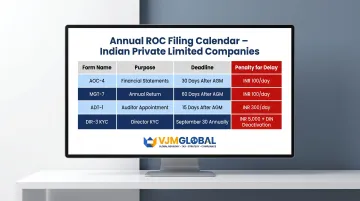
Missing these deadlines has real consequences — penalties accumulate daily, and a lapsed DIR-3 KYC deactivates the director's DIN, halting company operations. VJM Global handles all annual ROC filings, GST returns, and statutory audit coordination for foreign-owned Private Limited Companies, so nothing falls through the cracks.
Conclusion
India's company registration framework offers Singapore investors a range of structures — from full-scale Private Limited Companies to exploratory Liaison Offices. Each serves a distinct purpose depending on business intent, revenue model, and time horizon.
The structure chosen on Day 1 sets the foundation for compliance, liability, taxation, and scalability. Getting that choice right from the start requires guidance from professionals with direct India entry experience. VJM Global has supported hundreds of foreign businesses through this process, from entity selection through post-incorporation compliance.
Their credentials speak to the depth of that experience:
- 30+ years in cross-border tax, audit, and business setup advisory
- 1,000+ foreign businesses served across multiple continents
- 95% client retention rate across engagements
- 100+ chartered accountants and business setup professionals on staff
For Singapore investors ready to explore India entry, VJM Global offers a direct starting point — reach out at [email protected] to discuss which structure fits your goals.
Frequently Asked Questions
How many types of business registration are there in India?
There are seven types of registration in India (Sole Proprietorship, Partnership, LLP, OPC, Private Limited, Public Limited, Section 8), but for Singapore investors specifically, the relevant structures are Private Limited Company, LLP, Branch Office, Liaison Office, and Project Office.
What is the difference between an incorporated entity and a foreign office structure in India?
Incorporated entities (Private Limited Company or LLP) create a separate legal presence in India with independent liability, while foreign office structures (Branch, Liaison, or Project Office) are extensions of the Singapore parent company. Most Singapore investors choose incorporated entities for long-term operations and foreign offices for market exploration or project-specific work.
Can a Singapore company own 100% of an Indian Private Limited Company?
Yes, 100% foreign ownership is permitted in most sectors under the automatic FDI route without government approval, making a wholly-owned Indian subsidiary the most common and practical structure for Singapore investors.
Does a Singapore investor need RBI approval to open a Branch or Liaison Office in India?
Yes, Branch and Liaison Offices require prior approval from the Reserve Bank of India under FEMA, unlike Private Limited Companies which are registered with the Ministry of Corporate Affairs (MCA) under the automatic FDI route.
Is at least one Indian resident director mandatory for a company registered in India?
Yes, Section 149(3) of the Companies Act, 2013 requires at least one director who has stayed in India for 182 days or more in the preceding financial year. This residency requirement applies regardless of the company's foreign ownership structure.
What is the difference between a Branch Office and a Liaison Office for foreign companies in India?
A Branch Office can generate revenue and conduct commercial activities (within approved scope), while a Liaison Office cannot generate any revenue and can only serve as a communication channel — funded entirely by the foreign parent company.