This guide cuts through that complexity. It covers the four major grant categories — startup support, technology and productivity, overseas expansion, and workforce and sustainability — and explains exactly who qualifies, how much is available, and how to apply. Most grants are accessed through the Business Grants Portal (BGP), which brings Singapore's government business grants into one centralised platform.
Key Takeaways
- Singapore grants are co-funding schemes, not full subsidies — businesses cover costs upfront and claim reimbursements after project completion
- Most grants require Singapore registration, at least 30% local shareholding, and group annual turnover below SGD 100 million or fewer than 200 employees
- Startups should prioritise StartupSG Founder, Tech, and Equity
- SMEs should focus on EDG, PSG, and MRA
- Applications are submitted via the BGP using CorpPass — processing typically takes 8–12 weeks
- Never pay vendors before grant approval — retrospective applications are automatically disqualified
What Are Singapore Business Grants and Who Can Apply?
Singapore business grants are government-funded financial assistance that does not require repayment. Unlike loans, they are awarded based on specific activities — digitalisation, market entry, capability building — rather than creditworthiness. The grant funds a portion of your project costs; you pay the remainder.
Core Eligibility Requirements
The following criteria apply across most major Enterprise Singapore grants (EDG, PSG, MRA, BizAdapt):
- Registered and operating in Singapore
- At least 30% local shareholding held directly or indirectly by Singapore citizens or permanent residents
- Group annual sales turnover not exceeding SGD 100 million OR group employment of not more than 200 employees
- Financial viability to complete the funded project
The Foreign Ownership Challenge
Fully foreign-owned companies typically do not meet the 30% local equity condition for major EnterpriseSG grants. There is no blanket ban across every Singapore programme (eligibility must be checked scheme by scheme), but companies should not assume qualification without reviewing their shareholding structure first.
Foreign companies and multinational subsidiaries setting up in Singapore often need to structure their local entity correctly from the outset. Getting the corporate structure right before applying — not after — is the most common way foreign-owned businesses avoid wasted applications. A cross-border advisory firm with entity structuring experience can help confirm whether your shareholding arrangement qualifies before you commit time to the process.
Startup Grants in Singapore: StartupSG Programmes
Enterprise Singapore's StartupSG umbrella covers early-stage founders through four distinct programmes spanning equity-free funding, technology commercialisation, co-investment, and social enterprise support.
StartupSG Founder Grant
The StartupSG Founder grant provides first-time entrepreneurs SGD 20,000 to SGD 50,000 in equity-free funding through a 1:1 co-matching model. For every dollar the entrepreneur raises through paid-up capital or via Accredited Mentor Partners, the government matches it.
Key eligibility rules:
- Main applicant must be a first-time founder and Singapore citizen or PR
- Company must have at least 51% citizen/PR shareholding
- Must be incorporated within the past 6 months at application
- Must not have received prior government funding for the same business idea
- Excluded sectors include bars, night clubs, massage parlours, and gambling-related businesses
Applicants must receive a Letter of Recommendation from an Accredited Mentor Partner before submitting through the BGP.
StartupSG Tech Grant
StartupSG Tech supports the commercialisation of proprietary technology and scalable business models through two funding tracks: Proof of Concept (POC) and Proof of Viability (POV). Off-the-shelf system integration is explicitly excluded; the grant targets startups with genuine R&D-based innovation.
Key eligibility and focus areas:
- Singapore-registered startups with at least 30% local shareholding
- Sectors with strategic national interest: advanced manufacturing, biomedical, clean technology, ICT, and agritech
Note: Specific funding amounts for POC and POV tracks were not confirmed on the current official StartupSG page at time of writing. Check the Enterprise Singapore website directly for current quantum details.
StartupSG Equity Programme
StartupSG Equity is a co-investment scheme administered by SEEDS Capital. The government co-invests alongside qualified private-sector investors under the following structure:
| Track | Ratio (Govt:Investor) | Cap |
|---|---|---|
| General Tech — Tranche 1 | 7:3 | SGD 250,000 |
| General Tech — Tranche 2 | 1:1 | Up to SGD 2 million |
| Deep Tech | Tiered (2:1 → 1:3) | Up to SGD 12 million |
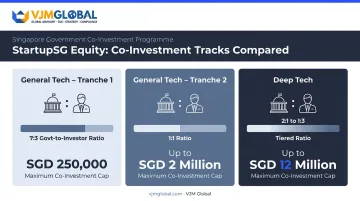
Eligibility requires proven research-based IP and a confirmed third-party private-sector co-investor. The programme prioritises Singapore-based startups with global growth potential.
VentureForGood (VFG) Grant
raiSE administers VentureForGood to support growth-stage social enterprises with up to SGD 300,000 in funding. Applicants must be raiSE members and operate social enterprises that deliver inclusive products, services, or employment opportunities for disadvantaged individuals.
SME Grants for Business Growth and Transformation
These grants target established businesses improving productivity, entering new markets, or strengthening operations. Several can be applied for simultaneously, so it's worth mapping out a stacking strategy before you apply.
Enterprise Development Grant (EDG)
The EDG is Enterprise Singapore's flagship SME transformation grant. It covers three pillars:
- Core Capabilities: business strategy, HR, financial management, branding
- Innovation and Productivity: process redesign, automation, product development
- Market Access: overseas expansion, mergers and acquisitions, standards adoption
Funding: Up to 50% of qualifying project costs, including equipment, software, internal manpower, and consultancy fees.
Eligibility: Singapore registration, 30% local shareholding, and financial viability to complete the project.
Timeline: Complete applications take approximately 8–12 weeks to assess. A Letter of Offer is issued after approval — the funded project must only begin after accepting the offer.
Apply via the BGP using CorpPass.
Productivity Solutions Grant (PSG)
The PSG funds adoption of pre-approved IT solutions and equipment to improve business productivity. Applicants must select from Enterprise Singapore's approved vendor list.
Eligible solution categories include:
- Customer management and CRM software
- Data analytics platforms
- Financial management systems
- HR and payroll tools
Funding: Up to 50% of qualifying costs, capped at SGD 30,000.
Critical rule: No payments or deposits to vendors may be made before submitting the application. Retrospective applications are disqualified.
Market Readiness Assistance (MRA) Grant
The MRA helps SMEs enter new overseas markets for the first time. A "new market" is defined as a country where the company's overseas sales have not exceeded SGD 100,000 in each of the prior three years.
Funding covers three activity types:
| Activity | Cap |
|---|---|
| Overseas Market Promotion | SGD 20,000 |
| Overseas Business Development | SGD 50,000 |
| Overseas Market Set-Up | SGD 30,000 |
| Total per company per new market | SGD 100,000 |
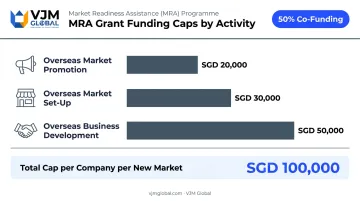
Support level: 50% of eligible costs. Eligibility follows the standard Singapore registration and 30% local shareholding requirements.
Business Adaptation Grant (BizAdapt)
Enhanced from 1 April 2026 under Budget 2026, BizAdapt helps businesses restructure supply chains and operations in response to global tariff disruptions.
Supported activities:
- FTA and trade compliance advisory
- Legal and contractual advisory
- Supply chain optimisation
- Manufacturing reconfiguration
Funding: Up to 70% for SMEs and 50% for non-SMEs, capped at SGD 100,000.
Target: Exporters and companies with overseas operations affected by tariffs.
Additional Singapore Grants Worth Knowing
Beyond the core EDG and MRA programmes, three additional schemes target workforce development, energy efficiency, and international tax planning — each with distinct eligibility rules.
SkillsFuture Enterprise Credit (SFEC)
Eligible employers receive a one-off SGD 10,000 credit usable against approved workforce training programmes and enterprise transformation schemes listed on the BGP. Key parameters:
- Offsets out-of-pocket training costs directly
- Stackable on top of other grant applications to reduce cash outlay
- Applied against schemes on the SkillsFuture Enterprise Credit-approved list
Energy Efficiency Fund (E2F)
Administered by the National Environment Agency (NEA), E2F supports manufacturing SMEs classified under SSIC codes 10XXX–32XXX that adopt energy-efficient technologies. Funding covers up to 70% of qualifying costs — including equipment, professional services, and manpower — for projects completed within 36 months.
Double Tax Deduction for Internationalisation (DTDi)
Unlike the grants above, DTDi is a tax incentive. It provides a 200% tax deduction on qualifying expenses for international market expansion — trade fairs, market research, and overseas business development activities. The scheme applies to qualifying expenses incurred from 1 April 2012 to 31 December 2030.
Companies can apply DTDi on the same expenses supported by MRA — meaning the same overseas expenditure can qualify for a cash reimbursement under MRA and a 200% tax deduction under DTDi, reducing both out-of-pocket costs and taxable income. Final claim treatment should follow IRAS and Enterprise Singapore guidance.
How to Successfully Apply for a Singapore Business Grant
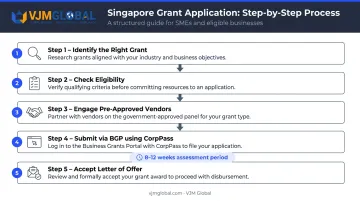
The Five-Step Application Process
- Identify the right grant — match your business goals to grant categories on the Enterprise Singapore website or GoBusiness
- Check eligibility — verify company size, shareholding structure, and financial criteria before investing time in a proposal
- Engage pre-approved vendors — required for PSG and some EDG projects; obtain formal written quotations
- Submit via BGP — log in using CorpPass at businessgrants.gov.sg; third parties cannot submit on a company's behalf
- Accept the Letter of Offer — issued approximately 8–12 weeks after submission; only begin the funded project after formal acceptance
Common Pitfalls to Avoid
- Paying vendors before grant approval — this disqualifies the claim entirely
- Incomplete financial statements — audited financials or certified management accounts are typically required
- Weak project proposals — vague outcome descriptions reduce approval chances; proposals must show measurable business impact
- Wrong vendor — PSG requires solutions from the approved vendor list; using an unlisted vendor makes the project ineligible
Getting Your Entity Grant-Ready
Foreign companies and first-time applicants often encounter issues at the shareholding verification stage. Meeting the 30% local equity requirement means structuring the company correctly before applying, not as an afterthought. Working with an experienced advisory firm ensures the entity is set up correctly from incorporation, so grant applications aren't blocked by structural issues later.
Frequently Asked Questions
What business grants are available for companies in Singapore?
Major categories include startup grants (StartupSG Founder, Tech, Equity), SME transformation grants (EDG, PSG), overseas expansion grants (MRA), workforce credits (SFEC), and sector-specific support (E2F for manufacturing). The Business Grants Portal maintains a full catalogue with eligibility filters.
What Singapore company grants are available in 2026?
Core grants — EDG, PSG, MRA, and StartupSG programmes — remain active in 2026. The BizAdapt grant was enhanced from April 2026 under Budget 2026, with improved support rates for SMEs and non-SMEs. Check the Enterprise Singapore website for current funding percentages, as support levels are subject to revision.
Who is eligible for the StartupSG Founder grant?
The main applicant must be a first-time founder who is a Singapore citizen or PR. The company must have at least 51% citizen/PR shareholding, be incorporated within the past 6 months, and must not have previously received government funding for the same business idea.
Who is eligible for the PSG (Productivity Solutions Grant) in Singapore?
Eligible applicants must be Singapore-registered businesses with at least 30% local shareholding and group annual turnover under SGD 100 million or fewer than 200 employees. The IT solution must be used in Singapore, and no payments to vendors can be made before the application is submitted.
Can foreign-owned companies apply for Singapore government grants?
Most major Singapore grants require at least 30% local shareholding held by Singapore citizens or PRs. Fully foreign-owned companies typically do not qualify unless they restructure their entity.
How long does the Singapore grant application process take?
Most Enterprise Singapore grant applications submitted through the BGP take approximately 8–12 weeks for assessment. After that, a Letter of Offer is issued and must be accepted within the stated deadline before the funded project may begin.