Introduction
Singapore doesn't use VAT. Foreign companies invoicing Singapore clients or onboarding Singapore vendors quickly discover the country operates a Goods and Services Tax (GST) system instead. What international businesses call a "Singapore VAT number" actually refers to one of two legally distinct identifiers:
- GST Registration Number — issued to GST-registered entities
- Unique Entity Number (UEN) — the broader business identifier assigned to all registered entities
Confusing these two identifiers creates real compliance risk. Using the wrong number on an invoice — or entering it in the wrong format — can result in payment delays, rejected input tax claims, and penalties under Singapore's GST Act.
The scale of the problem is significant. According to IRAS (Inland Revenue Authority of Singapore), approximately 3,000 businesses are audited annually for input tax claim errors, with an average recovery of more than S$18,000 in GST and penalties per business.
Key Takeaways
- Singapore uses GST, not VAT — the GST Registration Number is the functional equivalent
- Every registered business gets a UEN from ACRA; GST-registered businesses receive a separate GST number from IRAS on top of that
- Local and non-resident businesses follow different GST number formats
- Mandatory registration kicks in only above S$1 million annual taxable turnover
- Verify both identifiers through official portals: Bizfile (UEN) and IRAS myTax (GST)
What Singapore's "VAT Number" Actually Means
The Terminology Gap
Singapore introduced GST in 1994, modelled on VAT systems used elsewhere but branded locally as GST. IRAS explicitly states: "In other countries, GST is known as the Value-Added Tax or VAT." The term "VAT number" has no official standing in Singapore tax legislation or IRAS publications — it's a colloquial reference used by international businesses accustomed to EU-style VAT identification systems.
The current GST rate is 9%, effective from 1 January 2024, up from 7% in 2022.
Two Identifiers, Two Functions
Singapore uses two distinct identifiers that serve VAT-equivalent functions:
| Identifier | Issued By | Purpose |
|---|---|---|
| UEN (Unique Entity Number) | ACRA | General business registration ID for all entities; used for government dealings, contracts, and PayNow |
| GST Registration Number | IRAS | Tax-specific identifier for GST-registered businesses; required on tax invoices and GST returns |
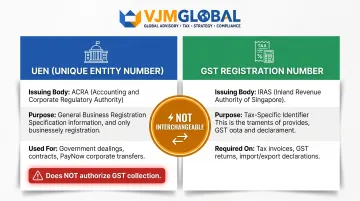
On cross-border invoices, the GST Registration Number is what international businesses need to verify before processing payment or claiming input tax credits.
The Two Tax Identifiers Every Business Needs to Know
Understanding the UEN
The UEN is a 9 or 10-character identifier assigned to every registered business entity in Singapore at the point of incorporation or registration. It acts as the master identifier for all dealings with Singapore government agencies—from CPF submissions to corporate tax filings.
Having a UEN does not authorize a business to charge GST. The UEN appears on general business documents, contracts, and government correspondence, but it's not sufficient for tax invoice compliance.
The GST Registration Number: What It Authorizes
Where the UEN establishes your business identity, the GST Registration Number is a separate identifier assigned by IRAS that authorizes GST collection. It must appear on:
- Tax invoices
- Credit notes
- GST returns
- Import/export declarations
When Registration Becomes Mandatory vs. Voluntary
GST registration is compulsory when a business's taxable turnover exceeds S$1 million, assessed on either:
- Retrospective basis: Turnover exceeded S$1M at calendar year-end (1 Jan - 31 Dec)
- Prospective basis: Turnover is expected to exceed S$1M in the next 12 months
Businesses below this threshold can voluntarily register, subject to conditions including completing an IRAS e-Learning course and setting up GIRO for GST payments. Voluntary registrants must remain registered for a minimum of two years.
Overseas Vendor Registration (OVR)
Foreign businesses supplying digital services or low-value goods (valued at S$400 or below) to Singapore consumers face a distinct registration regime. Both conditions must be met to trigger OVR obligations:
- Global turnover exceeding S$1 million, AND
- B2C supplies to Singapore exceeding S$100,000
OVR-registered businesses receive a non-resident GST number with an F-prefix format, setting them apart from Singapore-resident businesses.
Breaking Down the Singapore GST Registration Number Format
Unlike EU VAT numbers with standardised country-code prefixes, Singapore GST numbers follow several distinct patterns depending on whether the registrant is a local business or non-resident overseas vendor.
Local Business GST Number Formats
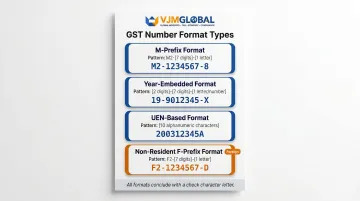
IRAS recognises three local formats:
1. M-Prefix Format (Older System)
- Pattern: M + digit/letter + 7 digits + check letter
- Examples: M2-1234567-8, MR-1234567-8
- Still actively used by businesses registered under earlier rules
2. Year-Embedded Format
- Pattern: YY-NNNNNNN-X
- Example: 19-9012345-X
- First two digits represent year of GST registration
- Seven sequential digits follow
- Final letter is the check character
3. UEN-Based Format
- Pattern: YYYYNNNNNC or NNNNNNNNT (9–10 characters)
- Examples: 200312345A, 123456789A
- Applies when a business's UEN and GST number are identical
A few formatting details apply across all three local formats:
- Hyphenated (M2-1234567-K) and non-hyphenated (M21234567K) versions represent the same number
- Both are valid depending on context (human-readable vs. system input)
- Always ends in a letter (check character)
- Total length: 9–10 characters
- Case-sensitive in system entries
Non-Resident GST Number Format
Local formats cover Singapore-registered entities, but overseas vendors operating under the OVR regime follow a separate structure entirely.
Overseas vendors registered under the OVR regime receive a distinct format:
- Pattern: FX-NNNNNNN-C
- Example: F2-1234567-D
- The F-prefix explicitly flags the entity as a foreign business
- Trailing letter serves as the check character
- Covers B2C digital services and low-value goods supplied to Singapore consumers
One compliance point worth keeping in mind: the GST Registration Number and the UEN can look similar in length, but they are not interchangeable. IRAS does not publish a public validation algorithm for the check character. Verification must be done through official IRAS tools.
Understanding the UEN Format and What Each Segment Tells You
The UEN is a structured identifier that encodes meaningful information about the entity: its year of registration, registering authority, and entity type. Understanding how the format breaks down helps you identify entity structure at a glance — and catch errors before they cause compliance issues.
Four Main UEN Format Types
1. Registered Business (ROB) — 9-character format, no year prefix
- Pattern: NNNNNNNNT
- Example: 12345678A
- N = digit, T = alphabetical check letter
2. Local Company (ROC) — year of incorporation embedded in prefix
- Pattern: YYYYNNNNNC (10 characters)
- Example: 199012345X
- First four digits encode year of incorporation
3. Other Entities (LLPs, Foreign Branches) — century and type encoded together
- Pattern: SYYPQNNNNC or TYYPQNNNNC (10 characters)
- Examples: T08LL1234A, S99LP5678B
- S = registered in 1900s, T = registered in 2000s
- PQ segment encodes entity type (see table below)
4. Foreign Companies — F-prefix signals foreign registration explicitly
- Pattern: F000NNNNNC or FDDDNNNNNC (10 characters)
- Example: F10FC0001C
Entity-Type Codes (PQ Segment)
For format types 3 and 4, the PQ segment identifies the legal structure of the entity. The codes map as follows:
| Code | Entity Type |
|---|---|
| LL | Limited Liability Partnership |
| LP | Limited Partnership |
| FC | Foreign Company (branch of overseas entity) |
| RF | Representative Office / Foreign Entity |
| NB | Miscellaneous / Other Entities |
| UF | Foreign entities registered with ACRA (non-branch) |
Check Character Validation
The final character in every UEN is algorithmically derived, enabling programmatic format validation. ACRA does not publish the algorithm publicly. To confirm whether a UEN is active and maps to a registered entity, use ACRA's Bizfile portal — it returns live registration status and entity details.
How to Verify Singapore Tax Numbers and Avoid Compliance Errors
Verification Tools and Methods
Verifying a UEN:
- Portal: ACRA Bizfile
- Access: Free public searches by UEN or company name
- Confirms: Registration status, entity type, registered address
- Use case: Verify before onboarding any Singapore vendor or client
Verifying a GST Registration Number:
- Portal: IRAS myTax Portal - GST Search
- Access: Free, no login required
- Search options: Business name OR up to four Tax Reference Numbers simultaneously
- Confirms: Current GST registration status and authorisation to charge GST
- Critical note: A company may have deregistered since the number was issued
Common Errors to Avoid
1. Quoting UEN Instead of GST Number on Tax Invoices
The invoice becomes non-compliant and the buyer cannot claim GST input tax credits. The issuing business may also face penalties under GST Act Section 64.
2. Using Outdated or Deregistered GST Numbers
This typically occurs when a counterpart drops below the S$1M threshold or voluntarily deregisters. Always verify current status through the IRAS search before processing invoices.
3. Applying Wrong Format (Local vs. Non-Resident)
Using an M-prefix for an OVR entity — or an F-prefix for a local entity — causes system validation failures in ERP and accounting platforms.
4. Incorrect Separator Usage
Some accounting and ERP systems perform strict format validation. Check whether your system expects hyphenated (M2-1234567-K) or non-hyphenated (M21234567K) format before entering numbers.
5. Assuming Every UEN Holder is GST-Registered
Only businesses above the S$1M threshold (or voluntary registrants) hold GST numbers. Accepting invoices with GST charges from non-registered entities creates direct compliance exposure.
Statutory Penalties for Non-Compliance
The GST Act 1993 establishes the following penalties:
| Violation | Penalty | Additional Fine | Imprisonment |
|---|---|---|---|
| Non-registered person issuing invoice showing tax (S.64) | 3x the tax amount | Up to S$10,000 | — |
| Unauthorized collection of tax (S.64A) | 3x amount collected | Up to S$10,000 | Up to 7 years |
| Using wrong tax number on invoice | Input tax claim denied | Audit penalties | — |
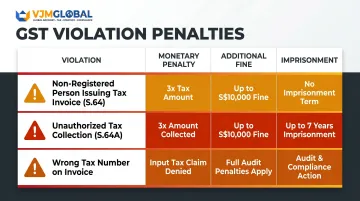
For businesses operating across Asia-Pacific, Singapore's GST framework is one of several overlapping compliance obligations. Getting the tax identifier right at the invoice level is the detail that keeps input tax claims intact and audits straightforward.
Frequently Asked Questions
Do companies in Singapore have VAT numbers?
Singapore does not use VAT—it operates a GST system. GST-registered businesses receive a GST Registration Number from IRAS, which functions as the equivalent of a VAT number for international purposes.
What is the format of the tax ID number in Singapore?
Singapore uses two identifiers: the UEN (9–10 characters, issued by ACRA to all registered entities) and the GST Registration Number (9–10 characters ending in a letter check character, issued by IRAS to GST-registered businesses only). Local businesses use M-prefix or year-based formats; non-resident vendors receive an F-prefix number.
What is the difference between a UEN and a GST Registration Number in Singapore?
The UEN is a universal business registration number issued by ACRA to all registered entities for general government dealings. Only GST-registered businesses receive a GST Registration Number — issued by IRAS specifically for GST transactions and tax invoices.
How do I verify a Singapore company's GST registration status?
Use the IRAS GST Registered Business Search tool. Search by UEN or GST number to confirm current registration status, as companies may have deregistered since the number was issued.
Do foreign companies need to register for GST in Singapore?
Foreign businesses supplying digital services or low-value goods to Singapore consumers above the S$100,000 threshold must register under the Overseas Vendor Registration (OVR) regime and will receive a non-resident GST number in the F-prefix format.
What happens if I use the wrong tax number on a Singapore tax invoice?
Using a UEN instead of a valid GST Registration Number makes the invoice non-compliant — the buyer cannot claim GST input tax credits against it. The issuing business may face penalties up to 3x the tax amount plus fines up to S$10,000 under GST Act Section 64.