Introduction
Indian entrepreneurs expanding into Singapore — whether setting up a subsidiary, a trading entity, or a regional headquarters — encounter one regulatory concept almost immediately: the UEN (Unique Entity Number).
The UEN is Singapore's single, unified business identifier used across all government agencies. Unlike India's fragmented system—where businesses juggle separate identifiers such as CIN (company identity), PAN (tax purposes), and GSTIN (GST compliance)—Singapore consolidates everything into one number. One number handles tax filings, government transactions, and regulatory correspondence.
This guide covers:
- What a UEN is and how it works
- How it compares to Indian identifiers
- What it's used for in Singapore
- How Indian businesses can obtain one
- How to verify Singapore companies using their UEN
Key Takeaways
- UEN is Singapore's single government-issued identifier for all business entities
- Launched in 2009 to consolidate multiple agency-specific registration numbers into one
- Used for tax filing, customs permits, bank account opening, grants, and mandatory display on invoices
- Indian businesses can obtain a UEN by registering a Singapore entity via ACRA at SGD 315 total cost
- Verify any Singapore company's UEN instantly using ACRA's free BizFile+ search portal
What is a UEN (Unique Entity Number) in Singapore?
The Unique Entity Number (UEN) is a 9 or 10-character alphanumeric identifier issued to all registered business entities and organisations in Singapore. It serves as their official government-recognised identity number for all regulatory and administrative interactions.
The UEN system was introduced in 2009 by Singapore's Ministry of Finance (MoF) and the Accounting and Corporate Regulatory Authority (ACRA) to consolidate the multiple identification numbers that businesses previously used across different government agencies. This replaced a fragmented system with a single unified identifier, cutting compliance overhead considerably.
Who Receives a UEN?
The following entities automatically receive a UEN upon registration:
Business entities:
- Local companies (private limited and public)
- Limited Liability Partnerships (LLPs) and Limited Partnerships (LPs)
- Sole proprietorships, partnerships, and foreign companies registered in Singapore
- Representative offices
Institutions and organisations:
- Societies, charities, and trade unions
- Healthcare and educational institutions
- Management corporations (MCSTs)
ACRA issues UENs for most business entities. Other agencies — the Registry of Societies, Commissioner of Charities, and Ministry of Health — handle registration for their respective entity types.
Who Does NOT Need a UEN?
Not every entity operating in or with Singapore requires a UEN. Four categories are excluded:
- Individual persons – they use NRIC or FIN instead
- Sub-entities – branches or divisions of a Singapore-registered company
- Foreign companies with no Singapore government interactions – entities operating entirely outside Singapore
- One-time foreign sellers – foreign parties selling goods to the Singapore government on a one-time basis
Once assigned, a UEN is permanent and does not change unless the business undergoes a structural change. It remains valid as long as the business registration is active. Sole proprietorships must renew their registration periodically, but the same UEN is retained throughout.
UEN vs. Indian Business Identifiers: What's the Equivalent?
Indian businesses operate with multiple identifiers across different government departments. Singapore's UEN replaces all of them with a single number.
| Attribute | Singapore UEN | India CIN | India PAN | India GSTIN |
|---|---|---|---|---|
| Format | 9-10 alphanumeric | 21-digit alphanumeric | 10-character alphanumeric | 15-digit alphanumeric |
| Issuing Authority | ACRA (primary) | MCA/ROC | Income Tax Department | GST Council/CBIC |
| Primary Purpose | All government interactions | Company identification & MCA filings | Income tax identification | GST compliance & filing |
| Scope | Multipurpose—tax, customs, employment, grants, corporate filings | Corporate affairs only | Tax only | Indirect tax only |
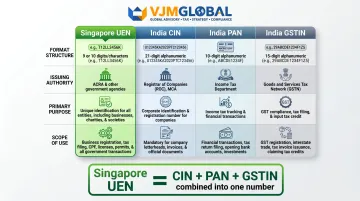
Unlike India—where businesses manage separate identifiers for company registration (CIN), income tax (PAN), and GST (GSTIN)—Singapore's UEN is a single multipurpose number accepted by all government agencies: ACRA, IRAS (tax authority), Ministry of Manpower, CPF Board, Singapore Customs, and more.
What This Means When Dealing with Singapore Entities
When onboarding a Singapore supplier, verifying a joint venture partner, or setting up a Singapore subsidiary, request the UEN—it's the official identifier, equivalent to asking for a company's CIN in India. A quick lookup on ACRA's BizFile+ portal using the UEN reveals registration status, registered address, paid-up capital, and director details in one step.
What is a UEN Used For in Singapore?
In Singapore, a single UEN covers all interactions with government agencies — no separate registration numbers needed for each body.
Business Identification Across All Government Agencies
A single UEN is accepted by:
- ACRA – corporate filings and annual returns
- IRAS – tax filing and exemptions
- Ministry of Manpower (MOM) – work pass applications
- CPF Board – employer contributions
- Monetary Authority of Singapore (MAS) – financial services licensing
- Singapore Customs – import/export permits
Indian businesses accustomed to managing separate identifiers — PAN, GSTIN, TAN, IEC — will find Singapore's unified approach considerably simpler.
Corporate Tax Filing with IRAS
The UEN is the mandatory reference for:
- Filing annual corporate income tax returns
- Applying for tax exemptions
- Accessing Singapore's tax incentives
Tax advantage for Indian businesses: Singapore taxes corporate income at a flat 17% rate. New startup companies receive 75% exemption on the first SGD 100,000 and 50% exemption on the next SGD 100,000 of normal chargeable income for the first three consecutive years.
The India-Singapore Double Taxation Avoidance Agreement (DTAA), most recently amended in 2019, provides reduced withholding tax rates:
- Approximately 10% on dividends (under certain conditions)
- 10-15% on interest
- 10% on royalties and fees for technical services
Import/Export Operations with Singapore Customs
Businesses engaged in trade between India and Singapore must quote their UEN when applying for import/export permits through TradeNet, Singapore's national single window for trade documentation.
For Indian businesses specifically:
- Indian exporters selling into Singapore need to verify their Singapore buyers' UEN
- Companies procuring from Singapore suppliers should request the UEN for compliance documentation
- Any business shipping goods through Singapore must reference their UEN on customs declarations
Opening Corporate Bank Accounts
Singapore banks require the UEN as part of Know Your Customer (KYC) verification during corporate account opening. This typically comes up within the first few weeks of incorporating a Singapore entity.
Legal Display Requirement on Official Documents
Under Section 144(1A) of the Companies Act 1967, the UEN must appear on:
- All invoices
- Business letters
- Contracts
- Statements of account
- Official publications
Non-compliance is a legal offence under Section 144(1B), with penalties up to SGD 1,000. Indian businesses used to displaying GSTIN on invoices will find this analogous.
Applying for Singapore Government Grants
The UEN links grant applications to the company's registered profile for eligibility validation. Key grants include:
Enterprise Development Grant (EDG):
- Supports up to 50% of qualifying costs (up to 70% for sustainability projects)
- Requires minimum 30% local (Singaporean/PR) equity
Productivity Solutions Grant (PSG):
- Subsidises pre-approved digital solutions and equipment
- Registration and operation in Singapore required
Market Readiness Assistance (MRA):
- Covers up to 50% of eligible costs for overseas market expansion
- Capped at SGD 100,000 per new market
- Requires minimum 30% local equity
Important note for Indian businesses: Wholly Indian-owned subsidiaries will not qualify for EDG or MRA unless shareholding is restructured to meet the 30% local equity threshold.
UEN Format: How to Read a Singapore Business Number
Singapore uses three distinct UEN formats depending on entity type and registration date:
| Format | Structure | Applies To | Example |
|---|---|---|---|
| Post-2009 businesses/entities | TyyPQnnnnX | LLPs, LPs, foreign entities, public accounting firms | T09LL0001B |
| Post-2009 local companies | yyyynnnnnX | Private limited companies, public companies | 201912345K |
| Pre-2009 entities | nnnnnnnnX | Older businesses registered before 2009 | 12345678A |
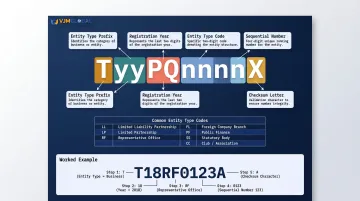
Decoding the TyyPQnnnnX Format
- T or S – Type indicator
- yy – Year of registration (two digits)
- PQ – Entity-type indicator (two-letter code)
- nnnn – Sequential running number
- X – Checksum alphabet (system-generated)
Entity-Type Indicators
| Code | Entity Type |
|---|---|
| LL | Limited Liability Partnership |
| LP | Limited Partnership |
| RF | Foreign Registered Entity |
| FL | Foreign Limited Liability Partnership |
| PF | Public Accounting Firm |
| SS | Society |
| CC | Charity |
These codes let you quickly identify the legal structure of any Singapore company you're evaluating. For example, T18RF0123A indicates a foreign registered entity set up in 2018 — most likely a branch office or representative office rather than a local subsidiary.
Permanence and Validity
ACRA assigns a permanent UEN that cannot be changed once issued. Key rules to know:
- Remains valid indefinitely as long as business registration is active
- Cannot be altered unless the business undergoes a structural change
- Sole proprietorships that renew registration periodically keep the same UEN
How Indian Businesses Can Obtain a UEN in Singapore
Step 1: Choose the Right Singapore Business Structure
Indian companies have four main options for establishing a presence in Singapore:
| Structure | Liability | Regulatory Oversight | Best For |
|---|---|---|---|
| Private Limited Company (Subsidiary) | Limited to company assets; separate legal entity | Full Companies Act compliance | Most Indian businesses—offers liability protection and operational flexibility |
| Branch Office | Parent company bears full liability | Must file parent company accounts | Established companies extending operations |
| Representative Office | Cannot conduct commercial activities | Limited to market research/liaison | Market exploration phase only |
| Limited Liability Partnership | Limited to LLP assets | LLP Act compliance | Professional services firms |
Most Indian businesses prefer a private limited company for liability protection and flexibility.
Step 2: Prepare Required Documentation
Typical documents needed for Indian applicants include:
- Notarised and apostilled Certificate of Incorporation from India, along with the Memorandum of Association (MoA) and Articles of Association (AoA)
- Director and shareholder identity proof (passport copies)
- Proof of Singapore registered address
- Company constitution
- Details of at least one locally resident director (required under the Companies Act)
Note: All foreign businesses must engage a registered corporate service provider (CSP) to handle registration—this is mandatory under ACRA rules.
Step 3: Register via ACRA's BizFile+ Portal
The UEN is automatically issued upon successful registration approval through ACRA's official BizFile+ portal at bizfile.gov.sg.
Current ACRA registration fees (verified as of January 2026):
| Service | Fee |
|---|---|
| Apply for new business entity name | SGD 15 |
| Register new business entity | SGD 300 |
| Total setup cost | SGD 315 |
At SGD 315 total, Singapore's setup costs are among the most accessible for Indian SMEs exploring international expansion.
Processing timelines:
- Standard applications: Within the same day or a few working days
- Complex applications: Up to 15 working days
- Referred applications (requiring approval from other government agencies): 14 to 60 days
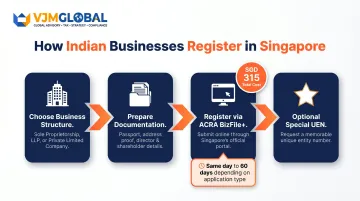
Step 4 (Optional): Apply for a Special UEN (SUN)
For businesses that prefer a memorable or auspicious number, ACRA offers reserved UENs through the Special UEN (SUN) programme. This is a consideration some Indian entrepreneurs value when establishing their Singapore presence.
| SUN Tier | Fee | Pattern Criteria |
|---|---|---|
| Tier 1 | SGD 3,000 | Consecutive identical numbers (e.g., 9999) or any combination involving "8" |
| Tier 2 | SGD 1,000 | Repetitive patterns excluding "8", or ending in triple identical numbers (e.g., 777) |
Critical constraints:
- SUN must be selected at the time of initial registration—cannot be applied for after registration
- Fees are non-refundable and non-exchangeable
- Only the sequential number portion can be customised; prefix and checksum are system-generated
Advisory Support for Singapore Expansion
These four steps cover the registration process, but selecting the right structure and preparing compliant documentation can be challenging without local knowledge. VJM Global's advisory team works with Indian businesses on entity structuring, documentation preparation, and compliance strategy—drawing on 30+ years of experience supporting companies across international jurisdictions.
How to Look Up and Verify a Company's UEN in Singapore
Why Verify a Singapore Partner's UEN?
Indian businesses should verify a Singapore partner's UEN before engaging in contracts, trade agreements, or investments to:
- Confirm the entity is actively registered
- Reveal its legal structure and business activity code
- Screen for shell companies or operators with compliance violations
- Verify registered address and key management
Once you have a reason to verify, the process itself takes just a few minutes using ACRA's free tools.
Free UEN Search via ACRA's BizFile+ Portal
ACRA offers a free entity search function at bizfile.gov.sg that does not require login.
What the free search returns:
- UEN
- Registration status ("Live," "Struck Off," or "In Liquidation")
- Registered address
- Entity type
Paid Business Profile (SGD 5.50)
A Business Profile (SGD 5.50) goes further, adding:
- All free search information
- Registration date
- Directors and shareholders
- Paid-up capital
- Business activity code (SSIC)
- Position holder details
Additional information products:
| Product | Fee | Information Included |
|---|---|---|
| Corporate Compliance & Financial Profile | SGD 50 | Financial profile, ratios, audit opinions |
| People Profile | SGD 33 | Person's involvement across different businesses |
| Extracts (past filings) | From SGD 11 | Annual returns, audited accounts |
Red Flags to Watch For
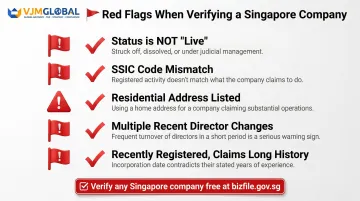
When verifying a Singapore company, watch for these warning signs:
- Registration status other than "Live" — the entity may be inactive or struck off for non-compliance
- SSIC business activity code that doesn't match what the partner claims to do
- A residential address listed for what's presented as a substantial operation — common with shell companies
- Multiple recent director changes in a short period, which can signal instability or restructuring
- A recent registration date paired with claims of a long operating history
Frequently Asked Questions
What is a UEN in Singapore?
The UEN (Unique Entity Number) is a 9 or 10-character government-issued identifier assigned to all registered business entities in Singapore. It serves as the single reference number for all government transactions—replacing the multiple agency-specific numbers businesses previously needed.
What is a UEN used for in Singapore?
The UEN is required for all interactions with Singapore government agencies — including ACRA, IRAS, CPF, and Customs — as well as for filing taxes, applying for permits, and opening corporate bank accounts. It must also appear on official business documents as legally required.
How can I look up a company by its UEN in Singapore?
Visit ACRA's BizFile+ portal at bizfile.gov.sg and use the free search function. Enter the company name or UEN to view basic registration details including status and registered address. For comprehensive information including directors, shareholders, and financial details, purchase a Business Profile for SGD 5.50.
Is the GST number the same as the UEN in Singapore?
For locally registered companies, the GST registration number is generally the same as the UEN. Foreign companies registering for GST without a local entity — such as those under the Overseas Vendor Registration regime — receive a separate GST number that differs from any UEN.
Can an Indian business or foreign company obtain a UEN in Singapore?
Yes. Indian businesses can obtain a UEN by registering in Singapore as a subsidiary, branch office, or representative office through ACRA. Companies with no Singapore presence and no government interactions do not require one.
How long does it take to receive a UEN after registering in Singapore?
UENs are typically issued immediately upon ACRA approval for straightforward applications—often within the same day or a few working days. If the application is referred to another government agency for review — such as MAS for financial services entities — the process can take 14 to 60 days.