%20(3).jpg)

Singapore consistently ranks among the world's easiest places to start a business, securing 2nd place in the 2025 IMD World Competitiveness Ranking and serving as a direct gateway to Southeast Asia's 684.1 million consumer base. With 2026 GDP growth projected at 2.0–4.0%, the fundamentals for new ventures are strong.
For entrepreneurs already sold on Singapore, the harder question is which business to start. Opportunities span digital services, consumer products, and B2B sectors — and not all of them suit the same budget, skill set, or timeline.
This guide covers the most viable business ideas for 2026, the criteria that separate low-risk opportunities from speculative ones, a budget-based roadmap, and the practical steps to register and launch in Singapore.
Singapore's business advantages rest on three core pillars: a predictable 17% flat corporate tax rate, strategic positioning as Southeast Asia's commercial gateway, and mature legal infrastructure that protects intellectual property and reduces operational risk. Together, these factors make Singapore one of the most accessible markets for new businesses anywhere in the world.
The government's 2025-2026 support framework amplifies these advantages through targeted grants:
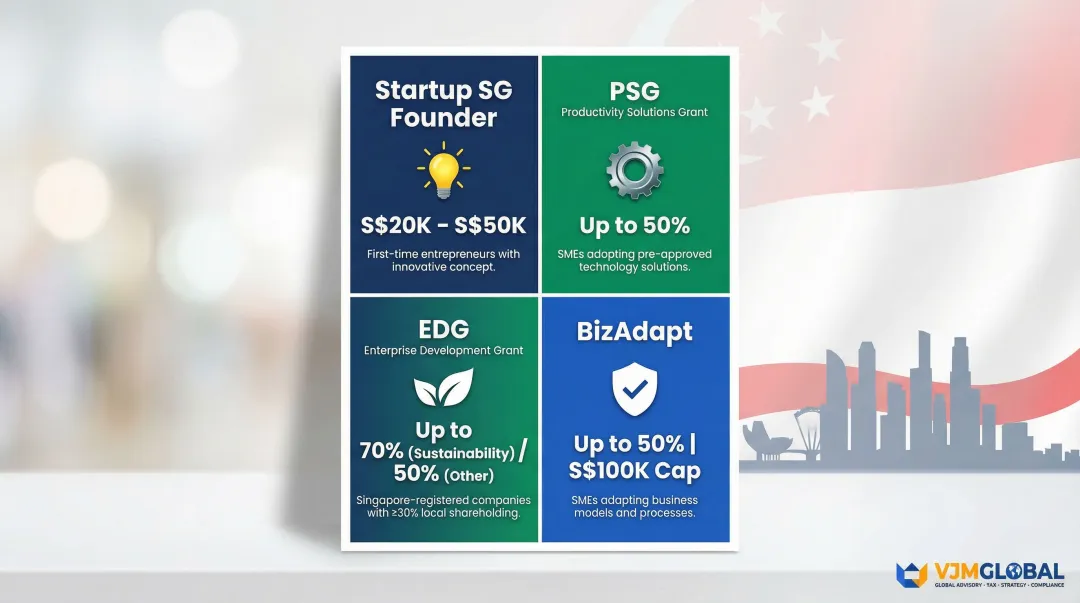
These programs directly reduce capital requirements and accelerate market entry for qualified businesses. That said, these advantages don't eliminate Singapore's structural challenges.
High operational costs — particularly office rent and manpower — pressure margins significantly. Competition across most sectors is intense, requiring clear differentiation from day one. Licensed industries like F&B, healthcare, and financial services also face regulatory requirements that extend timelines and increase capital needs. Factor these trade-offs into your planning before committing.
These businesses were selected based on four criteria:
Singapore SMEs are actively seeking cost-effective digital marketing solutions — SEO, paid advertising, influencer campaigns, and short-video content. 89.0% residential broadband penetration and a highly connected consumer base create strong, recurring B2B demand for agencies that deliver measurable results.
What makes this a standout 2026 opportunity: AI adoption among Singapore SMEs tripled from 4.2% to 14.5% between 2023 and 2024, allowing lean agencies to serve more clients with AI-powered content tools. SMEs trust referrals and local case studies over offshore providers, and government digitalization initiatives push marketing spend upward consistently.
Estimated Startup CostProfit PotentialBest ForLow (under S$5,000 for tools, website, and initial branding)High; monthly client retainers provide recurring revenueMarketers, content creators, and digital strategists with existing skills
Singapore's proximity to Southeast Asian manufacturing hubs, world-ranked logistics network, and trusted cross-border payment infrastructure make it a practical base for online product brands and dropshipping operations. Founders here can reach regional and global markets with fewer friction points than most comparable cities.
2026-specific differentiators include accelerating social commerce through TikTok Shop and Instagram, which reduces customer acquisition costs dramatically. Singapore's B2C e-commerce market is projected to grow 10.3% annually, reaching US$18.08 billion by 2025 and expanding to US$25.50 billion by 2029. AI-driven product selection tools are reducing inventory risk by identifying trending products before they saturate markets.
Estimated Startup CostProfit PotentialBest ForLow-to-medium (S$2,000–S$15,000 depending on inventory model)Medium-to-high; scalable regionally with the right product nicheTrend-spotters, product entrepreneurs, and those comfortable with digital platforms

As Singapore SMEs accelerate digital transformation, demand for web development, managed IT support, and SME-focused cybersecurity audits is rising sharply. The Singapore IT services market is valued at USD 29.80 billion in 2025 and forecast to reach USD 65.80 billion by 2030, representing 17.16% annual growth.
Cybersecurity for SMEs is particularly underserved. Ransomware cases increased 21% to 159 incidents in 2024, while phishing attempts surged 49% to 6,100 cases. Larger contracts require demonstrable compliance certifications. Expertise in this space translates directly to premium pricing and predictable retainer income.
Estimated Startup CostProfit PotentialBest ForMedium (S$5,000–S$20,000 for tools, certifications, and setup)High; monthly managed service retainers provide stable, recurring revenueIT professionals, developers, and cybersecurity specialists
Singapore's wellness economy is fueled by growing health consciousness, a high-income urban population, and increasing corporate interest in employee wellness programs. The total wellness economy was valued at US$20.38 billion in 2023, with average monthly household health expenditure reaching S$474.
Successful 2026 wellness businesses differentiate through:
Corporate contracts offer particularly stable revenue, and premium wellness segments command high customer lifetime value.
Estimated Startup CostProfit PotentialBest ForMedium (S$10,000–S$50,000 depending on physical vs. online model)Medium-to-high; high customer lifetime value in premium wellness segmentsHealth professionals, fitness trainers, and lifestyle coaches
Singapore's Green Plan 2030 creates policy tailwinds for eco-friendly businesses through grants and incentives. Combined with increasing consumer preference for sustainable products and mandatory ESG reporting for listed companies, green businesses represent a forward-looking 2026 opportunity.
Practical entry points include:
All listed companies must report Scope 1 and 2 GHG emissions starting FY2025, with Scope 3 reporting mandatory for STI constituents in FY2026. This creates significant B2B demand for sustainability expertise.
Estimated Startup CostProfit PotentialBest ForVariable (S$3,000 for consulting/online retail to S$50,000+ for agri-tech)Medium; growing rapidly as ESG mandates increase B2B demandEnvironmentally-motivated entrepreneurs and sustainability professionals
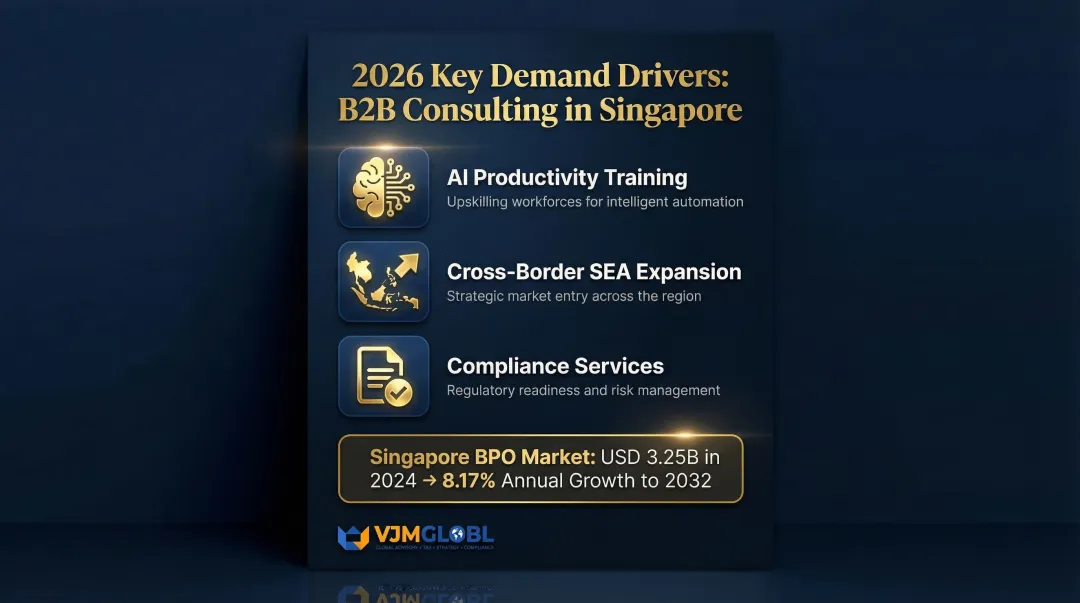
Singapore hosts regional headquarters for 4,200 multinational firms, and these organizations consistently outsource specialized expertise rather than hire full-time. B2B consulting across HR advisory, financial consulting, strategy, corporate training, and localization services benefits directly from this structural demand.
2026-specific demand drivers include:
The Singapore BPO market was valued at USD 3.25 billion in 2024, projected to grow at 8.17% annually to 2032, reflecting strong ongoing demand for professional services. High margins and low overhead make this one of the most accessible categories for experienced professionals transitioning from corporate roles.
Estimated Startup CostProfit PotentialBest ForLow (S$1,000–S$5,000); primarily skill and reputation-drivenHigh; project fees and retainers with low overheadExperienced professionals transitioning from corporate roles
The most common mistake entrepreneurs make is choosing businesses based on market trends alone, without considering their own skills, risk tolerance, and target customer base. This leads to running out of capital or hitting early burnout within the first 12-18 months.
Four criteria help narrow the field. Each one addresses a real constraint that catches Singapore entrepreneurs off guard.
Singapore's high operating costs—office rent and manpower—mean businesses with low fixed costs and scalable digital or service delivery models have notably better survival rates. Five-year survival rates for high-tech startups in Singapore stand at 53%, with service-based businesses generally outperforming capital-intensive ventures during the critical early years.
Prioritize models where you can test market fit before committing to long-term leases or significant inventory investments.
Singapore's domestic consumer base is approximately 6.11 million people—relatively small for aggressive growth targets. The most successful businesses are built with regional or global expansion in mind from day one, using Singapore as a trusted headquarters and launchpad into Southeast Asia's broader markets.
Ask yourself: Can this business serve customers in Malaysia, Indonesia, Thailand, or beyond with minimal adaptation?
Industries like F&B, financial services, healthcare, childcare, and recruitment require specific licenses. Key regulatory agencies include:
These requirements affect both your startup timeline and initial capital needs. Verify what applies to your business through the GoBusiness portal before finalizing your selection.
Government grants should factor into your business selection process. Entrepreneurs who choose businesses eligible for PSG, EDG, or Startup SG Founder grants gain meaningful financial support:
The right business isn't just about profitability—it's about what's achievable given your available capital. Singapore allows company incorporation with as little as S$1 in paid-up capital, making the financial barrier to entry genuinely low. However, realistic startup costs vary significantly by business model.
With under S$5,000, service-based businesses are most viable because they require almost no physical infrastructure. Investment covers:
Best fits: Freelance digital marketing, content creation, online tutoring, coaching, translation, and virtual assistance.
This budget range opens the door to digital-first ventures. Typical startup costs include:
Singapore's digital payment infrastructure and logistics networks let founders test products regionally before scaling further.
Best fits: E-commerce stores with supplier relationships, IT consulting with 1–2 clients secured, content marketing agencies with portfolio work, and digital product creation.
At this investment level, you can launch:
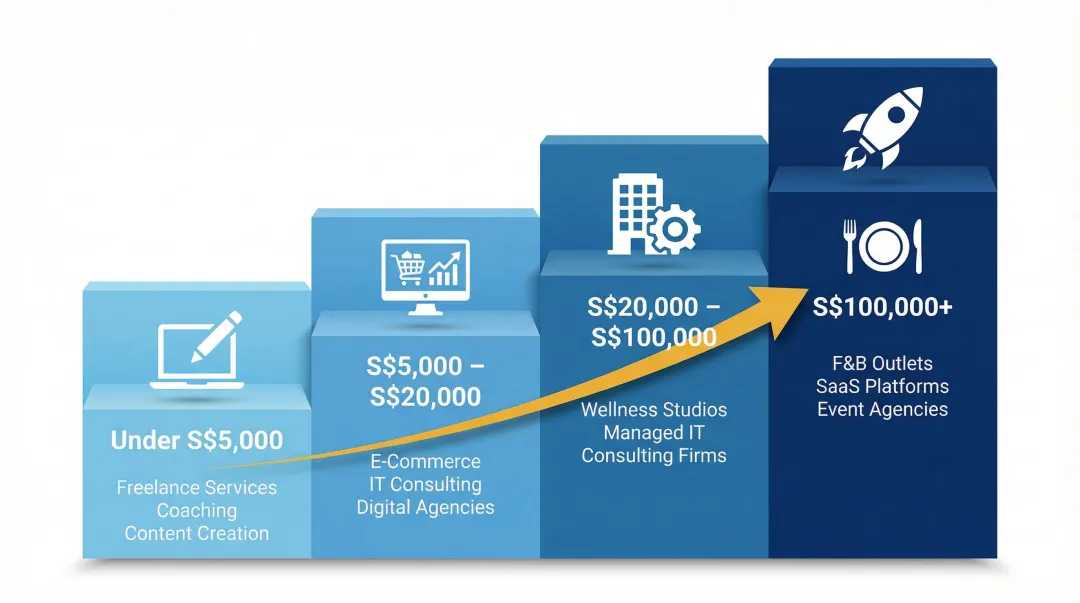
This tier requires structured financial planning — specifically cash flow forecasting and early exploration of government grants such as the Enterprise Development Grant (EDG) or Startup SG Founder to extend your runway.
This budget opens physical businesses (specialty F&B, co-working-adjacent services, event management agencies) and technology platforms (SaaS products, logistics micro-services). At this scale, engaging experienced accounting and compliance partners from day one prevents costly regulatory missteps — errors that are far more expensive to fix after the fact than to avoid upfront.
Singapore's Private Limited Company structure requires:
Government fees total S$315 (S$15 name application + S$300 incorporation). Foreign entrepreneurs can incorporate fully remotely through authorized agents.
New businesses must plan for:
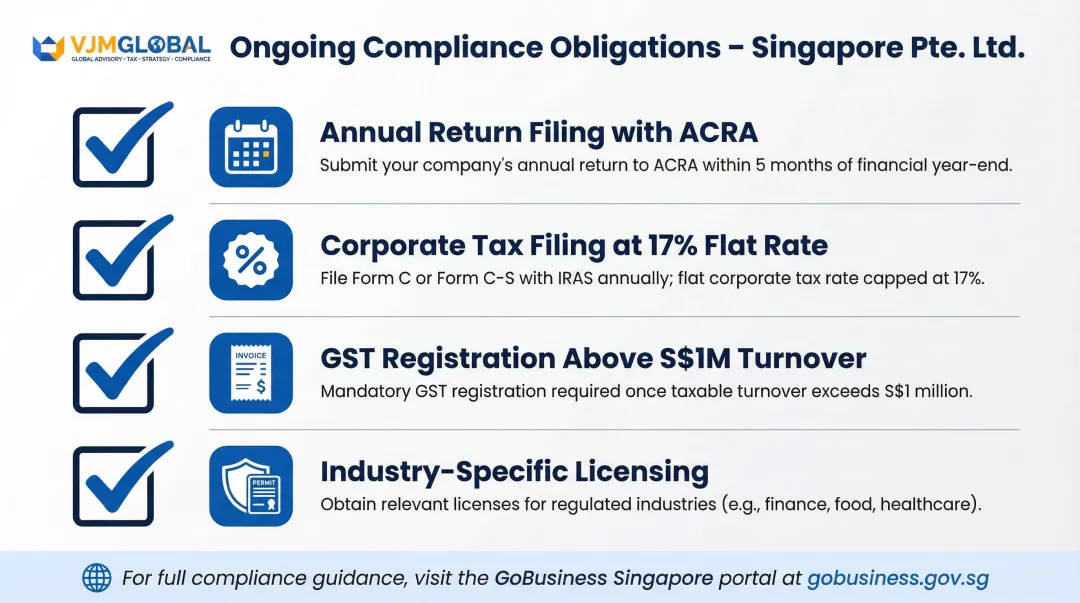
Businesses with cross-border operations also need to address transfer pricing rules and double-tax treaties — Singapore has approximately 100 DTAs that can reduce withholding tax on dividends, interest, and royalties. Getting these obligations right from day one matters more than most founders expect.
Fortunately, Singapore's government support ecosystem makes the compliance process more manageable than in most jurisdictions.
Singapore offers comprehensive support portals:
GoBusiness in particular consolidates licensing applications across multiple government agencies into a single submission — a practical time-saver for founders juggling setup tasks across departments.
Singapore's combination of low taxes, strong legal infrastructure, accessible government grants, and strategic access to Southeast Asian markets makes it one of the world's most attractive destinations to start a business in 2026. Yet success depends on choosing a venture that aligns with both market demand and your specific skills, capital position, and risk tolerance.
Validate your business idea against the selection criteria discussed: scalability potential, barrier to entry, regulatory fit, and personal expertise. From there, engage Singapore's support ecosystem early — grants, tax incentives, and compliance obligations are far easier to plan for before incorporation than to navigate after the fact.
For businesses planning to extend their Singapore operations into India — or managing cross-border accounting and tax compliance across multiple jurisdictions — VJM Global's team of 100+ accounting and tax professionals specializes in exactly that. With 30+ years of experience serving foreign entrepreneurs and multinational companies, VJM Global handles everything from India market entry and GST compliance to international tax advisory, so your expansion doesn't stall on regulatory complexity.
Digital and service-based businesses—digital marketing agencies, IT services, and B2B consulting—consistently rank among the highest-margin opportunities due to low overhead and recurring revenue models. Singapore's dense concentration of SMEs and multinationals generates sustained demand for these services, making them among the most reliably profitable options available.
Freelance and service-based businesses (content creation, tutoring, consulting) are the most affordable to start (under S$5,000). They require no office or equipment costs and can scale using digital tools, with many founders turning a profit within 3–6 months depending on client acquisition pace.
Yes—S$3,000 is sufficient for service-based or freelance businesses. This covers company incorporation fees (approximately S$315 in government fees), a basic website, essential tools, and working capital for initial operations.
S$10,000 unlocks e-commerce dropshipping stores, digital marketing agencies, web development shops, and online wellness coaching businesses. Entrepreneurs should also pursue government grants like the Startup SG Founder grant to supplement this capital and stretch their capital further.
A Private Limited Company (Pte. Ltd.) is the most recommended structure for most businesses due to limited liability, Singapore's 17% corporate tax rate and startup tax exemptions, credibility with clients, and eligibility for government grants. It requires at least one locally resident director.
The most consistently successful small businesses stay lean, go digital, and serve a defined niche. Digital agencies, e-commerce brands, tutoring centers, and freelance IT services lead on both survival rates and revenue growth among Singapore SMEs — categories where low overhead and repeat clients compound quickly.