%2520(3).avif)

For tax year 2025 returns due April 15, 2026, millions of taxpayers will owe a federal balance and need a reliable way to pay. 1040PayTax.com is one portal that routes those payments to the IRS - but understanding how it works, what it costs, and where it fits among official IRS payment channels matters before you submit a dollar.
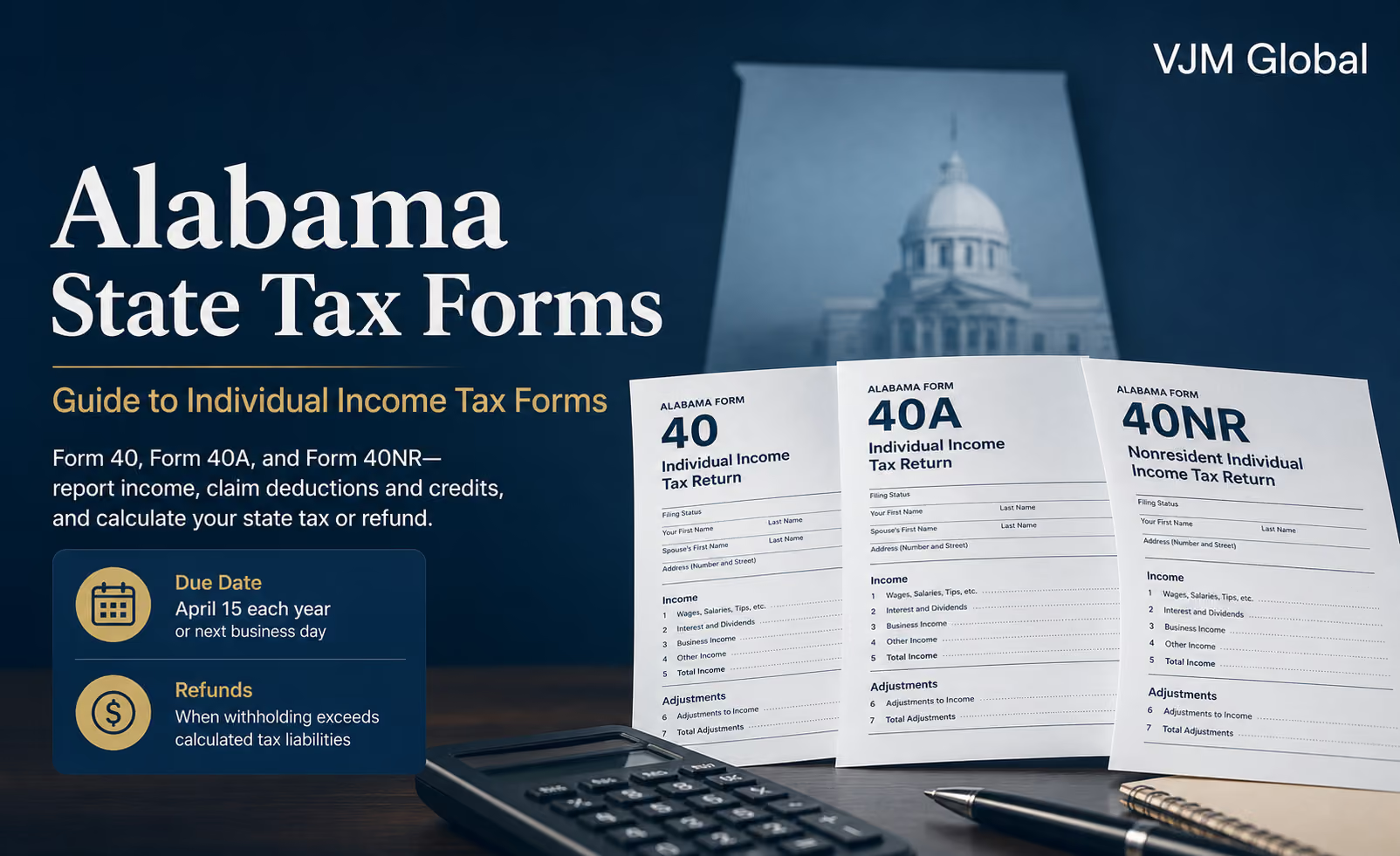
1040PayTax.com is a federal tax payment gateway powered by Drake Software. It does not file tax returns - it redirects users to IRS-authorized third-party processors or IRS Direct Pay based on the payment method chosen.
Taxpayers can pay via bank account (no fees through Direct Pay), debit card (flat fees around $2–$4), or credit card (percentage-based fees, typically 1.75%–1.99%). Users can pay through major card networks like Mastercard and Visa.
The portal handles individual income tax return balances, estimated taxes (1040-ES), extensions, and prior-year adjustments. Users can also pay state taxes through authorized links on 1040paytax.com.
If you cannot pay in full by the due date, the IRS offers short-term payment plans and long-term installment agreements. VJM Global – USA can help assess which option fits your financial profile.
Always confirm you are on a secure page (https, correct URL) before entering any personal identification number, social security number, or bank account details.
The portal is powered by Drake Software, a tax software provider, and acts as a front-end interface - not a filing system. 1040paytax.com does not file tax returns. It assists in making payments for federal income taxes or extensions by connecting users to IRS-approved payment services. The site does not take bank or card details directly; it connects users to separate payment processors or IRS Direct Pay depending on the method you select.
Common use cases: paying a $3,500 balance due for tax year 2025 by April 15, 2026, making a 2026 second-quarter estimated tax payment by June 15, 2026, or resolving a prior-year balance. 1040paytax.com focuses on federal taxes, not state liabilities, though users can pay state taxes through authorized links on the site.
International taxpayers - nonresident aliens, Americans abroad, or owners of foreign-owned U.S. entities - can use the same portal but should expect additional identity-verification steps if their IRS filing history is limited or their bank account lacks a U.S. routing number.
The most critical step when making payments through any portal is selecting the correct payment type and tax year so the IRS applies the money to the right account. A misapplication can trigger penalty notices and interest accrual even though you paid on time.
Typical payment types include:
Form 1040 current-year balance due
1040-ES estimated tax (specify quarter)
Amended return (1040-X)
Installment agreement payment
Prior-year balance (specify tax year)
Each payment must be submitted separately if it relates to a different tax year. If you owe for both 2024 and 2025, those are two distinct transactions. On-screen help icons define each payment type - use them if you are unsure which form matches your situation. A common mistake we see at VJM Global – USA: taxpayers coding an estimated tax payment as a balance-due payment, which delays credit to the correct period.
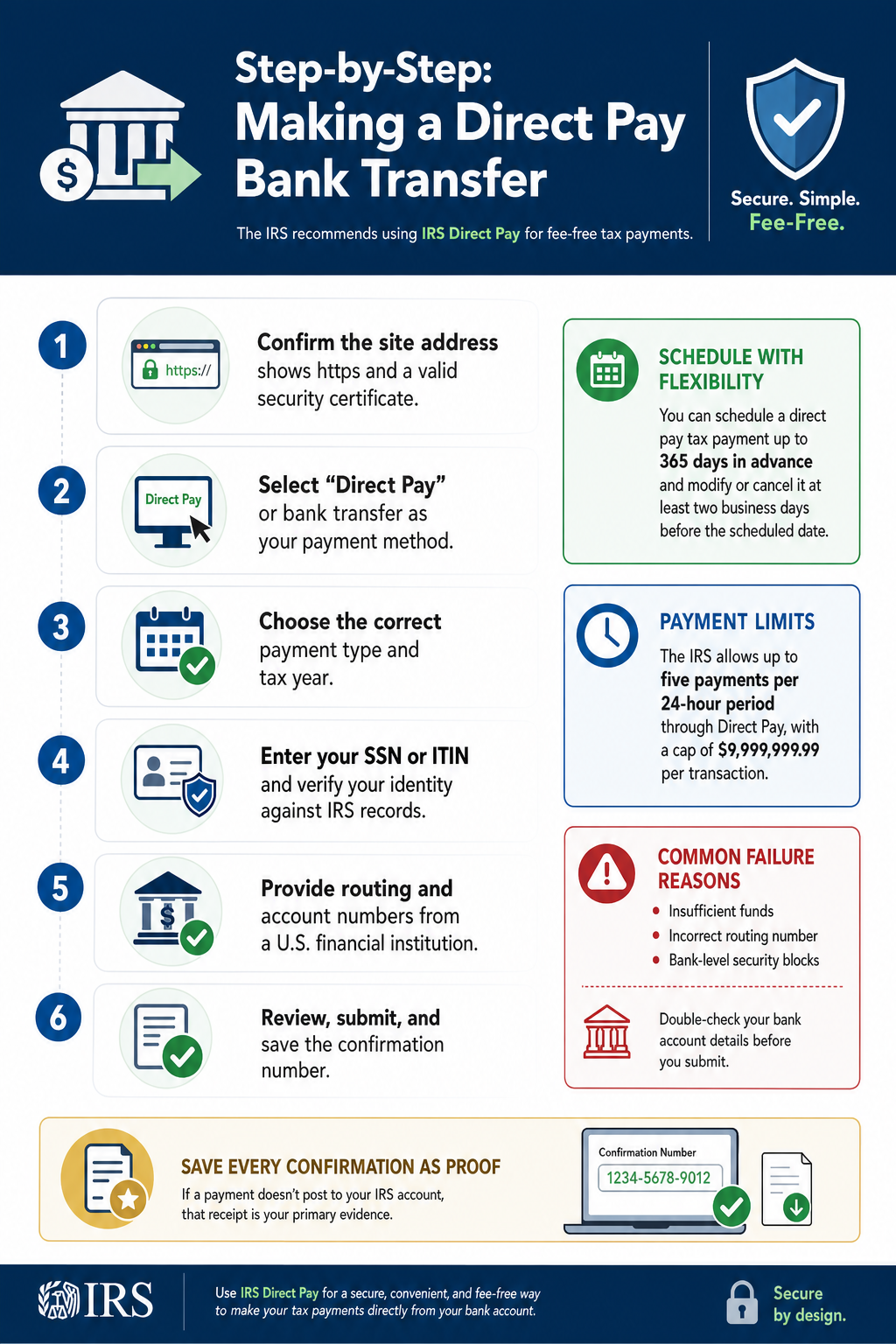
The IRS recommends using IRS Direct Pay for fee-free tax payments. Direct bank transfers can be made through IRS Direct Pay without fees from a checking or savings account. Here is the process at a high level:
Confirm the site address shows https and a valid security certificate.
Select "Direct Pay" or bank transfer as your payment method.
Choose the correct payment type and tax year.
Enter your SSN or ITIN and verify your identity against IRS records.
Provide routing and account numbers from a U.S. financial institution.
Review, submit, and save the confirmation number.
You can schedule a direct pay tax payment up to 365 days in advance and modify or cancel it at least two business days before the scheduled date. The IRS allows up to five payments per 24-hour period through Direct Pay, with a cap of $9,999,999.99 per transaction.
Common failure reasons: insufficient funds, incorrect routing number, or bank-level security blocks. Double-check your bank account details before you submit. Save every confirmation as proof - if a payment doesn't post to your IRS account, that receipt is your primary evidence.
The IRS uses third-party payment processors for debit and credit card transactions. 1040PayTax.com redirects users to IRS-authorized processors such as Pay1040 or ACI Payments, Inc. The site itself does not collect your card information - it routes you to the processor's secure page.
Typical fees:
Card Type | Pay1040 Fee | ACI Payments Fee |
|---|---|---|
Personal debit | ~$2.15 flat | ~$2.10 flat |
Personal credit | ~1.75% | ~1.85% |
Commercial credit | ~2.89% | ~2.95% |
On a $10,000 credit card payment, that 1.75% fee equals $175 - money that goes to the processor, not the IRS. Credit card payments incur processing fees from service providers regardless of which processor handles the transaction. In most cases, rewards or points do not offset this cost on larger tax payments. |
Process: choose card payment, select the federal tax payment type, enter card details on the processor's secure page, review tax and fee amounts, and print or save the confirmation receipt. Major networks - Visa, Mastercard, American Express, Discover - are generally accepted, though prepaid or certain debit networks may vary by processor.
The IRS provides various methods to pay taxes, including online options beyond 1040PayTax.com. Taxpayers should know when an alternate system is more appropriate.
EFTPS: A no-fee system for businesses and individuals. EFTPS requires enrollment and can take up to five days to process. Once enrolled, you can schedule payments up to 365 days in advance. Note that new individual enrollment is being phased out - by late 2026, new individuals must use Direct Pay or their IRS Online Account.
Electronic Funds Withdrawal (EFW): Available within e-filed returns. Electronic Funds Withdrawal can schedule payments up to 365 days in advance directly through tax software or a tax professional at the time the return is transmitted.
Check or money order: Checks or money orders must be made out to the United States Treasury, mailed with Form 1040-V. Allow several business days before the deadline for postal delivery.
In-person cash payments: Available at select retail partners and IRS Taxpayer Assistance Centers. Appointments and confirmation codes are required in advance.
Taxpayers who cannot pay their full federal tax payment by the due date may qualify for a payment plan. Short-term payment plans can be requested for temporary financial issues - these generally cover balances payable within 120 to 180 days, with no formal setup fee. Interest and late-payment penalties continue to accrue.
You can apply for a long-term payment plan online if owed under $50,000 through the IRS Online Payment Agreement tool. Direct debit installment agreements allow monthly automated withdrawals and typically carry lower setup fees. The IRS typically responds to installment agreement requests within 30 days.
An active installment agreement usually halts more aggressive collection actions - wage garnishments, bank levies - while payments are current. But it does not stop interest from accumulating on your debt, so some businesses explore professional tax resolution services for USA businesses to evaluate broader options.
For more severe hardship, you can request an Offer in Compromise if unable to pay due to hardship. You may also need to submit Form 433-F to delay collection processes while the IRS reviews your financial situation. VJM Global – USA’s IRS tax resolution and audit support services regularly assess whether clients should pursue penalty abatement, a compromise, or "currently not collectible" status.
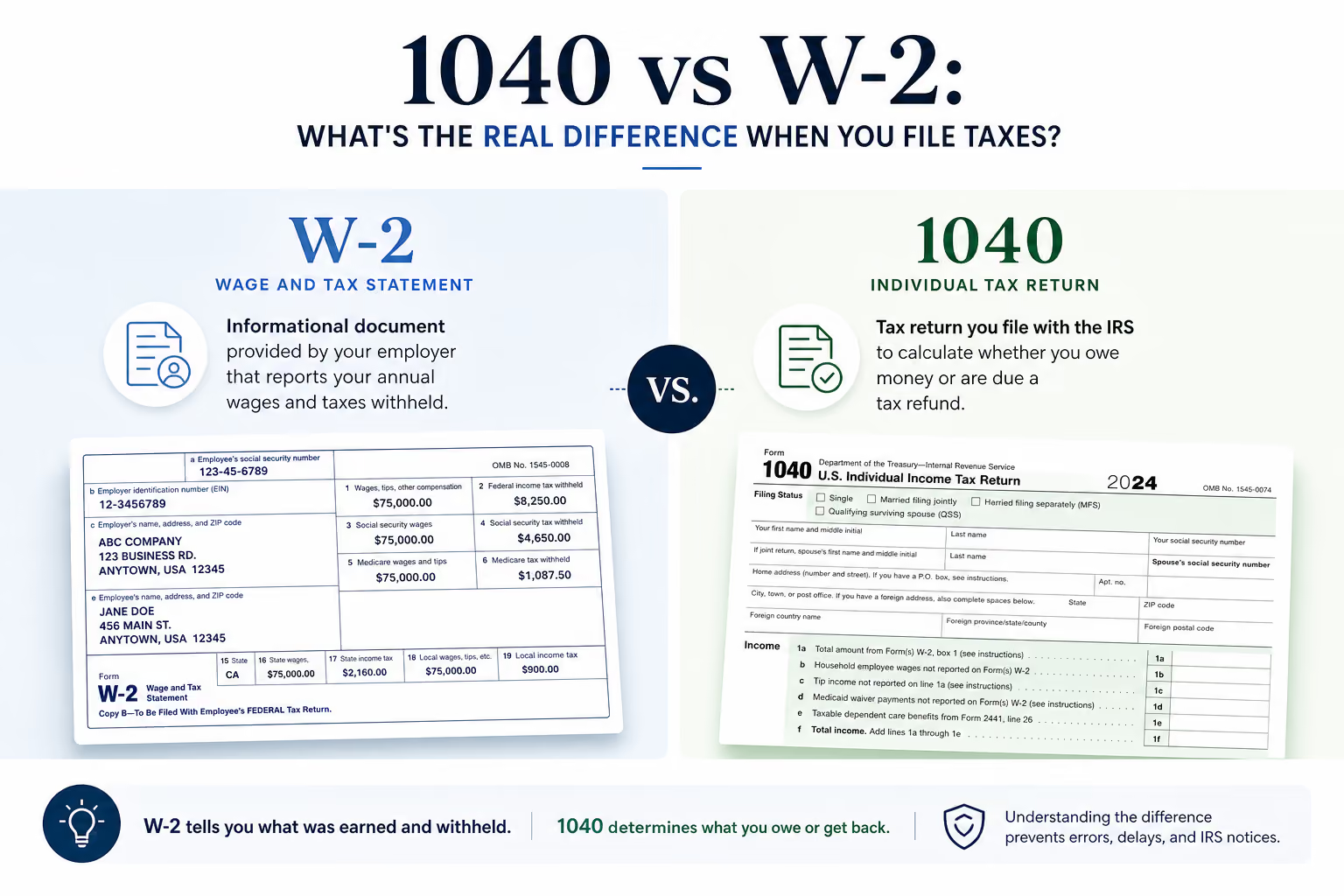
Every payment made through 1040PayTax.com must match the amounts and tax years on your Form 1040 or amended return. A mismatch - even by one tax year - can result in an IRS notice.
Best practices:
Match each confirmation to the corresponding tax return copy.
Keep records for at least three to seven years depending on income type.
Label estimated tax payments clearly as 1040-ES for the correct quarter (e.g., 2026 Q3 due September 15, 2026).
Log in to your IRS online account to verify posted payments, balances by tax year, and whether transactions have been correctly applied.
Businesses with pass-through income - partnerships, S corporations, or an LLC taxed as a partnership - should allocate estimated and balance-due payments at the owner level to reflect K-1 data and avoid underpayment penalties, and may benefit from expert tax preparation services for LLCs and LLPs in the USA and complete business accounting services for U.S. companies from India.
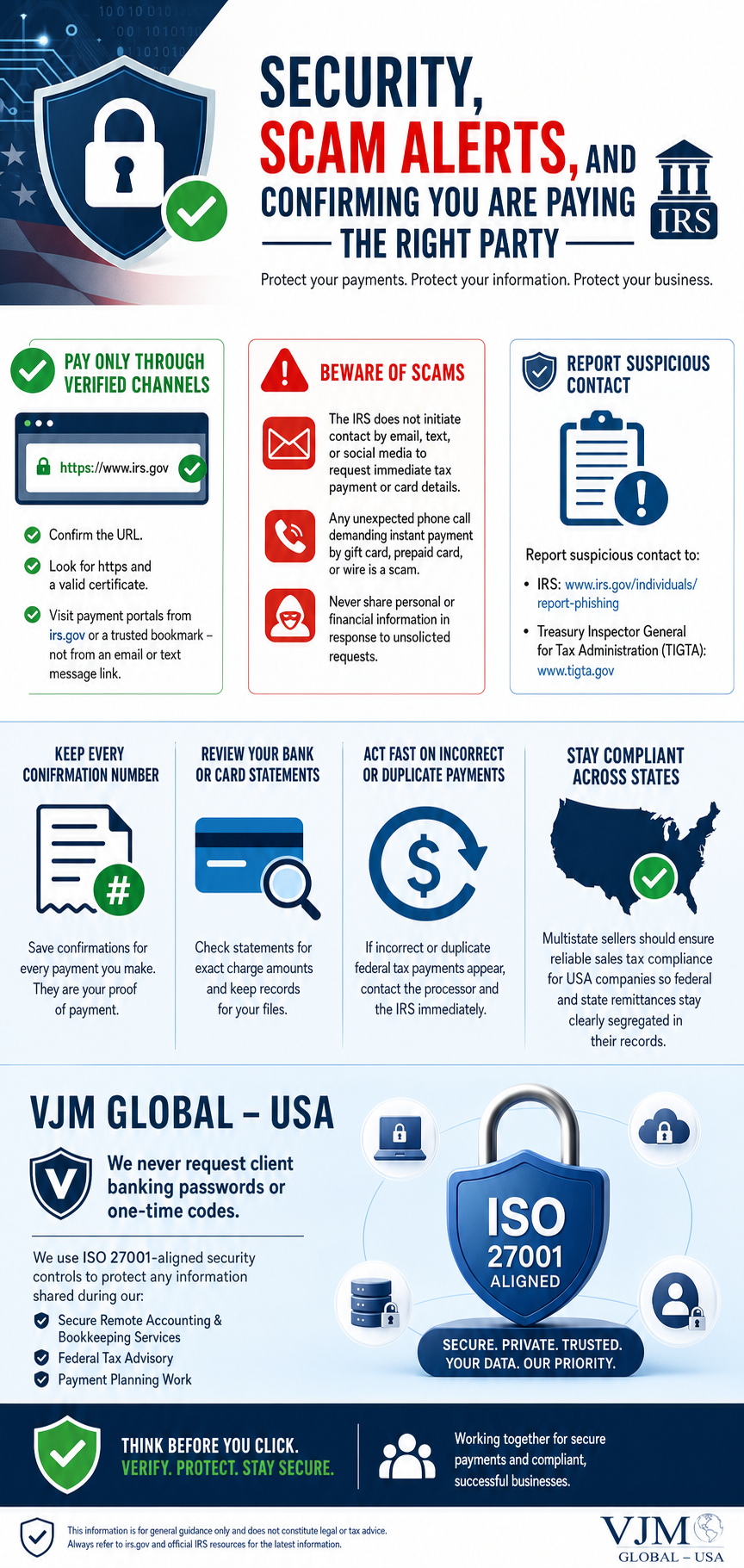
Federal tax payments should only go through verified channels. Before entering any paperwork or personal data, confirm the URL, check for https and a valid certificate, and visit payment portals from irs.gov or a trusted bookmark - not from an email or text message link.
The IRS does not initiate contact by email, text, or social media to request immediate tax payment or card details. Any unexpected phone call demanding instant payment by gift card, prepaid card, or wire is a scam. Report suspicious contact to the IRS and the Treasury Inspector General.
Keep every confirmation number. Check your bank or card statements for exact charge amounts. If incorrect or duplicate federal tax payments appear, contact the processor and the IRS immediately; multistate sellers should also ensure they maintain reliable sales tax compliance for USA companies so federal and state remittances stay clearly segregated in their records. VJM Global – USA never requests client banking passwords or one-time codes and uses ISO 27001-aligned security controls for any information shared during secure remote accounting and bookkeeping services or federal tax advisory or payment planning work.
VJM Global – USA’s global tax, accounting, and business consulting services support individuals, entrepreneurs, and cross-border businesses in planning, filing, and paying U.S. federal taxes in compliance with Internal Revenue Service rules. Our team handles:
Computing accurate balances due for Form 1040 returns
Planning quarterly 1040-ES estimated tax payments
Selecting the most cost-effective payment method
Reviewing IRS account transcripts to confirm correct posting
Analyzing whether a client qualifies for streamlined agreements, Offer in Compromise, or appeal options
Our international tax team’s cross-border tax planning strategies frequently assist foreign-owned U.S. businesses and U.S. owners of foreign entities with coordinating federal tax payment schedules across multiple countries, applying foreign tax credits, and avoiding double taxation. Taxpayers expecting large payments - $250,000 or more from a liquidity event or business sale - should schedule a planning call several months ahead to model cash-flow impact, safe harbor estimated payments, and IRS risk exposure. Contact us at [email protected].
Yes. Paying through 1040PayTax.com does not substitute for filing a Form 1040. Your individual tax return must still be filed by the due date - April 15, 2026 for tax year 2025, or October 15, 2026 if a valid extension was filed. Payments made before filing are treated as advance payments and matched to the return once the IRS processes it.
Most electronic payments appear within a few business days. A confirmation is usually generated immediately. We recommend waiting at least one week before calling the IRS about a missing payment. Keep your confirmation number, bank statement, and any email receipt as proof.
The IRS accepts multiple payments for the same tax year. You can send part via Direct Pay and the remainder via EFTPS or a mailed check, as long as each payment clearly identifies the tax year and form. Coordinate timing so all payments post by the due date. Document each separate transaction for reconciliation.
If a payment is misapplied - coded as 2024 estimated tax instead of 2025 balance due, for example - you can request a re-designation by calling the IRS or by mail with a written request and proof of payment. Where large amounts or multiple years are involved, a tax professional can help resolve the failure faster and prevent compounding penalties.
Card convenience fees paid to processors may qualify as deductible in limited circumstances - typically when tied to business or self-employment taxes reported on Schedule C or Schedule E. For individual income taxes with no business connection, deductibility is generally not available. Decide based on your specific facts, and consult a qualified advisor to confirm whether your fees qualify on your federal tax return.