%2520(3).avif)
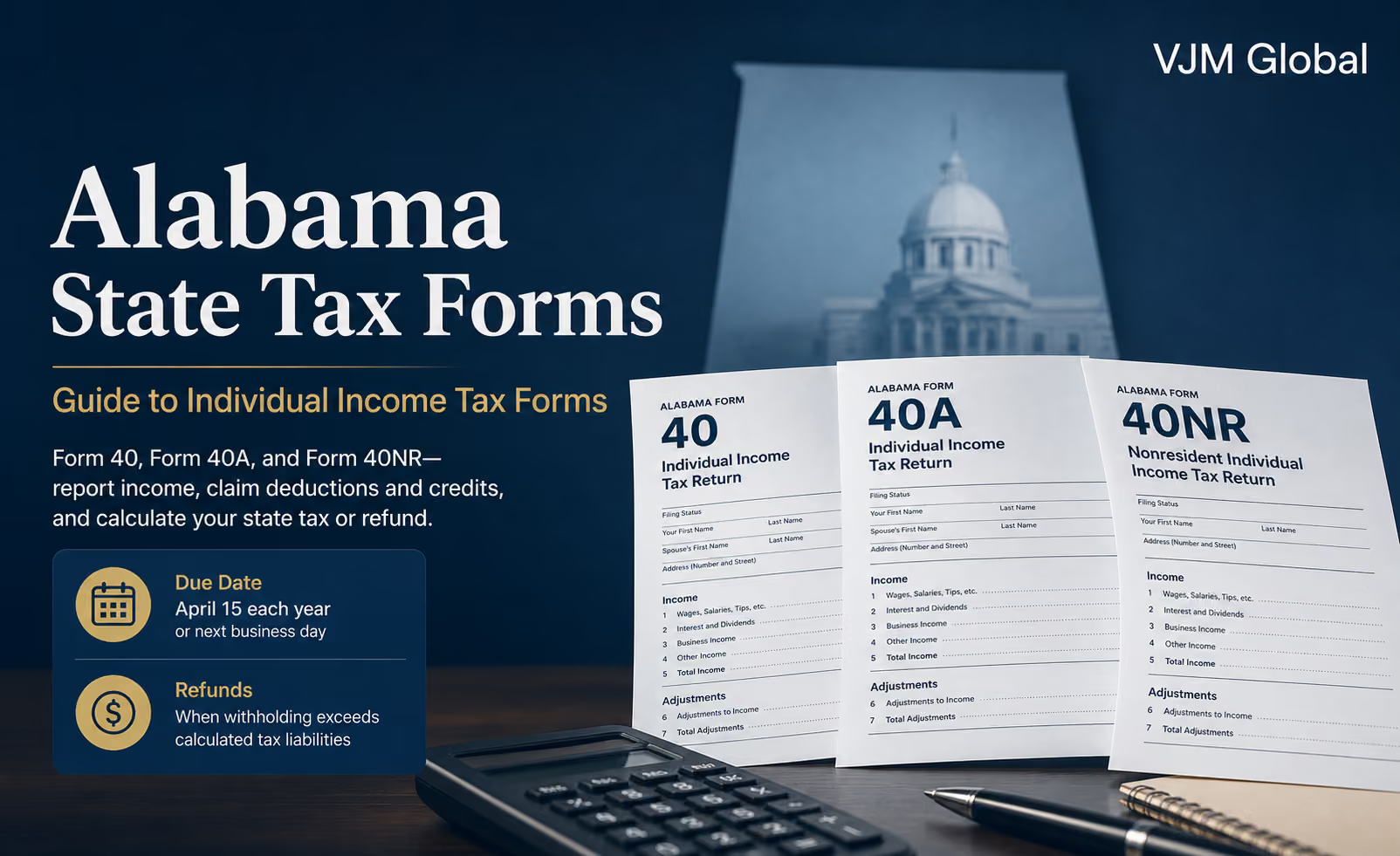
Alabama income tax forms are the state-level returns used to report income, deductions, credits, and tax owed or refunded for a specific tax year. The Alabama Department of Revenue (ALDOR) oversees tax form processing and updates these forms annually.
Three individual income tax forms cover nearly every filer category. Alabama income tax forms are for residents and part-year residents, while nonresidents use a separate return:
Form
Who Uses It
Form 40
Full-year residents (long form)
Form 40A
Full-year residents with simpler returns
Form 40NR
Nonresidents and part-year residents
These forms work alongside - but separate from - federal Form 1040. Alabama tax rules on deductions and credits often differ from federal treatment. Official current-year PDFs are available on the ALDOR revenue website and should be preferred over third-party templates for accuracy.
Filing requirements depend on residency status, filing status, income level, and whether income is sourced to Alabama. SALT encompasses multi-state income tax compliance and nexus analysis, which matters for anyone earning across state lines.
Full-year Alabama residents generally must file an individual income tax return when gross income exceeds the state's filing threshold - approximately $4,500 for single filers. Part year residents who moved into or out of Alabama during the tax year file Form 40NR for the nonresident period and may also need Form 40 for the resident period. Nonresidents earning wages from an Alabama employer, rental income from Alabama property, or business income from in-state activities must file Form 40NR.
A return may still be required even at low income levels - for example, when Alabama withholding was taken and the taxpayer wants a refund, or when self-employment income or early distributions trigger a liability. For borderline cases and multi-state scenarios, consult the latest ALDOR filing requirement tables or a professional such as VJM Global – USA.
Alabama offers different forms tailored to each filer's situation.
Form 40 is the primary return for most full-year residents. The AL ADoR 40 form reports specific transactions in Alabama, covering wages, interest, dividends, net profit from business activity, capital gains, and other available credits. Taxpayers determine whether to claim the standard deduction or itemize. Alabama tax applies a rate of 5% on taxable income above $3,000 for single filers (above $6,000 for joint filers), with lower rates on the first brackets.
Form 40A is a shorter version for full-year residents with simpler tax situations - those with only wage income, interest and dividends under $1,500, no itemized deductions, and no income adjustments. Not all taxpayers qualify.
Form 40NR is for nonresidents earning income from Alabama. It reports only Alabama-source income and prorates deductions and exemptions based on Alabama versus total income.
Common schedules and additional forms include Schedule A (itemized deductions), Schedule CR (capital credit and credit for taxes paid to other states), and worksheets for Alabama-specific adjustments. Alabama's state specific income tax adjustments may include overtime exemptions not recognized at the federal level. Accurate completion requires W-2s, 1099s, Alabama withholding statements, and documentation for major deductions.
Filing deadlines for C-Corps and individuals typically occur on April 15. This due date applies to Forms 40, 40A, and 40NR for the relevant tax year. Taxpayers must file the AL ADoR 40 by the tax year end deadline.
Forms can be submitted online, by mail, or in person. Individuals can file Alabama taxes electronically through My Alabama Taxes, and Alabama allows electronic filing for tax returns without charge. E-filing results in faster processing and refunds, while mailed forms should be postmarked by the due date.
Alabama automatically grants a six-month extension for filing (to October 15 for calendar-year filers), but this does not extend the payment deadline. Any tax owed must still be paid by the original date to avoid penalties.
Failure to file can result in fines or interest charges. The failure-to-file penalty equals the greater of 10% of unpaid tax or $50. Late payment accrues at 1% per month up to 25% of tax due. Late submissions incur additional financial burdens through daily interest on any balance. Penalties emphasize the importance of timely filing - even when requesting an extension, pay your estimated balance by April 15.
VJM Global – USA helps clients coordinate Alabama and federal due dates, estimate payments, and avoid underpayment penalties for multi-state earners and business owners.
Errors on any Alabama state tax form can delay refunds or trigger ALDOR notices. Before starting, gather your federal return (Form 1040), W-2 and 1099 forms, records of Alabama withholding, bank interest statements, and documentation for deductions and credits.
Federal adjusted gross income flows to the Alabama return and is then modified by Alabama-specific additions and subtractions to reach Alabama taxable income. The standard deduction or itemizing can be chosen for Alabama tax returns - itemizing typically benefits filers with larger mortgage interest, property taxes, and charitable contributions. Alabama allows personal exemptions of $1,500 for single and married-separate filers, $3,000 for joint filers, plus $1,000 per dependent.
Double-check Social Security numbers, filing status, residency boxes, and local addresses. These identification details are frequently mis-entered and cause processing delays.
Review Alabama tax credits carefully. Schedule CR captures credit for taxes paid to other states, which prevents double taxation for individuals working across state lines. Enter credits on the correct line of the form instructions to make sure they reduce your liability properly.
For complex situations - multi-state income, pass-through business income, significant capital gains, or mid-year moves - working with experienced professionals like VJM Global – USA reduces the risk of errors and missed credits.
Below are answers to common questions not fully covered in the sections above.
Prior-year individual income tax forms (Form 40, 40A, 40NR and related schedules) are available as PDFs in the forms section of the ALDOR revenue website, organized by tax year. Always match the form versions to the tax year being filed or amended - using the wrong year's form causes miscalculations. VJM Global – USA can help locate and complete the correct prior-year return and determine whether the statute of limitations still allows a refund.
Alabama withholding on a W-2 generally indicates Alabama-source wages. You will likely need to file Form 40NR as a nonresident to reconcile taxes paid and claim any refund of over-withheld Alabama tax. You may also need to file a return in your current state and use credits for taxes paid to another state to avoid double taxation. A multi-state tax specialist at VJM Global – USA can coordinate these filing positions.
Alabama permits married couples to file jointly or separately, similar to federal filing statuses. Joint filers use a single Form 40 or Form 40A, reporting combined income and deductions. Comparing joint versus separate computations often reveals a difference - VJM Global – USA can run both scenarios to determine which status produces the lower overall Alabama tax.
To correct a previously filed return, file an amended Alabama tax form for that year, mark it as "amended," and attach revised schedules with explanations. Changes to your federal return - such as an IRS audit adjustment or amended Form 1040 - often require a corresponding Alabama amendment within a specified time frame. Check ALDOR form instructions for the exact process and print a copy for your records.
Alabama individual income tax forms start from federal adjusted gross income, but the state does not automatically follow all federal deductions and credits. Alabama maintains its own standards for standard deductions, personal exemptions, and certain adjustments. Understanding of foreign-owned entity tax obligations is complex in the US - for example, IRS Form 5472 is required for related-party transactions with foreign parents, the federal corporate income tax rate is set at 21%, and a 30% branch profits tax applies to certain foreign-owned US company structures. The federal estate tax exemption is $15 million for individuals in 2026. None of these federal provisions automatically carry over to Alabama returns without review. For complex deduction and credit questions, consult with VJM Global – USA.