
Foreign companies seeking to tap into India's talent market face a critical decision: set up a local entity or partner with an employer of record in India. Using an India EOR lets foreign employers start hiring compliant full time employees quickly, without navigating entity registration, labour law intricacies, or payroll infrastructure from scratch.
This guide explains what an employer of record service does in the Indian context, how it compares to establishing your own entity, and what compliance obligations an EOR manages on your behalf. It is written for CFOs, HR directors, and expansion teams at foreign companies actively evaluating their India hiring strategy.
An employer of record is a third-party organisation that becomes the legal employer of your workforce in India. The EOR handles employment contracts under Indian law, payroll processing, statutory deductions, benefits administration, and compliance with the Employees' Provident Fund (EPF) Organisation, Employees' State Insurance (ESI), Professional Tax, and applicable labour codes.
The client company — the foreign organisation — retains full control over the employee's day-to-day work, performance management, and project direction. The EOR manages the legal employment relationship and the associated compliance burden.
India's regulatory environment makes this arrangement particularly useful. The country operates under multiple central and state-level labour laws, including the Industrial Disputes Act 1947, Payment of Wages Act 1936, Maternity Benefit Act 1961, and the four consolidated Labour Codes — on Wages, Industrial Relations, Social Security, and Occupational Safety — that are progressively being notified across states. An experienced EOR provider maintains current compliance across this evolving landscape.
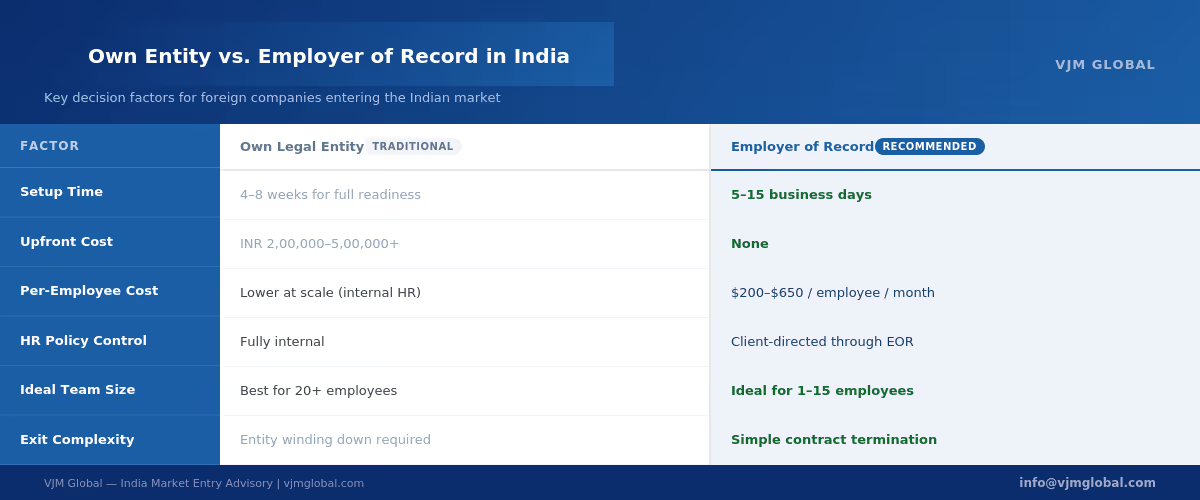
The decision depends on headcount, timeline, and long-term market commitment.
Factor
Own Entity
EOR
Setup time
4–8 weeks for full readiness
5–15 business days
Upfront cost
INR 2,00,000–5,00,000+
None
Per-employee cost
Lower at scale (internal HR)
$200–$650/month
HR policy control
Fully internal
Client-directed through EOR
Ideal team size
20+ employees
1–15 employees
Exit complexity
Entity winding down required
Simple contract termination
Companies at the exploration or pilot stage — typically hiring one to fifteen employees — generally find an EOR more practical. Once headcount exceeds twenty and the India presence becomes permanent, establishing a wholly owned subsidiary or branch becomes cost-effective.
The process from decision to deployed employee typically runs as follows.
The client defines the role, compensation structure, and start date. The EOR drafts an employment contract compliant with Indian law, covering notice periods, leave entitlements under the Shops and Establishments Act applicable to the state, and any applicable industry-specific requirements.
The EOR registers the employee with EPF and ESI authorities where applicable, sets up payroll on its registered entity, and processes the first payroll cycle. Professional Tax registration and deduction is handled at the state level — the EOR manages this across all states where employees are located.
Ongoing management includes monthly payroll, statutory deductions, annual filings, and any employment law changes affecting the employee's state or industry. Termination processes — whether voluntary or initiated — are managed in compliance with applicable notice requirements and gratuity provisions under the Payment of Gratuity Act 1972.
India's employment compliance framework operates across both central and state jurisdictions. An EOR covering these areas typically handles the following.
Provident Fund contributions are mandatory for employees earning up to INR 15,000 per month in basic wages. Both employer (12%) and employee (12%) contributions are deposited monthly with the EPFO. For employees above the threshold, contributions continue on a voluntary basis or at actual basic pay under agreed structures.
ESI coverage applies to employees earning up to INR 21,000 per month in establishments with ten or more employees in specified industries. Employer contribution is 3.25% and employee contribution is 0.75% of gross wages.
Gratuity becomes payable after five years of continuous service, calculated at 15 days' wages for each completed year. The EOR tracks service duration and accrual for all client employees.
Maternity benefits under the Maternity Benefit Act 1961 provide 26 weeks of paid leave for the first two children and 12 weeks thereafter. Creche facilities are required for establishments with 50 or more employees.
The four Labour Codes — consolidating 44 central labour laws — are being notified at different rates across states. An EOR operating at scale maintains jurisdiction-specific compliance calendars and updates employment contracts and policies as new notifications take effect.
EOR pricing in India is typically structured as a per-employee monthly fee, often tiered by role level and services included. This expense management approach provides predictable costs without capital outlay for entity setup. Market rates generally range from approximately $200–$650 per employee per month in 2025–2026, depending on provider capabilities, employee seniority, and scope of HR services included.
Against this, consider the cost of establishing and maintaining a legal entity in India: incorporation fees, statutory audit requirements under the Companies Act 2013, GST registration and filings, ROC annual compliance, and the overhead of an internal HR and payroll function. For small teams, the EOR fee structure is typically more cost-effective for the first two to three years of India operations.

These three models serve different needs and carry different risk profiles.
An EOR is the legal employer. Employment contracts are between the EOR and the employee. The EOR bears employer-side statutory obligations. This is appropriate for full-time, permanent employees.
A Professional Employer Organisation (PEO) operates on a co-employment model. The client company and the PEO share employer responsibilities. PEO structures are common in the United States but less standardised in India — the EOR model is more prevalent and legally clearer in the Indian context.
Independent contractors provide services under a service agreement, not an employment contract. No EPF, ESI, or statutory employment benefits apply. However, Indian tax and labour authorities have increased scrutiny of contractor relationships that resemble employment in practice — misclassification carries penalties under the Contract Labour (Regulation and Abolition) Act 1970 and Income Tax Act 1961. Where the engagement resembles employment, an EOR arrangement is significantly lower risk.
Employee data processed by an EOR — payroll records, tax filings, benefit enrolments — is subject to India's Information Technology Act 2000 and the Digital Personal Data Protection Act 2023 (DPDPA), which received Presidential assent in August 2023. Rules under DPDPA are being progressively notified.
When evaluating an EOR, confirm data residency policies, breach notification procedures, and whether the provider holds relevant certifications such as ISO 27001 for information security management. Payroll and employment records must be retained for the periods specified under the applicable labour laws — typically between three and seven years depending on the record type.

Is using an EOR in India legally recognised? Yes. An EOR functions as the registered employer under Indian law. Employment contracts, statutory registrations, and payroll are all compliant. The commercial arrangement between the EOR and client company is typically documented in a service agreement.
Can an EOR hire employees across all Indian states? A properly established EOR maintains registrations across states and can hire in any location. State-specific compliance — Professional Tax, Shops and Establishments Act requirements, and state-level notifications under the Labour Codes — is managed by the EOR.
Does using an EOR create a Permanent Establishment risk? This is a material consideration. If employees carry out core business activities, negotiate contracts, or otherwise act as agents of the foreign company in India, Permanent Establishment exposure under the Income Tax Act 1961 and applicable Double Taxation Avoidance Agreements may arise. EOR arrangements are generally designed to avoid PE risk, but the specifics depend on employee roles and the nature of activities. Tax advice should be obtained before deployment.
What is the minimum headcount for an EOR to be practical? An EOR is most cost-effective for one to fifteen employees. Above twenty, establishing a legal entity typically becomes more economical. Some providers have no minimum — single-employee engagements are feasible.
How long does onboarding through an EOR take? Employment can typically begin within five to fifteen business days from agreement, assuming documentation is complete and the employee has cleared background verification where required.
What happens if we want to transition to our own entity later? Most EOR agreements include a transition clause. Employees can be novated from the EOR to the client's Indian entity once incorporated. The EOR and client manage the transition to avoid breaks in employment that could affect gratuity and other entitlements.