GST registration for contractors covers the mandatory tax compliance process for civil, works, and construction contractors executing "works contract" services under Section 2(119) of the CGST Act. This matters enormously for contractors bidding on government and PSU tenders, running multi-state projects, or moving materials and manpower across state lines. Incorrect registration decisions here can block Input Tax Credit or invite penalties.
This guide breaks down what GST registration actually means for contractors, why it's mandatory, the exact registration process, and the state-wise rules most contractors get wrong.
Key Takeaways
- Registration triggers at Rs. 20 lakh turnover, or Rs. 10 lakh in Manipur, Mizoram, Nagaland, and Tripura
- A works contract counts as a service supply, so registration follows your supplier location, not the project site
- Working in another state doesn't need new registration unless you create a genuine fixed establishment there
- Casual Taxable Person registration suits short projects up to 180 days with no fixed establishment
- Professional guidance avoids both non-compliance risk and unneeded multi-state registration costs
What Is GST Registration for Contractors?
Under Section 2(119) of the CGST Act, a works contract means a contract for building, construction, fabrication, erection, installation, fitting out, repair, maintenance, renovation, or alteration of immovable property, where transfer of property in goods is involved in executing that contract.
Fabrication work on machinery or other movable property doesn't qualify as a works contract under this definition, even though it feels similar on the ground.
Why Classification as "Service" Matters
Para 6(a) of Schedule II to the CGST Act treats works contract purely as a supply of service. This single classification decision shapes everything downstream:
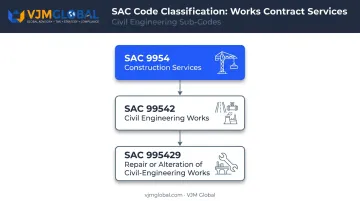
- The correct SAC (Services Accounting Code) is 9954, covering construction services, not an HSN goods code
- Sub-heading 99542 applies to civil-engineering works like roads, pipelines, and power plants
- Repair or alteration of civil-engineering works falls under 995429
Location of Supplier, Not Project Site
Registration location is determined by Section 2(71), the "location of supplier of services" — meaning your registered place of business, or a fixed establishment most directly concerned with the supply. This is entirely different from "place of supply," which only decides whether CGST/SGST or IGST applies on an invoice.
This distinction trips up most contractors: they conflate where the site is with where they must register. The two questions have separate legal answers, and getting it right matters regardless of the size or type of contracting work involved.
Who this applies to:
- Civil and construction contractors
- Government works contractors
- EPC (Engineering, Procurement, Construction) contractors
- Sub-contractors, whose obligations can vary slightly depending on contract structure
Why GST Registration Is Mandatory for Contractors in India
Two provisions of the CGST Act govern the registration trigger for contractors.
Section 22 sets the aggregate turnover threshold at Rs. 20 lakh (Rs. 10 lakh in the special category states of Manipur, Mizoram, Nagaland, and Tripura). Once you cross this in a financial year, registration becomes compulsory in the state from which you supply.
Section 24 lists compulsory registration triggers regardless of turnover, including inter-state taxable supply.
But there's a nuance contractors often miss: Notification 10/2017-Integrated Tax exempts small inter-state service suppliers from mandatory registration as long as their turnover stays under the Section 22 threshold.
Since works contract is a service, a contractor billing modest inter-state service value below Rs. 20 lakh isn't automatically forced to register, unlike inter-state goods movement, which does trigger registration irrespective of turnover.
The Scale of Compliance Need
India's construction sector isn't a niche compliance concern. Construction GVA grew 9.4% in real terms in FY 2024-25, with a sharper 10.8% expansion in Q4 alone, according to provisional estimates from the Ministry of Statistics and Programme Implementation. That growth translates directly into thousands of contractors navigating registration decisions every quarter.
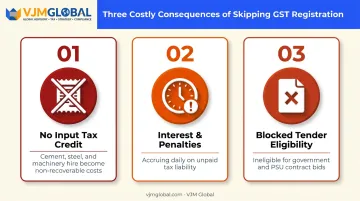
What Non-Registration Actually Costs
Staying unregistered when you're obligated to register carries direct financial consequences:
- No Input Tax Credit on cement, steel, machinery hire, or sub-contracted services under Section 16
- Interest and penalties on unpaid tax liability
- Blocked eligibility for most government and PSU tender or empanelment processes, which routinely require a valid GSTIN as a bid condition
Registration also solved a genuine old problem. Under the pre-GST VAT regime, Central Sales Tax on inter-state stock transfers for PAN-India projects wasn't creditable, inflating project costs. GST registration now enables continuous ITC flow across state boundaries for the same contractor.
Firms like VJM Global work through this turnover-versus-location assessment with contractor clients regularly, since getting it wrong in either direction (registering too little or too much) creates avoidable cost.
How to Register for GST as a Contractor: Step-by-Step Process
Registration happens entirely online through the GST portal (gst.gov.in), using PAN, Aadhaar-based authentication, and details of your principal place of business. Note upfront: composition scheme is not available for works contract services. Contractors register as regular taxpayers, or as a Casual Taxable Person for short-term, single-state projects.
Documents you'll need:
- Sample work order or contract copy
- Proof of principal place of business
- Professional or trade licence
- Bank account details
- Authorisation letters (for partnerships or companies)
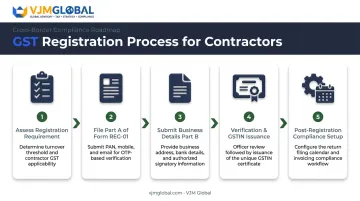
Step 1: Assess Registration Requirement and Category
Evaluate three things before filing anything: your aggregate turnover, whether you're making inter-state supplies, and how long the project will run. This determines whether you need regular registration or the more limited Casual Taxable Person route.
Step 2: File Part A of Form REG-01
Enter your legal name as per PAN, PAN number, mobile number, and email address. The system verifies PAN and OTP-authenticates your mobile and email. Successful verification generates a Temporary Reference Number (TRN), which you'll use for everything that follows.
Step 3: Submit Business and Project Details (Part B)
Using the TRN, complete details on business constitution, promoters, authorised signatory, principal and additional places of business, and bank account information. Contractors should attach works-contract-specific supporting documents here, such as the sample work order.
Step 4: Verification and GSTIN Issuance
Once submitted, your application moves through a defined verification timeline:
- Standard approval takes 7 working days under Rule 9 when documents check out
- Applications without Aadhaar authentication, or those flagged for physical verification, can take up to 30 working days
- Deficiencies get raised via Form REG-03; you respond through REG-04 within 7 working days
- Once approved, your registration certificate is issued electronically in Form REG-06
Step 5: Set Up Post-Registration Compliance
Registration triggers a fresh set of compliance obligations. Set up:
- Configure invoicing with the correct SAC 9954 codes and sub-headings
- Set up delivery challan and e-way bill formats for machinery and material movement to project sites
- Establish a filing calendar for periodic GSTR-1 and GSTR-3B returns
Contractors juggling multi-state projects or unfamiliar with SAC coding often hand this ongoing filing to specialists; VJM Global's GST compliance team manages registration, returns, and e-way bill documentation for contractors operating across India.
GST Registration Rules for Multi-State Contractors & Common Misconceptions
Here's where most contractors go wrong, and it costs them either unnecessary compliance or genuine legal exposure.
The Fixed Establishment Test
The most common misconception: a project outside your home state automatically demands a new GST registration there. It doesn't. The real test is Section 2(50), the "fixed establishment" definition: a place with a sufficient degree of permanence and suitable structure of human and technical resources to supply or receive services.
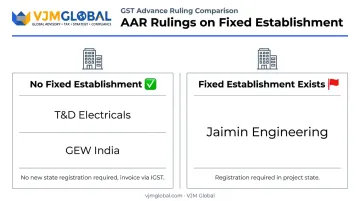
Karnataka's Authority for Advance Ruling addressed this directly. In the T&D Electricals ruling, a Rajasthan-registered contractor executing work at a Karnataka project site was found not to need separate Karnataka registration, since no fixed establishment existed there, and the contractor invoiced from Rajasthan using IGST.
Karnataka's AAR reached a similar conclusion in the GEW (India) matter involving a Noida-registered contractor performing structural erection work in Karwar.
Contrast this with the Rajasthan AAR's Jaimin Engineering ruling, where a Gujarat-based contractor was found liable to register in Rajasthan, because the facts showed an actual office or fixed establishment set up there, not merely a temporary site presence.
A fresh registration genuinely is required once you establish a branch office, warehouse, or permanent site office with staff and infrastructure, and that establishment (not just a temporary site shed) becomes the place most directly concerned with the supply.
Place of Supply vs. Location of Registration
These are two different legal questions, and contractors conflate them constantly:
| Concept | Governing Section | Determines |
|---|---|---|
| Place of supply | Section 12(3)(a), IGST Act | Location of the immovable property; controls CGST/SGST vs. IGST |
| Location of registration | Section 22, CGST Act | Where you must actually hold a GSTIN |
A project's physical location decides your tax type on the invoice. It does not, by itself, decide where you must register.
Moving Machinery and Materials to Site
Registration and invoicing settled, one more compliance question often trips up contractors: moving equipment and materials across state lines to the job site.
Own-use transfers of equipment or materials to a project site aren't a taxable supply, so they move under a delivery challan (Rule 55), not a tax invoice. Once consignment value exceeds ₹50,000, an e-way bill is also required under Rule 138, regardless of whether ownership changes hands.
For projects under 180 days without a fixed establishment, the Casual Taxable Person registration remains the cleaner alternative to setting up full state registration, though it's unsuitable once a contract extends beyond that window.
Conclusion
GST registration for contractors comes down to two things: your aggregate turnover, and the location of your supplier, not the location of every project site you touch. Confusing "place of supply" with "location of registration" is the single most expensive mistake contractors make when bidding pan-India work.
Correctly identifying a genuine fixed establishment versus a temporary site presence saves real money and effort across multi-state projects. Getting this classification right affects ITC eligibility, tender qualification, and penalty exposure. It's worth having experienced professionals like VJM Global review your specific contract structure before you file, especially if you're a foreign entity or NRI-run contracting business entering the Indian construction market.
Frequently Asked Questions
Do contractors need to pay GST in India?
Yes. Once registered, contractors providing works contract services must charge and remit GST, since works contract is treated as a taxable supply of service under the CGST Act.
What is a GST registered contractor?
A GST registered contractor holds a valid GSTIN, authorising them to charge GST, issue tax invoices, and claim Input Tax Credit on works contract supplies.
Is GST registration mandatory for civil contractors?
Registration becomes mandatory once aggregate turnover crosses Rs. 20 lakh (Rs. 10 lakh in specified states), or if the contractor makes inter-state supplies exceeding the exempted threshold.
What is the GST rate applicable on works contract services?
Works contract services generally attract 18% GST. Some government and affordable housing projects still qualify for concessional rates, though these narrowed after 18 July 2022. Always verify the current rate for your specific contract.
Can a contractor operate in multiple states using a single GST registration?
Yes, a contractor can execute projects across multiple states from one registration, provided they don't set up a genuine fixed establishment in another state.
What is the turnover limit for GST registration for contractors?
The threshold is Rs. 20 lakh (Rs. 10 lakh in Manipur, Mizoram, Nagaland, and Tripura). Inter-state service suppliers below this threshold may remain exempt from compulsory registration under Notification 10/2017-Integrated Tax.