More entrepreneurs are entering this market today not despite the regulations, but because of them. Singapore's licensing system creates a predictable pathway: explicit license categories, published fees, mandatory training requirements, and transparent inspection frameworks. The business formats range from low-capital home-based operations (currently requiring no SFA license) to full-service restaurants, allowing entrepreneurs to choose an entry point that matches their financial commitment and operational capacity.
This guide walks through the exact licenses needed, realistic startup costs, mandatory compliance requirements, and the step-by-step process to launch a food business in Singapore — from ACRA registration through to receiving your first SFA operating license.
Key Takeaways
- Register with ACRA, obtain the correct SFA license (Food Shop or Food Stall), and ensure all food handlers complete the WSQ Food Safety Course Level 1
- Business format (restaurant, hawker stall, home-based, or catering) determines which licenses apply and what they cost
- A Food Shop License costs S$195/year; a Food Stall License costs S$32–S$64/year; home-based food businesses currently don't need an SFA license
- Foreigners can start a food business but must appoint at least one Singapore-resident director when incorporating
- Plan for 4–8 weeks from initial registration to first operating license, depending on format and inspection completion speed
Types of Food Businesses You Can Start in Singapore
Singapore's food business landscape covers a broad range of operational models, each with distinct regulatory requirements. "Food business" includes dine-in restaurants, food courts, hawker stalls, home-based baking operations, catering services, food manufacturing units, and online food sellers.
Main Food Business Formats in Singapore:
| Format | SFA License Required | Typical Scale | Key Characteristics |
|---|---|---|---|
| Restaurant/Food Shop | Yes (Food Shop License) | Full commercial kitchen | Fixed premises, dine-in/takeaway, full menu |
| Hawker/Food Stall | Yes (Food Stall License) | Individual stall in licensed premises | Operates within coffee shop, food court, or hawker centre |
| Home-Based | No | Small-scale, direct-to-consumer | Cannot sell to licensed establishments or at fairs |
| Catering | Yes (Food Shop License) | Commercial kitchen required | Must appoint Food Hygiene Officer, stricter FSMS requirements |
| Food Manufacturing | Yes (Food Manufacturing License) | Factory/processing facility | Subject to additional GMP and safety controls |
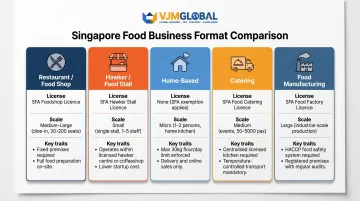
Your choice directly impacts business structure, startup costs, licensing obligations, and scalability. Each format comes with real trade-offs:
- Home-based: Low startup capital, but cannot supply restaurants or sell at fairs
- Hawker stall: License costs just S$32/year, but must operate within an existing licensed food shop
- Restaurant: Higher setup costs and stricter compliance, but full operational flexibility
Locking in your format early makes every subsequent step — from choosing a premises to applying for licenses — significantly more straightforward.
Licenses and Permits Required to Start a Food Business in Singapore
Singapore's food business licensing is governed primarily by the Singapore Food Agency (SFA). Most food businesses operating from fixed or mobile premises must hold a valid SFA license before serving customers. Operating without the required license carries enforcement risk — including fines, suspension, and forced closure under the Environmental Public Health Act.
Food Shop License
The Food Shop License is the primary permit for restaurants, bakeries, coffee shops, food courts, canteens, eating houses, takeaway kiosks, and mobile food wagons. It covers the entire premises (not individual stalls within).
Key Details:
- Cost: S$195 per year
- Application: Via GoBusiness portal (requires SingPass for individuals, CorpPass for companies)
- Validity: 1 year, renewable annually
- Inspection: Mandatory SFA inspection before license issuance
- Payment deadline: Within 28 days of inspection; applications cancelled if documents not submitted within 2 months
Required Documents:
- Layout plan showing kitchen equipment, sinks, wash basins, exhaust systems, and refreshment area boundaries (must include metric scale)
- URA Change of Use approval or HDB approval confirming premises can be used for food retail
- Tenancy agreement with Certificate of Stamp Duty from IRAS
- Cleaning programme
- Pest control contract
Food Stall License
The Food Stall License applies to individual stalls operating inside an existing Food Shop — for example, a single stall in a food court or coffee shop. The broader premises must already hold a Food Shop License.
Key Details:
- Cost: S$32/year or S$64/2 years
- Reduced rate: S$13/year for hawker stalls and canteen stalls in primary/secondary schools and junior colleges
- Application: Via GoBusiness portal
- Required Documents: Tenancy/lease agreement, Certificate of Stamp Duty from IRAS, layout plan showing stall location within premises
Note: Hawker stalls within NEA-managed centres follow a different process — NEA assists with SFA license applications as part of the tenancy process.
Additional Permits Based on Business Type
Beyond your core SFA license, several supplementary permits may apply depending on what you serve, sell, or store:
Halal Certification (MUIS)
- Applies to establishments serving Muslim-compliant food and beverages
- Fee structure: Two-stage payment (100% Application Fee + 40% Certification Fee at Stage 1; 60% Certification Fee at Stage 2)
- Specific staffing and ingredient sourcing requirements apply
- Fee schedule available from MUIS
Liquor License (Singapore Police Force)
- Needed if your venue sells alcohol — either on-premises consumption or retail takeaway
- Cost: S$110–S$880 annually depending on class and trading hours
- Class 1A (all liquor, 0600-2359 hours): S$880/year
- Class 3A (retail, off-premises): S$110/year
Public Entertainment License
- Covers live music, performances, and other scheduled entertainment activities at your venue
- Applied through GoBusiness portal
Petroleum/Flammable Materials License (SCDF)
- Required if storing more than 200kg of LPG for restaurants, or more than 30kg per stall (with a total premises limit of 200kg) for eating places
- Most small F&B operations fall within exemption limits
- License fees (if threshold exceeded): S$212 for up to 50kg; S$276 for 51-5,000kg
Trader's License (SFA)
- Required if importing meat, seafood, fresh fruits/vegetables, or shell eggs
- Separate licenses for different product categories
- All valid for 1 year; Cargo Clearance Permit (CCP) mandatory for every consignment
Home-Based Food Business Rules
Home-based food businesses currently do not require an SFA license to operate, but must comply with all food safety laws and several strict restrictions:
Restrictions:
- Selling to SFA-licensed establishments (restaurants, hawker stalls, coffee shops, cafes, canteens) is not permitted
- Food prepared at home cannot be sold at temporary fairs, even with a temporary fair stall license
- Ready-to-eat raw seafood is off the menu entirely
- HDB/URA Home-Based Business Scheme rules apply and must be followed
Requirements:
- Ingredients must be legally sourced from licensed manufacturers or importers only
- Full compliance with food safety standards applies (temperature control, hygiene, storage)
If your home-based operation grows to the point where you want to supply cafes, join pop-up events, or scale volume, you'll need to move to a licensed commercial kitchen before doing so — not after.
How to Start a Food Business in Singapore: Step by Step
The food business setup process involves three parallel tracks: business registration, premises setup, and licensing. Rushing any step or submitting incomplete documents delays approvals and incurs additional application fees.
Step 1 – Register Your Business Entity with ACRA
Before applying for any SFA license, you must register your business structure with the Accounting and Corporate Regulatory Authority (ACRA).
Business Structure Options:
| Structure | Name Application | Registration Fee | Total | Processing Time |
|---|---|---|---|---|
| Sole Proprietorship/Partnership | S$15 | S$100 | S$115 | Same day to 1-3 business days |
| Private Limited Company (Pte Ltd) | S$15 | S$300 | S$315 | Same day to 1-3 business days |
Why Choose Pte Ltd:
- Preferred structure for scalability and access to government grants
- Limited liability protection
- Easier to bring on investors or partners
- Required structure for most foreign entrepreneurs
Foreign Entrepreneur Requirements:
- Must appoint at least one Singapore-resident director (Singapore Citizen, Permanent Resident, or holder of Employment Pass/EntrePass)
- Total incorporation cost for foreigners: S$300–S$1,200 depending on entity type and additional nominee director or corporate secretarial services
Foreign entrepreneurs unfamiliar with Singapore's corporate framework should consider engaging a professional business setup firm to handle ACRA structuring, corporate secretarial obligations, and ongoing compliance requirements.
Step 2 – Secure a Location and Obtain Premises Approvals
Location selection directly impacts both regulatory approval and business viability.
Critical Location Requirements:
- Premises must be approved for food business use
- Obtain URA Change of Use or HDB approval confirming the premises can be used for food retail — this is a mandatory document for SFA Food Shop License applications
- Tenancy agreement with IRAS stamp duty is required for license application
Location Factors to Assess:
- Foot traffic and visibility
- Kitchen size and layout (must meet SFA requirements)
- Proximity to competition
- Lease terms and security deposit requirements (typically 2-3 months' rent)
- Access to utilities and ventilation systems
Do not sign a tenancy agreement until you confirm the premises can receive URA/HDB approval for food retail use.
Step 3 – Apply for Your SFA License and Food Permits
Once you have your ACRA registration and premises approval, apply for your SFA license through the GoBusiness portal.
Application Requirements:
- UEN (Unique Entity Number from ACRA registration)
- SingPass (individuals) or CorpPass (companies)
- Tenancy agreement with Certificate of Stamp Duty from IRAS
- Layout plan with metric scale
- Food handler certifications (WSQ FSC Level 1 for all food handlers)
- Pest control contract
- Any supplementary permits (Halal, Liquor, etc.)
Inspection and Approval:
- SFA conducts a pre-licensing inspection of your premises
- Payment must be made within 28 days of inspection
- If documents are not submitted within 2 months, application is cancelled
- Typical processing timeline: 4-8 weeks depending on application completeness and inspection scheduling
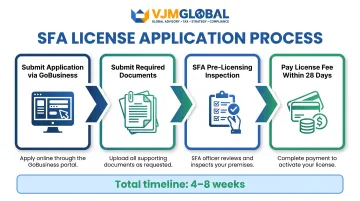
Critical: Submit complete, accurate documents the first time — incomplete applications are rejected, requiring re-application and adding weeks to your timeline.
Step 4 – Complete Mandatory Food Handler Training
Food handler certification appears as a document requirement in Step 3 — here's what that involves and how to plan for it. All food handlers must complete the WSQ Food Safety Course (FSC) Level 1 before operations begin.
WSQ FSC Level 1 Requirements:
- Mandatory for all food handlers in SFA-licensed retail and non-retail establishments
- Certificate valid for 5 years
- First retraining within 5 years; subsequent retraining every 10 years
- Course fee: Approximately S$150-S$160 before subsidies; with SkillsFuture funding, learners typically pay S$45-S$80
- Delivered by SFA-approved training providers
Food Hygiene Officer (FHO) Requirements: Certain establishments must appoint a Food Hygiene Officer:
- Category 1 establishments (kitchen 16 sqm or more, including food caterers, restaurants with catering, food manufacturers): Must appoint an Advanced FHO (WSQ FSC Level 4)
- Canteens and cold stores: Must appoint an FHO (WSQ FSC Level 3)
- FHOs must be supervisory personnel (chef, sous chef, restaurant manager, operations manager)
Step 5 – Set Up Operations and Prepare for Launch
Before opening, complete these operational setup steps:
Kitchen Equipment and Fit-Out:
- Prioritize quality for high-use items (refrigeration, cooking equipment, exhaust systems)
- Consider second-hand equipment for lower-priority items
- Ensure equipment meets SFA inspection standards
Employer Obligations:
- Register as an employer with CPF if hiring Singapore Citizens or PRs earning more than S$50/month
- Implement payroll systems to ensure compliance with CPF contribution requirements
Supplier Relationships:
- Establish relationships with licensed suppliers for all ingredients
- Home-based businesses: ingredients must be legally sourced from licensed manufacturers or importers only
- Maintain records of all ingredient sources (required for SFA compliance)
Standard Operating Procedures (SOPs):
- Create written SOPs for food prep, storage, hygiene, and temperature control
- Train all staff on SOPs before launch
- Document cleaning schedules and pest control protocols
One financial compliance item sits outside daily operations but shouldn't be overlooked as you grow.
GST Registration (if applicable):
- Businesses must register for GST if projected annual turnover exceeds S$1 million
- Most early-stage food businesses will be below this threshold initially
How Much Does It Cost to Start a Food Business in Singapore?
Startup costs vary significantly by business format and location. First-time operators often underestimate total costs by focusing on license fees alone — fit-out, equipment, deposits, and working capital add up fast.
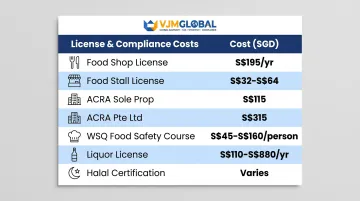
License and Compliance Costs
| Item | Cost | Notes |
|---|---|---|
| Food Shop License | S$195/year | Restaurants, cafes, bakeries, takeaway kiosks |
| Food Stall License | S$32–S$64 | Individual stalls within licensed premises |
| ACRA Registration (Sole Prop) | S$115 | One-time |
| ACRA Registration (Pte Ltd) | S$315 | One-time; foreigners may pay S$300–S$1,200 depending on services |
| WSQ Food Safety Course Level 1 | S$45–S$160/person | Depends on subsidy eligibility; all food handlers must complete |
| Liquor License (if applicable) | S$110–S$880/year | Varies by class and trading hours |
| Halal Certification (if applicable) | Varies | Two-stage payment; see MUIS fee schedule |
Total Startup Costs by Format
Home-Based Food Business:
- Minimal startup costs beyond ingredients, packaging, and basic equipment
- No SFA license required
- Estimated range: Under S$5,000 for most operators
Hawker Stall:
- Setup costs typically range from S$10,000–S$50,000 depending on equipment, renovation, and location
- NEA's Incubation Stall Programme cuts rent by 50% for the first 6 months and provides pre-fitted stalls (shelves, worktops, fridges, sinks) — a practical option for first-time hawkers
- Lower-end estimate for a basic setup: approximately S$8,000 (cited by The Straits Times, 2018)
Café or Restaurant:
- Startup costs range from S$50,000 to several hundred thousand dollars depending on:
- Location and rental costs
- Renovation and kitchen fit-out
- Equipment quality and scale
- Interior design and branding
- Rental now constitutes approximately 17% of total business costs in 2024 (down from 26% in 2019), but absolute rent values remain significant
Commonly Overlooked Costs
Budget for these items before signing any lease or submitting your license application:
- Security deposit: Typically 2–3 months' rent, paid upfront before taking possession
- Renovation and kitchen fit-out: Includes exhaust systems, ventilation, flooring, and lighting — can exceed equipment costs in prime locations
- Pest control contract: Mandatory for SFA Food Shop License applications; expect ongoing monthly or quarterly fees
- Marketing and branding: Food photography, menu design, signage, and initial social media advertising
- Working capital buffer: Set aside 2–3 months of operating expenses (rent, utilities, salaries, ingredients) to cover the ramp-up period before revenue stabilizes
Food Safety Rules Every Singapore Food Business Must Follow
Food safety compliance in Singapore is governed by the Sale of Food Act 1973 and the Environmental Public Health (Food Hygiene) Regulations, both enforced by the Singapore Food Agency (SFA). Licensed food businesses are subject to regular inspections under the Safety Assurance for Food Establishments (SAFE) framework, which uses a demerit point system — repeated violations can result in license suspension or revocation.
The SAFE framework determines how your establishment is graded and what compliance obligations apply to you.
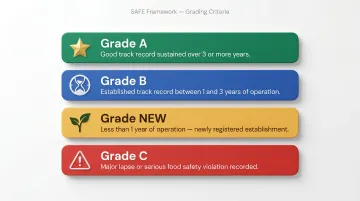
SAFE Framework (Launched January 2026)
The SAFE framework replaced Singapore's previous grading system with a track-record-based approach:
Grades:
- Grade A: Good track record (more than 3 years)
- Grade B: Track record of 1–3 years
- Grade NEW: Less than 1 year of operation
- Grade C: Major lapse — immediate downgrade for serious violations or court convictions
Category 1 Establishments (kitchen 16 sqm or more — food caterers, restaurants with catering, food manufacturers):
- Must appoint an Advanced Food Hygiene Officer (WSQ FSC Level 4)
- Must implement a Food Safety Management System (FSMS) to maintain or achieve Grade A
- Accepted FSMS standards include SS444, SS590, ISO 22000, FSSC 22000, BRCGS, or non-certified systems developed in accordance with SS590