Interest is coming from a specific group: UK e-commerce sellers expanding into US fulfilment, consultants billing American clients, manufacturers eyeing Midwest logistics, and SMEs already exporting to the US who want a formal presence rather than an ad hoc arrangement.
This guide walks through the practical steps — costs, registration, tax registrations, banking — and what you still need to plan once the entity exists.
Key Takeaways
- Missouri LLCs require no mandatory annual report, unlike most US states
- UK citizens can form a Missouri entity remotely: no visa or US residency needed
- Formation itself costs from $105 (LLC, paper filing), plus registered agent and EIN costs
- A visa is required only if you relocate to run the business on the ground in the US
- Coordinating entity, EIN, banking and tax across two countries is where most founders stall
What Does Starting a Business in Missouri Involve?
Starting a business in Missouri from the UK means forming a legal US entity — an LLC or corporation — registered with the Missouri Secretary of State. You can stay a UK resident throughout; nothing about the process requires you to move.
Most UK founders pick one of two structures:
- LLC: Pass-through taxation and a light compliance burden
- Corporation (C-Corp): The usual choice if you plan to raise US venture capital
Ownership and management can be entirely non-resident. The one non-negotiable requirement is a Missouri-based registered agent with a physical street address in the state.
Why Missouri Works for UK Entrepreneurs
Missouri's appeal comes down to three practical factors:
- Low, flat corporate tax. The 4% rate applies regardless of income bracket, which is simpler to plan around than tiered systems in other states.
- No LLC annual report. Missouri's Secretary of State explicitly states that LLCs do not have to file annual reports, unlike Delaware where annual franchise tax filings are mandatory.
- Central geography. Missouri's location cuts transit time for multi-state shipping and Midwest logistics compared with coastal alternatives.
That said, Missouri isn't near the top of every ranking. CNBC's 2025 America's Top States for Business study placed Missouri 34th overall, with a Cost of Doing Business score of 209. For founders prioritising low fees and low ongoing compliance over headline rankings, that trade-off still works.
Filing itself is cheap: $105 for LLC Articles of Organization on paper, or $50 online. Both sit well below formation costs in several higher-profile states.
What to Know Before You Start
Before filing anything, set realistic expectations.
- Timeline: Entity formation can be completed within days remotely. Tax registrations, banking, and ongoing compliance take considerably longer.
- Registered agent: Mandatory. You cannot list a UK address. Missouri requires a US-based registered agent, and there is no workaround.
- Immigration: Forming a Missouri entity grants no right to live or work in the US. Visa rules apply separately if you plan to relocate.
- Ongoing obligations: "No annual report" does not mean zero obligations. Sales tax registration, employer registrations, and local licenses can still apply depending on what you sell and where.
How to Start a Business in Missouri from the UK – Step by Step
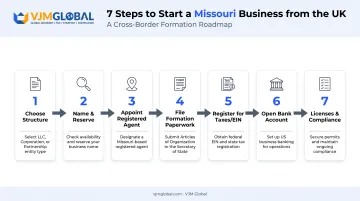
Two mistakes slow UK founders down more than any other: assuming Missouri registration covers nationwide compliance, and delaying registered agent appointment until the last minute.
Step 1 – Choose Your Business Structure
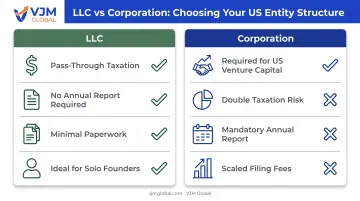
LLC vs. corporation for non-residents comes down to your goals:
- LLC: pass-through taxation, minimal paperwork, ideal for solo founders and small teams
- Corporation: required if you're planning to raise US venture capital
Single-member LLCs are fully permitted for solo UK founders. Choosing a corporation without mapping tax cost is a frequent trap: profits are taxed at the corporate level, then again when distributed as dividends.
Step 2 – Name and Reserve Your Business
Check availability through the Missouri Business Entity database first. If you're not ready to file immediately, reserve the name for 60 days for a $25 fee (extendable, though a name cannot be reserved beyond 180 days total).
If you'll trade under a different name than your registered entity, you'll need a separate DBA (fictitious name) filing.
Step 3 – Appoint a Missouri Registered Agent
A UK address cannot serve as your registered agent. Missouri law requires a physical, in-state address for service of process.
This requirement also works in your favour: using a registered agent's address keeps your personal UK address off the public record.
VJM Global can appoint your Missouri registered agent as part of US entity formation, along with EIN acquisition and Articles preparation, so those pieces sit in one engagement instead of three separate vendors.
Step 4 – File Formation Paperwork
File Articles of Organization (LLC, $105) or Articles of Incorporation (corporation) with the Missouri Secretary of State. Corporation fees scale with authorized capital — $58 total for capital of $30,000 or less, rising incrementally above that.
Draft an operating agreement (LLC) or bylaws (corporation) even though Missouri doesn't legally require either. Banks and business partners will ask for one anyway.
Skip the operating agreement and you weaken the liability protection the LLC is meant to provide.
Step 5 – Register for Taxes and Get an EIN
You'll need an EIN from the IRS as a foreign responsible party — no SSN required. Since you have no US address, you can't use the online application. Instead:
- Phone: call 267-941-1099 (not toll-free), Monday–Friday, 6am–11pm Eastern
- Fax: from outside the US, use 304-707-9471; expect a response in roughly 4 business days
- Mail: allow 4-5 weeks for processing
On Form SS-4, line 7b should read "foreign" or "N/A" if you have no SSN or ITIN and aren't eligible for one.
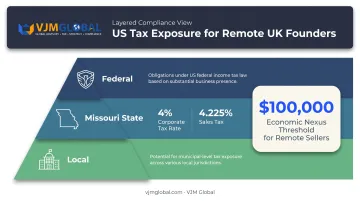
If you're selling tangible goods or taxable services, register for a Missouri sales tax license. The state rate is 4.225%, with local city and county taxes added on top depending on location.
You're stacking three layers of tax exposure: federal, Missouri state, and local. No physical US presence does not automatically mean no state tax nexus. Remote sellers exceeding $100,000 in Missouri sales in a calendar year must collect and remit use tax, regardless of physical presence.
Step 6 – Open a US Business Bank Account
Once you have your EIN and formation documents, fintech platforms generally allow remote account opening. Traditional banks more often require an in-person visit, which isn't practical from the UK.
You'll typically need:
- Certificate of formation
- EIN confirmation letter
- Proof of Missouri registered address
Step 7 – Handle Licenses, Insurance and Compliance
Check whether your industry or city requires additional professional or local licenses — this varies significantly by business type.
Workers' compensation insurance becomes mandatory once you hire 5 or more employees (just 1 employee if you're in construction). Below that threshold, coverage is optional.

One structural difference matters for ongoing cost: corporations must file an annual report in Missouri; LLCs are exempt.
Beyond Registration: What UK Founders Must Still Plan For
Forming a Missouri entity is the easy part. A few things still need attention:
- Visas only matter if you relocate. Running the business hands-on from US soil requires an E-2 or L-1 visa. Managing it remotely from the UK needs neither. USCIS is clear that entity formation itself confers no work authorization.
- UK–US double tax treaty rules apply. Under the treaty’s business-profits article, profits are generally taxable only in the UK unless you create a US permanent establishment. Get that distinction right before you assume the treaty shields you.
- Coordination beats fragmentation. Separate vendors for formation, EIN filing, and UK tax advice leave gaps. VJM Global can run entity formation, EIN application, registered agent service, and multi-jurisdiction tax compliance as one process, so founders avoid that cross-border friction.
Frequently Asked Questions
How much does it cost to start a business in Missouri?
LLC filing costs $50 online or $105 on paper. Corporation fees start at $58 for capital under $30,000. Missouri charges no mandatory annual report or fee for LLCs. Budget also for registered agent fees and an optional $25 name reservation.
How can I start a business in Missouri from the UK?
Choose your entity type, appoint a Missouri registered agent, file with the Secretary of State, get an EIN, and open a bank account. No US visit is required at any stage.
How do I register a foreign business in Missouri?
Foreign qualification applies only if an existing non-Missouri entity wants to operate there. Most new UK founders instead form a fresh Missouri entity from scratch.
Do I have to register my business in Missouri?
Yes, if the business will operate, maintain a physical presence, or generate revenue tied to the state.
What do I need to start a small business in Missouri?
Entity choice, a registered agent, formation filing, an EIN, and any applicable sales tax registration or professional licenses.
How do I register my business name in Missouri?
Search the Missouri Business Entity database, reserve the name for 60 days if needed, and file a fictitious name (DBA) if trading under a different name.