%2520(3).avif)

The 1040EZ tax form served millions of Americans for over three decades - until the IRS pulled it from circulation. Here's what it was, who could use it, and what replaced it.
IRS Form 1040EZ was a simplified federal tax return for basic tax situations, introduced in 1982 and discontinued after tax year 2017. Form 1040EZ was discontinued in 2018.
Taxpayers with simple returns - wages, limited taxable interest, no dependents - now file Form 1040 or Form 1040-SR instead of 1040EZ.
Historical 1040EZ forms for years up to 2017 are still used only to amend old returns or file late for those tax years.
Form 1040 now serves individual taxpayers for both simple and complex situations, while Form 1040-SR is designed for taxpayers aged 65 and older.
VJM Global - USA can help individuals choose the right current tax form and correctly calculate total income, taxable income, and total tax payments.
The Tax Cuts and Jobs Act of 2017 directed the IRS to consolidate individual income tax forms. Starting with tax year 2018, the IRS replaced Forms 1040EZ and 1040-A with a redesigned Form 1040 and later introduced Form 1040-SR for seniors. Form 1040EZ was discontinued after the 2018 tax year - the last valid filing used it for 2017 returns, typically due April 17, 2018.
Taxpayers who still need to file or amend returns for 2017 and prior years may use the original 1040EZ for those years, following IRS instructions for prior-year returns.
Prior-year copies remain available on the IRS website for download.
The change aimed to standardize individual income tax filing while supporting simple returns through a shorter main Form 1040 plus optional schedules.
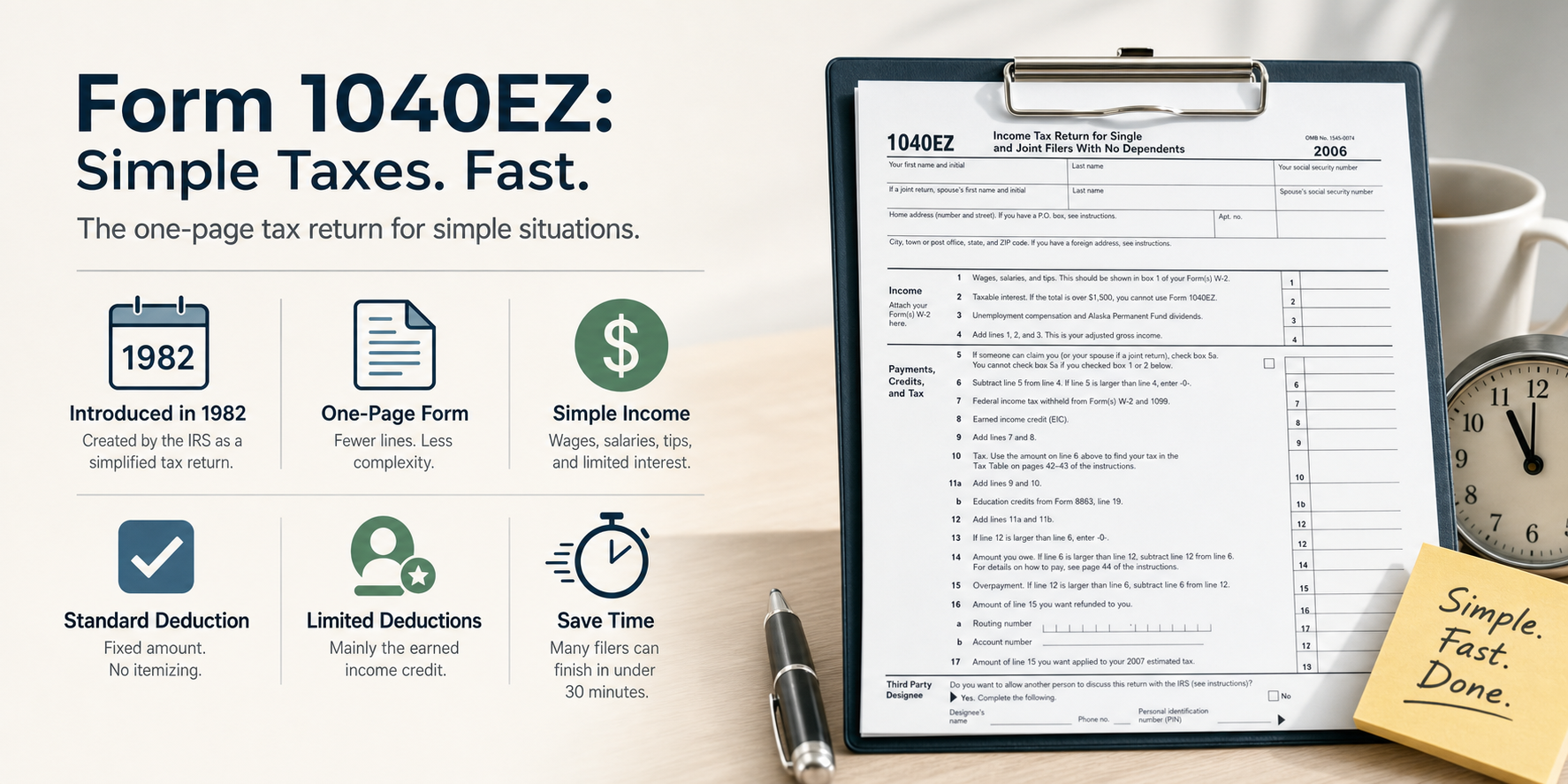
Form 1040EZ - officially titled "Income Tax Return for Single and Joint Filers With No Dependents" - was introduced in 1982. IRS Form 1040EZ was a simplified federal tax return designed for simple tax situations where taxpayers had straightforward total income.
It was a single-page form with fewer lines than standard forms, built for filers whose income came from wages, salaries, tips, and limited interest.
The form used a fixed standard deduction with no option to itemize. Form 1040EZ had limited deductions and credits available - mainly the earned income credit.
Its primary benefit: speed. Fewer lines, fewer calculations, no complex schedules. Many taxpayers with basic tax situations could expect to finish the form in under 30 minutes.
These rules applied only through tax year 2017. After that deadline, no taxpayer can use the 1040EZ for a current filing.
Taxable income had to be less than $100,000. 1040EZ was for taxpayers with income under $100,000, and 1040EZ allowed income reporting up to $100,000.
Taxable interest - from savings accounts, CDs, or similar sources - had to be $1,500 or less for the tax year. Form 1040EZ had a limit of $1,500 in interest income.
Eligibility for Form 1040EZ required filing status as single or married filing jointly. Other statuses (head of household, married filing separately) did not qualify.
1040EZ filers could not claim dependents. Taxpayers could not claim dependents on Form 1040EZ - no children, no qualifying relatives.
Taxpayers using Form 1040EZ had to be under age 65 and not blind, have no foreign earned income or foreign tax credits, and have no alternative minimum tax exposure.
Income sources had to be limited to wages, salaries, tips, taxable scholarships or taxable grants, Alaska Permanent Fund dividends, and unemployment compensation. Income for Form 1040EZ could only come from wages, salaries, and limited interest - other types of income disqualified you.
The 1040EZ accepted only a narrow slice of income types, one standard deduction amount, and a limited set of tax credits.
Total income on the form combined wages, salaries, tips, taxable interest (up to $1,500), certain scholarships, Alaska Permanent Fund dividends, and unemployment compensation into one figure. Taxpayers could claim income only from these sources.
The standard deduction was automatically applied based on filing status. For 2017: $6,350 for single filers, $12,700 for married filing jointly. A personal exemption of $4,050 per person was added. Taxpayers could not itemize deductions on Form 1040EZ - no mortgage interest, state taxes, or medical expenses.
Adjustments to income - student loan interest, IRA deductions, HSA contributions, educator expenses - were unable to be reported on this simplified form.
The main credit allowed was the earned income credit for eligible low- to moderate-income workers, with an optional entry for nontaxable combat pay election. Form 1040EZ had limited income types compared to Form 1040.
Federal tax was calculated using IRS tax tables based on filing status and taxable income. Tax withheld from W-2s plus other total tax payments determined whether filers received a refund or owed a balance.
The 1040EZ was a single-page form. Its layout made it free of the multi-schedule complexity found in other forms.
Top section: Taxpayer and spouse names, address, Social Security numbers, and filing status (single or joint filers only). No entry for dependents. A checkbox for the Presidential Election Campaign Fund.
Income section (Lines 1–4): Line 1 captured wages from your employer via Form W-2. Line 2 was for interest income. Line 3 covered unemployment compensation. Line 4 summed everything into total income - your adjusted gross income.
Tax computation (Lines 5–6): Line 5 applied the standard deduction and personal exemption. Line 6 showed taxable income after that subtraction. Filers used the IRS tax table and their filing status to find the amount of federal tax owed.
Payments and credits (Lines 7–9): Federal income tax withheld from pay, the earned income credit if eligible, and total payments were entered here.
Refund or amount owed (Lines 10–14): The difference between total tax and payments determined the outcome. Filers could submit direct deposit details (routing and account numbers) for a refund, or owe a balance to the IRS by check, money order, or mail. Both the taxpayer and spouse had to sign the return.
The 1040EZ was a short, simplified form suited only for basic situations. Form 1040 has more lines than Form 1040EZ and covers the full range of filing status options, dependents, and complex income types. Form 1040 allows more income types than 1040EZ - dividends, retirement distributions, self-employment, capital gains, Social Security benefits, alimony, and more.
Form 1040 supports both the standard deduction and itemized deductions, plus a broader set of tax credits including child tax credits, education credits, and foreign tax credits.
Form 1040-SR is designed for taxpayers aged 65 and older, featuring larger font, clearer shading, and a built-in standard deduction chart for seniors. It uses the same schedule structure as Form 1040.
There is no 1040EZ for 2024, 2025, or later years. All individual filers now start from Form 1040 or 1040-SR.
Taxpayers who once qualified for the 1040EZ tax form can typically file a short Form 1040 today without extra schedules - if they still have only wages, limited taxable interest, and use the standard deduction.
The mechanics of refunds and balances due on the 1040EZ mirror what taxpayers see on today's Form 1040.
Refunds occurred when total tax payments (withholding plus credits) exceeded the calculated total tax. Filers could choose direct deposit by entering routing and account numbers for a U.S. bank.
If tax exceeded payments, taxpayers had an amount due. They could pay by check, money order, or approved IRS electronic payment options for that tax year.
The IRS required a wet signature for paper-filed returns. Joint filers had to have both the taxpayer and spouse sign for the tax return to be valid. Unsigned returns could delay processing and refunds.
These same principles apply today on Form 1040 and Form 1040-SR, although most returns are now filed electronically and filers sign through e-file providers or software.
The 1040EZ is gone, but the need for accurate, compliant federal tax filing hasn't changed.
VJM Global - USA assists individuals in selecting the correct current tax form (Form 1040 or Form 1040-SR), determining filing status, and deciding between standard deduction and itemized deductions.
Our experienced professionals help clients reconcile wages, interest, dividends, unemployment compensation, and other income sources into accurate total income and taxable income figures - including other types of income the 1040EZ never supported.
We support clients in calculating total tax payments, including federal income tax withheld, estimated payments, and credits such as the earned income credit and other refundable or nonrefundable credits.
Our team can review prior-year filings that used Form 1040EZ, identify missed credits or deduction opportunities, and prepare amendments where appropriate under current IRS rules.
For questions, reach us at [email protected] or visit our New York office at 447 Broadway, 2nd Floor, #2964, New York, NY 10013. We prepare federal tax returns for both simple and complex tax situations - no fees for initial consultations on form selection.
No. The IRS no longer publishes Form 1040EZ for any tax year after 2017. For tax years 2018 through 2025 and beyond, taxpayers must use Form 1040 or Form 1040-SR.
Prior-year 1040EZ forms remain on the IRS website only for filing or amending returns for tax years up to 2017.
Choosing between Form 1040 and Form 1040-SR depends mainly on age - Form 1040-SR is available to those 65 or older - rather than income type alone.
Former 1040EZ filers were typically single and joint filers with no dependents, income under $100,000, and simple wage-based income. These taxpayers now generally file Form 1040 (or Form 1040-SR if age 65 or older) using the standard deduction and reporting wages, limited taxable interest, and unemployment compensation on the main form. If a former 1040EZ filer's tax situation has changed - dependents, investment income, self-employment - they should consider professional advice to make sure the correct schedules and credits are included.
Taxpayers can typically amend a prior-year Form 1040EZ return by filing Form 1040-X within the IRS amendment time limits - usually three years from the original filing date or two years from the date the tax was paid, whichever is later. The amendment may require converting the original 1040EZ data into a full Form 1040 for that tax year, especially when adding new income types or credits. Gather original W-2s, 1099s, records of taxable interest, and any additional documents before preparing an amended return.
Form 1040EZ allowed eligible low- to moderate-income workers to claim the earned income credit directly on the form, based on earned income and filing status, even though they could not claim dependents. Income limits and credit amounts changed each year, and filers used EIC tables from the instructions to find their credit. Today, the EIC is still available on Form 1040 and Form 1040-SR, but eligibility and calculation can be more complex - some taxpayers benefit from professional guidance to make sure they qualify and report correctly.
Prior-year 1040EZ forms and instructions (for example, for tax year 2017) can be downloaded free from the IRS website by searching for "Form 1040-EZ" and selecting the relevant year. Always use the exact form and instruction set that matches the tax year being filed or amended - standard deduction amounts, taxable income brackets, and credit rules differ by year. Filers mailing older-year returns or amendments should verify the correct IRS mailing address, which may differ from current addresses listed for recent-year federal tax forms.