%2520(3).avif)

A corrected Form 1099 arrives in June. A dependent was claimed twice. A student loan interest deduction was missed entirely. Each of these situations calls for IRS Form 1040-X - the official amended U.S. individual income tax return. This article covers who needs to file, the deadline rules, how the form works, and what to expect from the IRS after you submit it.
IRS Form 1040-X is the amended tax return used to fix a previously filed tax return (Form 1040, 1040-SR, or 1040-NR). It is not needed for simple math errors the IRS corrects automatically during processing.
Most taxpayers must file Form 1040-X within three years of the original individual income tax return filing date or two years after paying the federal tax, whichever is later, to claim an additional refund.
Since 2023, many electronically filed amended returns for tax year 2021 and later qualify for direct deposit of refunds, significantly speeding up processing compared with mailed paper forms.
Form 1040-X covers corrections to filing status, income, deductions, credits, and previously missed information such as a Form W-2, Form 1099, or Schedule C submitted after the original tax return was filed.
VJM Global – USA can review whether a 1040-X filing is necessary, estimate any additional refund or balance due, and prepare multi-year amended returns while coordinating with IRS rules and state returns.
Form 1040-X - "Amended U.S. Individual Income Tax Return" - is used to amend a previously filed tax return. It does not replace original returns; it adjusts specific line items on a federal return already submitted as Form 1040, 1040-SR, or 1040-NR.
Common reasons to file Form 1040-X include income corrections and missed deductions: a late Form 1099-NEC for freelance income, discovering eligibility for the American Opportunity Credit or first time homebuyer credit, realizing a dependent was claimed incorrectly, or correcting self employment taxes on Schedule C. Amending can correct errors in filing status or additional deductions that affect tax liability.
Form 1040-X cannot correct simple mathematical errors. The IRS automatically fixes simple mathematical errors on a return during processing and sends a notice if schedules or additional forms are missing. The IRS may request missing documents instead of requiring a 1040-X for omitted forms.
You should file Form 1040-X if you discover an error after your original return has processed. You generally should wait until your original return has been processed before filing the amendment - filing too early can cause processing conflicts.
Form 1040-X is strictly a federal IRS form. It differs from Form 1045 (used for quick refund carrybacks of net operating losses or unused credit amounts) and from state-specific amended forms. The current revision of the form and instructions are available on IRS.gov.
Anyone who has already filed a federal return and later discovers a significant error or omission should evaluate filing Form 1040-X. Concrete scenarios include:
Changing from Single to Head of Household
Adding a missed Schedule A itemized deduction or student loan interest deduction
Correcting self-employment income on Schedule C
Claiming a previously overlooked Child Tax Credit or other credits
Reporting additional income from a corrected W-2 or 1099
If the IRS sends an adjustment notice and the taxpayer disagrees, a 1040-X may be used to formally dispute those adjustments. Amending allows taxpayers to dispute IRS adjustments they disagree with by presenting correct information and supporting documents.
Form 1040-X can also be used to make certain elections after the original deadline, where the Internal Revenue Code permits. Nonresident and dual-status filers using Form 1040-NR may need the form when correcting U.S.-source income, treaty positions, or withholding issues, often in coordination with broader professional tax resolution services for USA businesses. A surviving spouse or executor may file on behalf of a deceased taxpayer to correct a prior tax year federal tax position.
Taxpayers can claim missed credits by filing Form 1040-X - this is one of the most common reasons we see clients amend.
To claim a refund via Form 1040-X, file within three years of the date the original individual income tax return was filed or within two years of the date the federal tax was paid, whichever is later. Taxpayers can file Form 1040-X within three years of the original return - this is the hard deadline most filers face.
Example: For a 2023 Form 1040 submitted on April 15, 2024, the deadline to claim a refund is April 15, 2027. If the original 2023 return was filed on October 15, 2024, after an extension, the three-year window runs to October 15, 2027.
Special situations - bad debt claims, worthless securities under IRC Section 165(g) - may allow longer periods. These require detailed review of IRS instructions and generally professional input.
There is generally no deadline for filing Form 1040-X if the taxpayer owes additional tax, but interest and penalties accrue from the original due date. State filing deadlines for amended state returns can differ from federal rules. Some states require filing within 120 days of the federal amendment. Multi-state filers should coordinate state amended returns with their federal strategy to save money and avoid penalties, and many businesses also rely on specialized sales tax compliance services for USA companies to manage ongoing indirect tax obligations.
Form 1040-X uses a three-column format to report changes:
Column | What It Shows |
|---|---|
A | Amounts from the original return or most recently adjusted return |
B | Net change (increase or decrease) |
C | Corrected amounts (Column A plus or minus Column B) |
Walk through each key section: income, adjustments to income, taxable income, tax, credits, other taxes, federal tax withheld, and refund or balance due. Form 1040-X does not replace original returns - it adjusts the specific line items that changed. |
Form 1040-X requires a detailed description of amendments made. The "Explanation of Changes" section in Part II is critical. Write clear, concise reasons referencing specific schedules - for example, "Correcting Schedule C gross receipts based on revised 1099-NEC totals." Without a complete answer in this section, the IRS may delay processing.
Include a revised Form 1040 with your 1040-X submission when paper-filing. You must attach any new or changed forms to Form 1040-X if your changes affect them - W-2c, corrected 1099, updated Schedule C, or any other affected schedules and documents. You should include supporting documents with Form 1040-X to substantiate changes even when filing electronically, keeping copies in your records for any future IRS review; businesses facing complex documentation requirements often benefit from structured audit preparation services and readiness support.
You can e-file Form 1040-X for tax years 2021 and later through approved software. The IRS allows electronic filing for eligible Forms 1040, 1040-SR, and 1040-NR amendments. Most taxpayers with straightforward corrections can electronically file their amended return after the original Form 1040 has been accepted.
Direct deposit for refunds is available for amended returns filed electronically. This is typically faster than receiving a paper check by mail. The IRS currently allows up to three electronically filed amended returns for the same tax year; additional submissions will be rejected and need to be mailed.
For paper-filed 1040-X forms, use the IRS mailing address listed in the official instructions - it varies by state of residence and whether a payment is enclosed. Use certified mail with return receipt or an IRS-approved private delivery service to document timely filing of the amended tax return.
An amendment can result in either an additional refund or additional tax owed. Filing an amended return can lead to a tax refund when corrections reduce your tax liability - or it can create a balance due if the original return understated income or overclaimed credits.
Direct deposit for refunds on Form 1040-X began in 2023, available for e-filed returns covering tax year 2021 or later. Taxpayers can have any refund deposited directly into a U.S. bank account. Paper-filed amendments still result in a paper check.
When a 1040-X shows additional federal tax due, interest accrues from the original due date. Paying electronically or enclosing a check with a paper filing can reduce the total interest. Amended refunds generally cannot be applied to estimated tax payments for the current year on the 1040-X itself - work with your advisor if you need to adjust estimated payments in response to the amended result.
Keep clear records of all payments and refunds related to each amended return, including IRS notices and account transcripts.
The IRS provides the "Where's My Amended Return?" (WMAR) online tool, typically available about three weeks after the IRS receives your Form 1040-X. The tool shows three status stages: received, adjusted (in process), and completed. For businesses, accurate tracking and documentation of these stages ties closely to broader financial audit and assurance services and overall compliance planning.
Processing of amended returns typically takes 8 to 12 weeks. The IRS can take up to 16 weeks to process Form 1040-X in more complex cases. If the tool shows no update after 16 weeks, contact the IRS by phone with your Social Security number, filing status, and exact refund amount ready.
Multiple amended returns - for example, a 1040-X filed for both tax year 2023 and tax year 2024 - process on different timelines. Large changes like net operating loss carrybacks or significant adjustments to business income can increase the likelihood of IRS scrutiny and document requests.
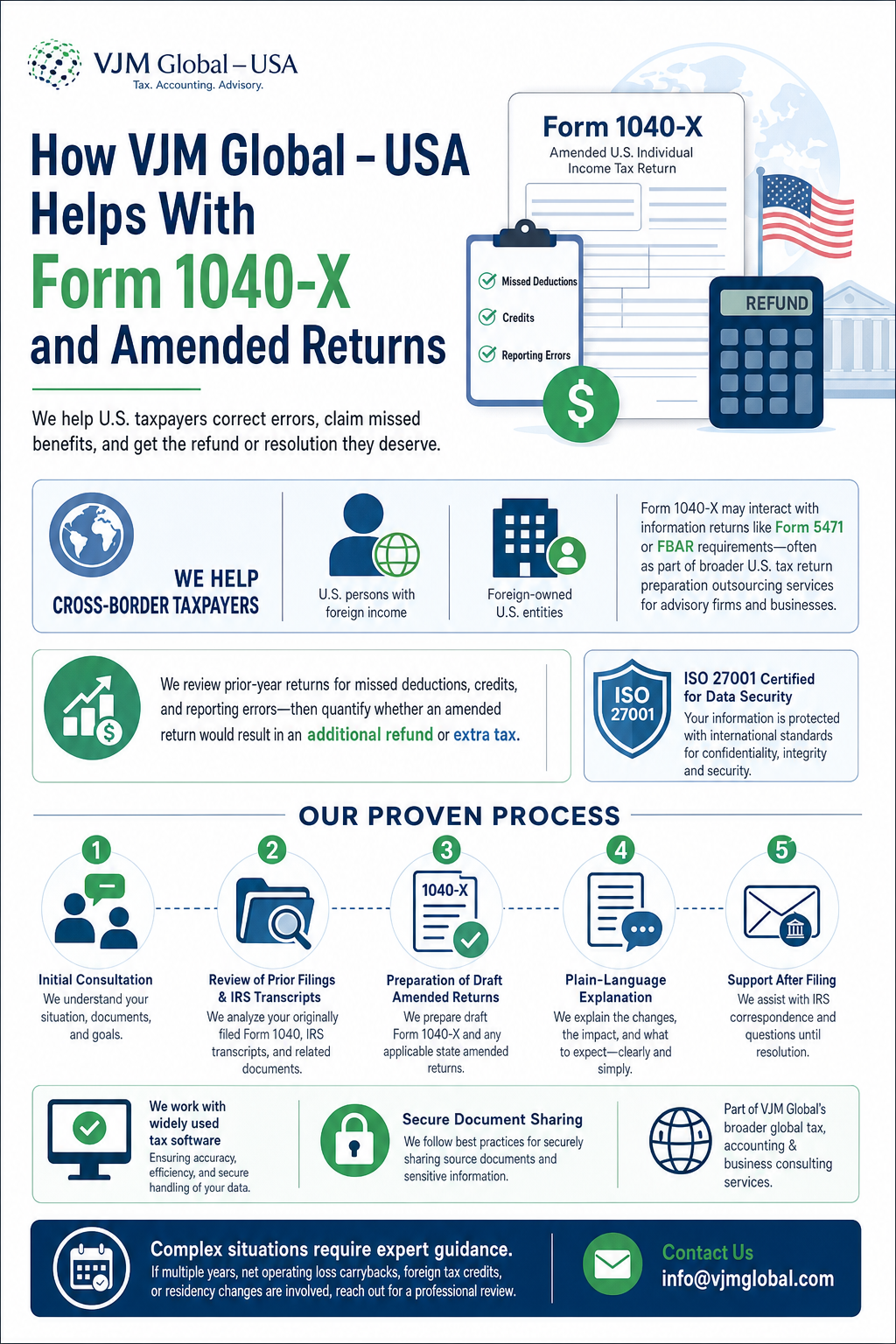
VJM Global – USA routinely handles federal individual income tax returns, Form 1040-X filings, and associated state amended returns. Our U.S. tax specialists review prior-year returns for missed deductions, credits, and reporting errors, then quantify whether an amended return would result in an additional refund or extra tax.
We often assist cross-border taxpayers - U.S. persons with foreign income and foreign-owned U.S. entities where Form 1040-X may interact with information returns like Form 5471 or FBAR requirements, frequently as part of broader U.S. tax return preparation outsourcing services for advisory firms and businesses. Our process: initial consultation, review of the originally filed Form 1040 and IRS transcripts, preparation of draft amended returns with a plain-language explanation of changes, and support with IRS correspondence after filing.
VJM Global – USA maintains ISO 27001 certification for data security and works with widely used tax software, which matters when securely sharing source documents, and these standards are part of VJM Global’s broader global tax, accounting & business consulting services. If multiple years, net operating loss carrybacks, foreign tax credits, or residency changes are involved, reach out at [email protected] for a professional review.
Yes, but you should file a separate Form 1040-X for each tax year you want to change, each with its own attachments and explanation of changes. The IRS processes each year on its own timeline. Coordinated multi-year amendments should be reviewed by a professional to make sure carryforwards, credits, and filing status are treated consistently across years, particularly where prior-year positions intersect with financial reporting and offshore audit services for CPA firms and businesses. This is free of charge to evaluate during an initial consultation with many firms, including VJM Global – USA.
Many states require an amended state income tax return when the federal 1040-X changes adjusted gross income, taxable income, or credits that flow through to the state return. Rules, forms, fees, and deadlines differ by state - check your state department of revenue page or work with an advisor. State tax authorities often receive notice of federal amended returns from the IRS, so ignoring state implications creates risk.
Filing an accurate amended tax return does not automatically trigger an audit. But large changes - especially those generating big refunds - may draw additional IRS attention. Keep thorough documentation: receipts, revised Forms W-2 or 1099, and detailed workpapers. Working with a qualified tax professional helps make sure explanations are clear and positions are consistent with the Internal Revenue Code.
Most free IRS e-file tools are designed for original Forms 1040, and support for amended returns is limited. Taxpayers can download a fillable PDF of Form 1040-X from IRS.gov, complete it manually, and mail it - but follow the instructions carefully. More complex amendments involving business income, rental properties, or foreign tax credits are better handled with professional software and support, and business owners often pair this with expert tax preparation services for LLCs and LLPs in the USA to keep entity-level filings aligned.
If the statute of limitations has passed, you generally cannot receive additional money back, even if the original federal tax return overstated the tax due. It can still be worth correcting a return for record-keeping or to align with future-year positions, especially when integrated with ongoing remote accounting and bookkeeping services, but the financial benefit may be limited. Consult a professional to review whether exceptions - such as bad-debt or worthless-security provisions - apply to your specific facts, ideally one with experience in broader global tax, accounting & business consulting services.