%2520(3).avif)
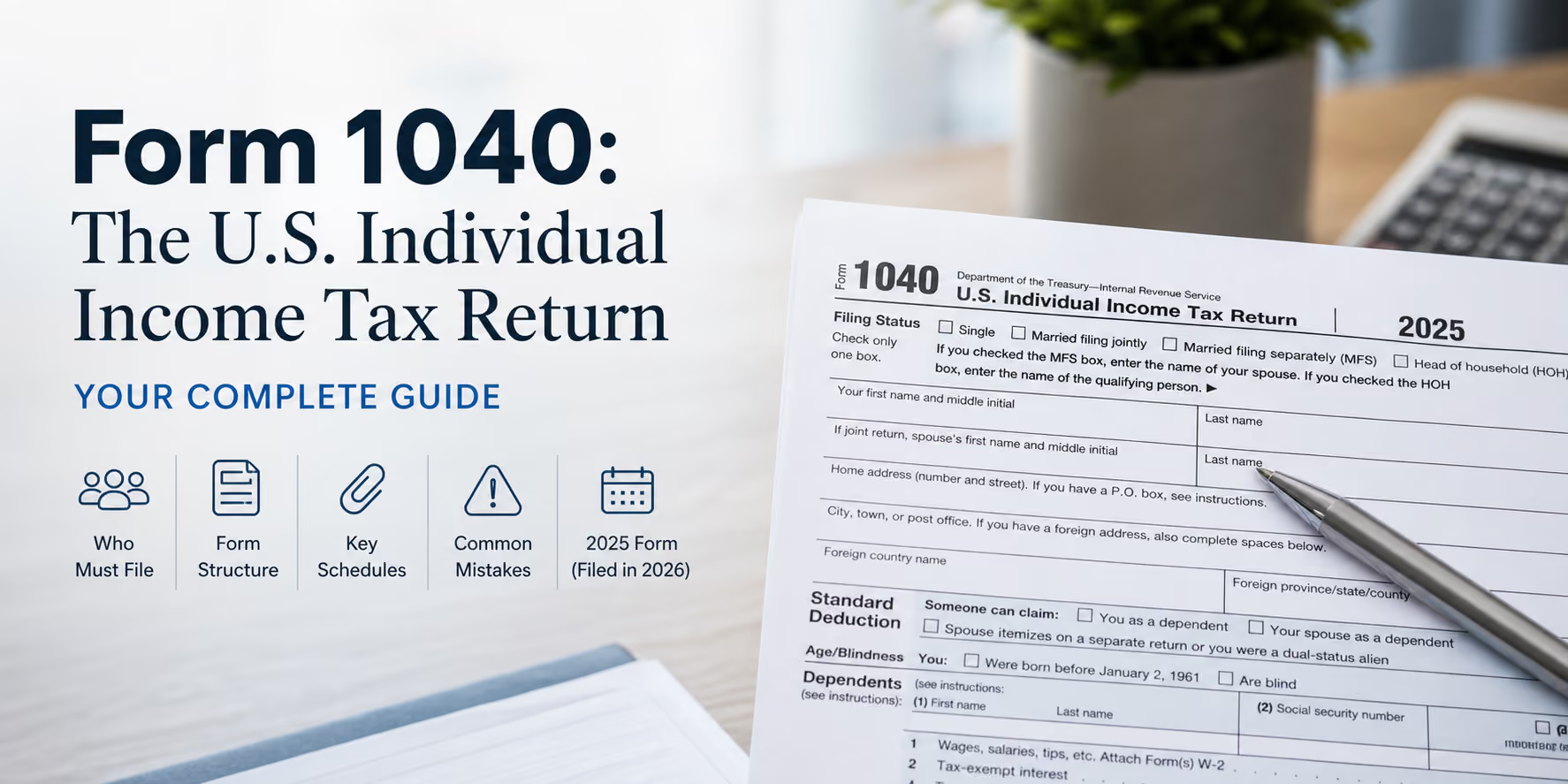
Form 5400 is sometimes mistakenly cited as the main federal tax return used by individuals in the U.S., but the correct form is IRS Form 1040 - the U.S. individual income tax return that roughly 160 million taxpayers file each year. This guide covers who must file, how the form is structured, what schedules attach to it, and where common mistakes happen. If you file as an employee, run a business, or hold investments across borders, the 1040 form is the document that ties your entire federal tax situation together.
IRS Form 1040 is used to report annual income to the IRS, claim tax deductions and tax credits, and calculate your tax refund or balance due. Form 1040 calculates taxable income and tax owed or refund due for each tax year. The IRS releases a revised Form 1040 each tax year, so line numbers, thresholds, and instructions change annually. The IRS's current version is the 2025 Form 1040, typically filed in 2026.
Most U.S. citizens must file Form 1040 if they earn income above IRS-published thresholds for their filing status and age. Resident aliens must file if their income exceeds a threshold. Nonresident aliens file Form 1040-NR for U.S. income instead.
Form 1040 includes various schedules for additional income and deductions. Schedules may need to be attached to Form 1040 for complex tax situations - for example, self employment income on Schedule C, rental income on Schedule E, or farm income on Schedule F. The IRS indicates that many taxpayers only need to file Form 1040 without additional schedules when their tax situation is straightforward.
Several related 1040 tax forms exist: Form 1040-SR for seniors, Form 1040-NR for non resident aliens, Form 1040-X for amended returns, Form 1040-ES for estimated tax payments, and Form 1040-V as a payment voucher for mailed payments. VJM Global – USA helps individuals and business owners prepare Form 1040, coordinate state taxes, and interpret IRS forms, instructions, and publications - especially where cross-border income or multi-state filing is involved.
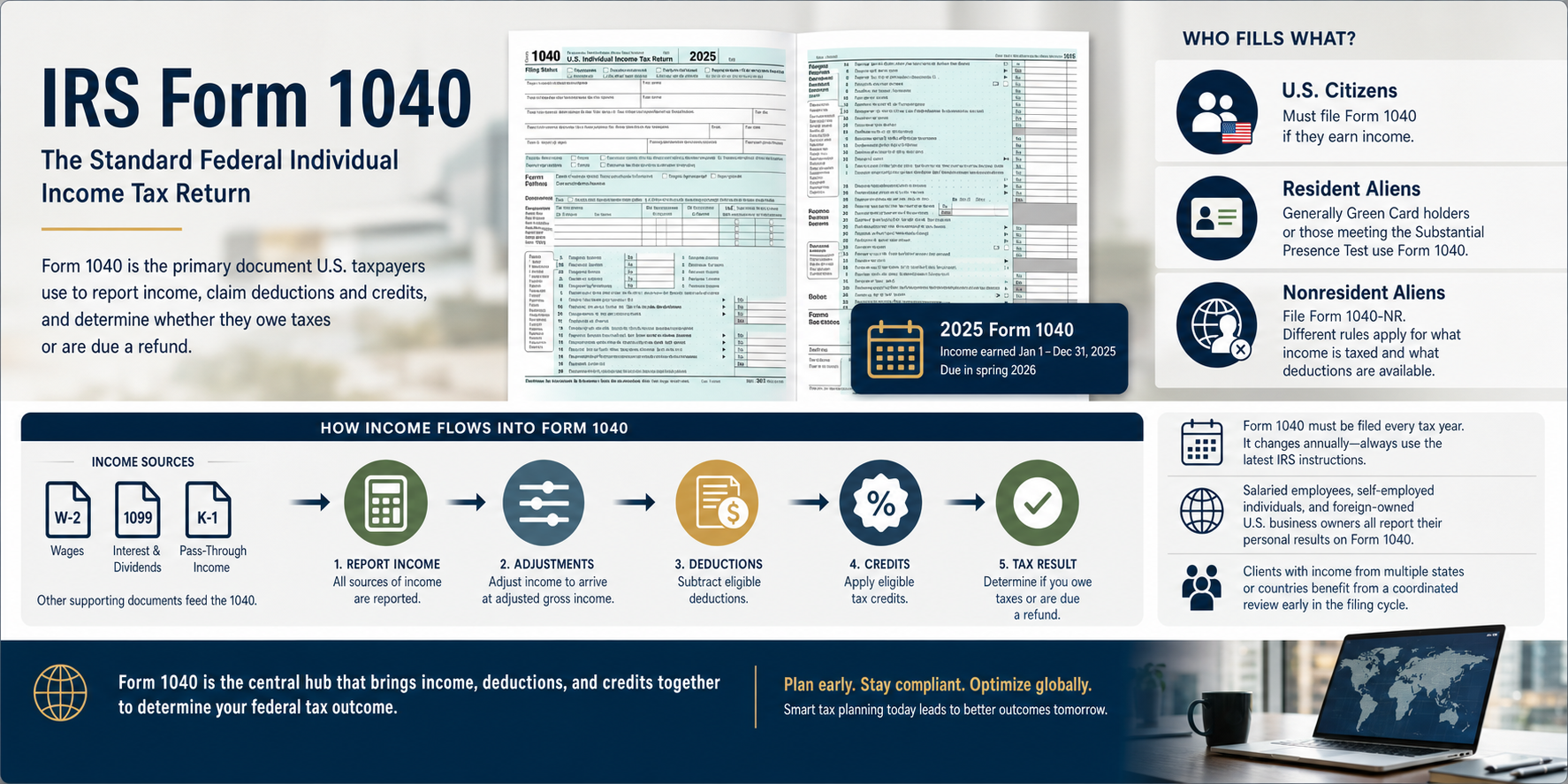
Form 1040 is the standard IRS form individual taxpayers use to file their annual federal individual income tax return. It serves as the primary document for reporting income from all sources, computing adjusted gross income, applying deductions and credits, and determining whether the taxpayer owes additional taxes or is due a refund. IRS Form 1040 includes sections for income, deductions, and credits, all organized into a standard form that is a two-page layout split into logical sections.
U.S. citizens must file Form 1040 if they earn income. Resident aliens - generally Green Card holders or those meeting the Substantial Presence Test - use the same form. Non resident aliens with U.S. source income instead file Form 1040-NR, which applies different rules about what income is taxed and what deductions are available.
The 1040 form acts as a central hub. Income statements like W-2s for wages, 1099s for interest and dividends, and K-1s from pass through entities all feed into it. Schedules for additional income, additional taxes, and additional credits attach when needed. The numbers flow from those supporting documents through adjustments, deductions, and credits to arrive at a final federal tax result.
Form 1040 must be filed for each tax year. For example, the 2025 Form 1040 covers income earned January 1 through December 31, 2025, and is due in spring 2026. Form 1040 changes annually, requiring taxpayers to consult the latest instructions published by the Internal Revenue Service.
At VJM Global – USA, we work with salaried employees, self-employed individuals, and foreign-owned U.S. business owners who all report their personal results on Form 1040, often requiring
cross-border tax planning strategies to coordinate income across jurisdictions. In our experience, clients with income from multiple states or countries benefit from a coordinated review early in the filing cycle.
Whether you must file depends on your filing status, gross income, age, and dependency status. Filing thresholds vary by age, income, and filing status, and the IRS publishes specific charts in Publication 501 each year.
For tax year 2025, the approximate gross income thresholds requiring a filing are:
Filing Status
Age Under 65
Age 65 or Older
Single
$15,750
$17,550
Married Filing Jointly (both under 65)
$31,500
Higher
Head of Household
$23,625
Higher
Married Filing Separately
$5
$5
Even if income falls below these levels, some individuals must file. Three common triggers: net self employment earnings of $400 or more (subject to self employment tax), taxes owed on early IRA or HSA distributions, and repayment obligations for excess advance premium tax credits.
Form 1040 is submitted to the IRS by April 15 of the following year - or the next business day if April 15 falls on a weekend or holiday. An automatic six-month extension to file (not to pay) is available via Form 4868, moving the deadline to around October 15. Estimated payments or taxes owed should still be paid by the original April deadline; late payment triggers penalties and interest.
Form 1040 must be signed and dated to be valid. Taxpayers with multi-state income, foreign accounts, or pass through entities often have additional filing triggers that go beyond the standard thresholds. VJM Global – USA routinely evaluates these requirements during early-stage filing reviews as part of its broader U.S. tax return preparation outsourcing services.
The standard Form 1040 spans two pages, divided into distinct sections: personal information, filing status, dependents, income, adjustments, tax computation, other taxes, payments, and refund or amount owed. Form 1040 has 20 schedules for various tax situations that may attach depending on the taxpayer's circumstances.
The Identification Section on Form 1040 includes personal details and filing status. Form 1040 includes a Personal Information section with name and Social Security number for both taxpayer and spouse. Filing Status on Form 1040 includes categories like Single and Married Filing Jointly, as well as Married Filing Separately, Head of Household, and Qualifying Surviving Spouse. Taxpayers can indicate dependents on Form 1040 for potential credits - the dependents area lists each dependent's name, SSN, and relationship.
The income section (roughly lines 1 through 9) captures wages, interest, dividends, capital gains, retirement distributions, and Social Security benefits. Form 1040 requires reporting of wages, salaries, tips, and other income sources. Additional income flows in via Schedule 1. Taxpayers report digital assets on Form 1040 via a mandatory checkbox.
Adjustments to income - above-the-line deductions like educator expenses, student loan interest, and half of self employment tax - reduce total income to arrive at adjusted gross income. Form 1040 requires reporting of Adjusted Gross Income (AGI), which appears on line 11 in the 2025 version. AGI controls eligibility for many credits and deductions.
After AGI, taxpayers subtract either the standard deduction or itemized deductions (Schedule A) to reach taxable income. Tax is then computed using IRS tax tables or rate schedules. Form 1040 includes a Tax and Sign-off section for tax liability calculations.
The Payments Section on Form 1040 reports total tax payments made throughout the year - withholdings from W-2s, estimated payments, and refundable credits like the Earned Income Tax Credit and child tax credit. The Refund or Amount Owed Section compares total tax to total payments on Form 1040 to determine the final result.
Form 1040 collects all income sources to compute total income and taxable income, with many entries supported by separate schedules and additional forms.
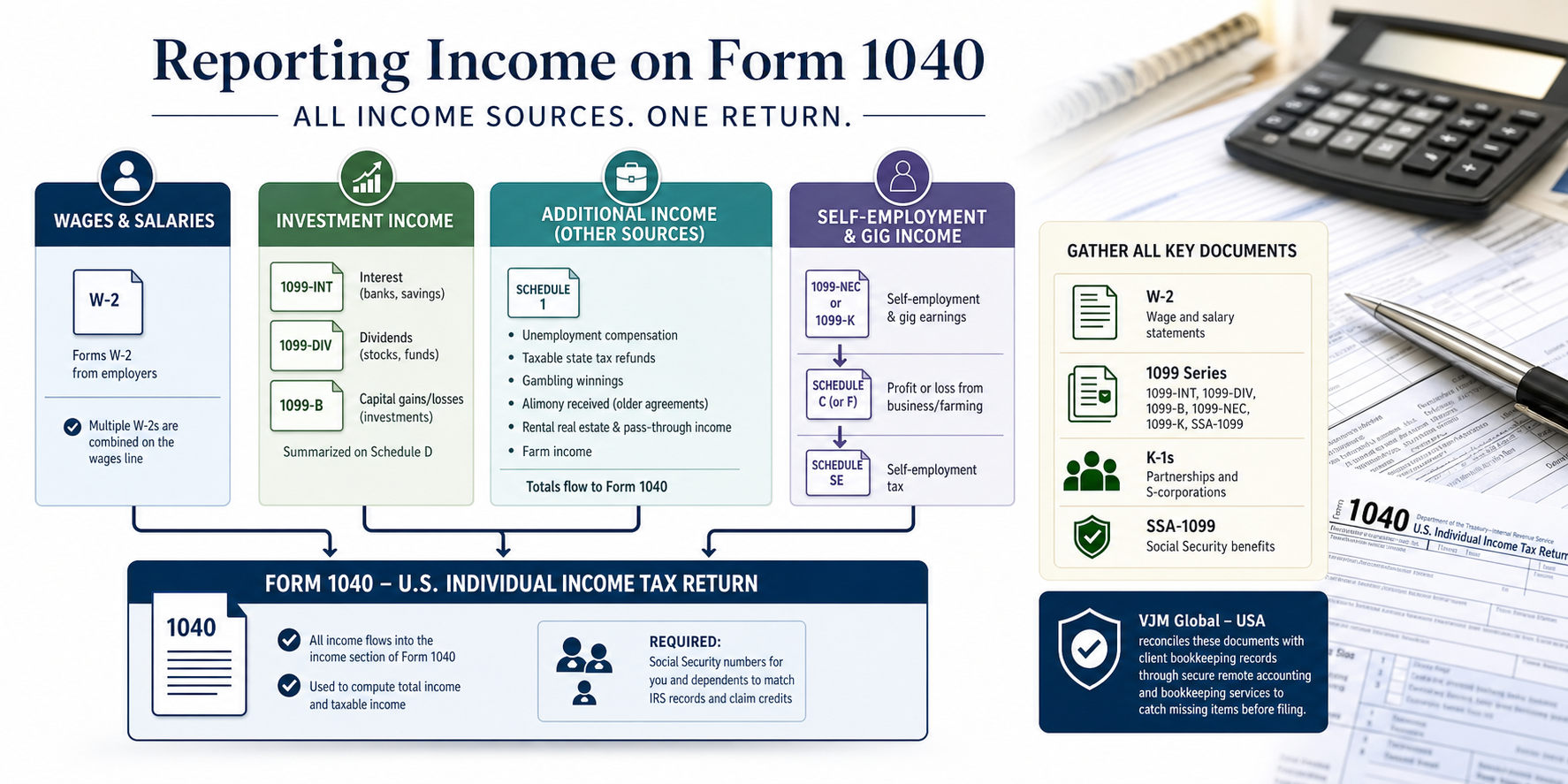
Wage and salary income comes from Forms W-2 issued by employers. Multiple W-2s are combined on the wages line. You need Social Security numbers for yourself and dependents to match IRS records and claim applicable credits.
Common investment income items include interest from bank accounts (Form 1099-INT), dividends from stocks (Form 1099-DIV), and capital gains or losses from sales of investments (Form 1099-B, summarized on Schedule D). These flow into the income section of Form 1040.
Schedule 1 reports additional income and adjustments to income. Categories on Schedule 1 include unemployment compensation, taxable state tax refunds, gambling winnings, alimony received under older divorce agreements, rental real estate and pass through income, and farm income. Those totals carry to the income section of Form 1040.
Self employment and gig-economy earnings - typically reported on Forms 1099-NEC or 1099-K - are detailed on Schedule C (or Schedule F for farming), with net profit or loss transferred back into the 1040 income section. Net earnings also trigger self employment tax, computed on Schedule SE.
Before starting, gather all relevant IRS forms: W-2, the full 1099 series, K-1s from partnerships or S-corporations, and SSA-1099 for Social Security. VJM Global – USA frequently reconciles these documents with client bookkeeping records for business owners and investors through secure remote accounting and bookkeeping services to catch missing items before filing.
The progression runs: total income → adjustments → adjusted gross income (AGI) → minus deductions → taxable income → federal tax computation. Adjusted Gross Income (AGI) is the total income minus allowable adjustments.
Common adjustments reported on Schedule 1 include deductible traditional IRA contributions, student loan interest, self-employed health insurance premiums, and half of self employment tax. These reduce AGI before the standard or itemized deduction applies, which can affect eligibility for credits and phase-outs.
Most taxpayers use the standard deduction on their Form 1040. For tax year 2025, the standard deduction is $15,750 for Single or Married Filing Separately, $31,500 for Married Filing Jointly, and $23,625 for Head of Household. Itemizing deductions on Schedule A may benefit those with substantial mortgage interest, state and local taxes (subject to the SALT cap, which increased to $40,000 for joint filers in 2025), and charitable contributions. Schedule A is used for itemized deductions on Form 1040.
Deductions and credits apply to lower taxable income on Form 1040. Federal income tax is calculated on taxable income reported on Form 1040 using IRS tax tables or rate schedules. Certain income - long-term capital gains and qualified dividends - is taxed at preferential rates via a separate worksheet referenced in the Form 1040 instructions and publications.
Errors in computing adjustments or additional deductions can cascade through the entire return, affecting credit eligibility and total tax liability. Complex cases - large investment portfolios, multi-state situations, foreign income - merit professional review from a firm providing global tax, accounting, and business consulting services.
Schedules 2 and 3 extend Form 1040 for taxpayers whose tax situation goes beyond the main form's lines.
Schedule 2 is used for reporting additional taxes on Form 1040. Common items include self employment tax, additional Medicare tax, net investment income tax, household employment taxes, additional tax on IRAs and other tax favored accounts (including early withdrawal penalties), and repayment of the premium tax credit. Schedule 2 is for additional taxes owed on Form 1040, and those totals are carried back to specific lines on the main return.
Schedule 3 claims additional credits and payments on Form 1040. It consolidates both non refundable credits and refundable credits not listed on the face of the 1040 - the credit for child and dependent care expenses, education credits, the foreign tax credit, residential energy credits, and certain business-related credits. Tax credits can be nonrefundable or refundable based on their definitions in tax law.
Accurate completion of these schedules can significantly reduce final tax liability or increase refunds, especially for families with dependents, students, or those who made energy-efficient home improvements. The current-year IRS instructions for Schedules 2 and 3 spell out which transactions trigger additional taxes or qualify for additional credits. VJM Global – USA routinely maps client transactions to the correct schedules during tax filing and, where issues arise, supports businesses through professional tax resolution services.
The "Form 1040" label also covers a family of related tax forms for different taxpayer situations.
1040A and 1040EZ were discontinued after tax year 2017; all individual filers now use Form 1040 or Form 1040-SR as their base return. VJM Global – USA frequently helps clients determine which variant applies, prepares estimated tax computations on Form 1040-ES, and manages amended return filings when prior-year corrections are needed, including for clients using outsourced real estate accounting services where rental income and deductions must be correctly reported on Form 1040.
Form 1040 covers federal income tax only. State taxes are filed on separate state-specific forms, often starting with federal AGI or federal taxable income pulled directly from the 1040.
Many states require taxpayers to begin with a figure from Form 1040, then apply state-level additions, subtractions, and credits. Some states have no individual income tax at all (Texas, Florida, Wyoming), while state corporate income tax rates vary by state, from 0% to 11.5%. States that do tax income sometimes treat wages, interest, dividends, and capital gains differently than federal rules.
Taxpayers who move between states or earn income sourced to multiple states - remote workers, rental property owners, business owners - may need to file part-year or nonresident returns in several states alongside Form 1040. VJM Global – USA prepares federal and state returns together so that 1040 data flows correctly into each state form and double taxation is minimized through credits for taxes paid to other states, while also managing reliable sales tax compliance for USA companies where required.
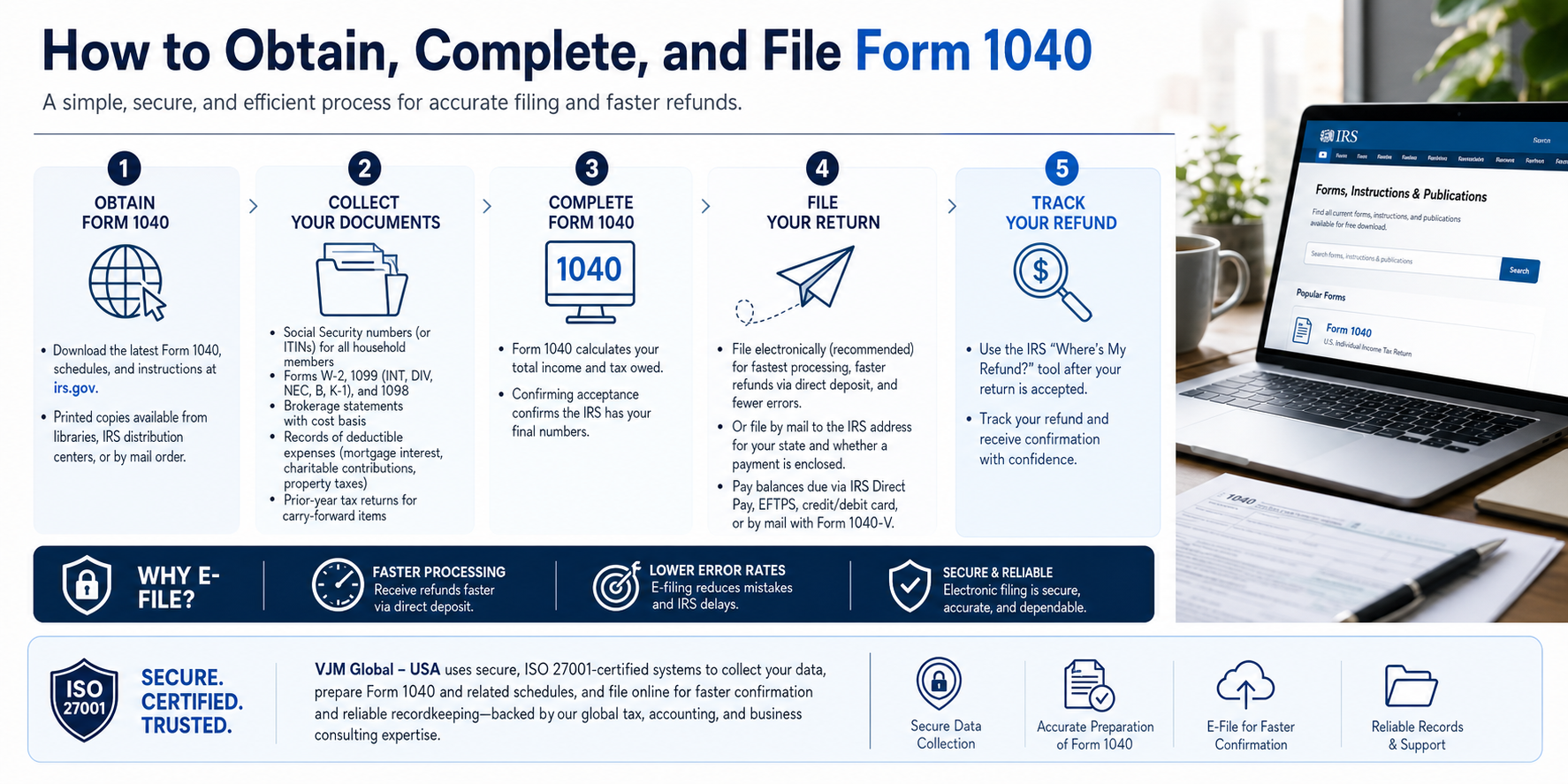
The latest IRS Form 1040, schedules, and instructions and publications can be downloaded from the IRS website (irs.gov). Printed copies are available through libraries, IRS distribution centers, or by mail order from the Forms, Instructions and Publications page.
Core documents to collect before starting:
Taxpayers submit Form 1040 either electronically or by mail. You can file Form 1040 electronically or by paper, but e-filing is recommended for fastest processing of Form 1040 - refunds arrive faster via direct deposit, and error rates drop. Paper returns must be mailed to specific IRS addresses based on the taxpayer's state and whether a payment is enclosed.
Balances due can be paid via IRS Direct Pay, the Electronic Federal Tax Payment System, credit or debit card, or by mail with Form 1040-V. Taxpayers can track refund status using the IRS "Where's My Refund?" tool once the return has been accepted. Form 1040 calculates total income and tax owed, so confirming acceptance confirms that the IRS has your final numbers.
VJM Global – USA uses secure, ISO 27001-certified systems to collect client data, prepare Form 1040 and related schedules, and file online for faster confirmation and reliable recordkeeping as part of its broader global tax, accounting, and business consulting services.
Many taxpayers can complete a simple individual tax return on their own. The risk of errors climbs sharply with complexity.
Typical mistakes we see in practice:
Underpayment of estimated taxes generates penalties reported directly on the 1040. Taxpayers who owe more than $1,000 after withholding and credits should be making quarterly payments via Form 1040-ES, and employers sponsoring retirement plans may also need independent 401(k) plan audit services to stay compliant with ERISA and DOL rules.
Professional advice is strongly recommended for anyone operating a business that passes income to their personal Form 1040, owning rental real estate or complex investment portfolios, earning multi-state income, or holding ownership in foreign entities requiring separate international information returns. VJM Global – USA reviews prior-year returns for missed deductions or credits, prepares amended Form 1040-X filings where corrections change the outcome, coordinates federal and state tax forms, and advises on estimated payments to avoid future penalties, with specialized tax preparation services for LLCs and LLPs in the USA where pass-through income flows onto Form 1040.
Many taxpayers with income below the standard deduction do not have a filing requirement. But filing may still be worthwhile to claim refundable credits - such as the Earned Income Tax Credit or child tax credit - or to get a tax refund of any federal income tax withheld from wages. Self employment earnings of $400 or more, advance premium tax credits, or taxes on other tax favored accounts can also create a filing obligation regardless of income level. Review the latest IRS filing requirement charts in the Form 1040 instructions for your specific tax year.
Eligible taxpayers can generally file online from abroad using approved tax software or authorized professionals, as long as they have a valid Social Security number or ITIN and can sign electronically. Certain foreign-related forms (such as FBAR filed separately with FinCEN) are not part of the 1040 itself but are typically prepared at the same time. VJM Global – USA regularly assists U.S. expats and foreign-based executives in coordinating these filings.
Keep copies of your income tax return, schedules, and key supporting documents for at least three years from the date filed or the original due date, whichever is later - that is the standard window for IRS audits and refund claims. Retain records for up to seven years if there are bad debt deductions or worthless securities claims. Records establishing cost basis in major assets - real estate, business interests - should be kept indefinitely, since they may affect taxable income in future years.
File Form 1040-X (Amended U.S. Individual Income Tax Return) to correct the error for the specific tax year. Amended returns normally must be filed within three years of the original filing date, or two years from the date tax was paid, whichever is later, to claim an additional refund. VJM Global – USA frequently reviews returns and prepares 1040-X filings when corrections will materially change taxable income or taxes owed.
C-corporations file their own corporate returns (Form 1120) and pay corporate income tax directly - that income does not flow to the owner's personal return unless distributed as dividends. Pass through entities such as partnerships (Form 1065) and S-corporations (Form 1120-S) issue Schedule K-1s reporting each owner's share of income, deductions, and credits. Those K-1 figures are then reported on the owner's personal Form 1040 as additional income or loss, so business owners need both an accurate entity-level return and a properly prepared individual income tax return. VJM Global – USA has extensive experience coordinating multi-entity and cross-border structures where these forms intersect.