[toc]
A partir del 1 de abril de 2019, se implementan los siguientes formatos revisados de declaración del GST. A continuación se detallan los nombres y formatos de las nuevas declaraciones del GST.
1. Propuesta de nuevas declaraciones del GST
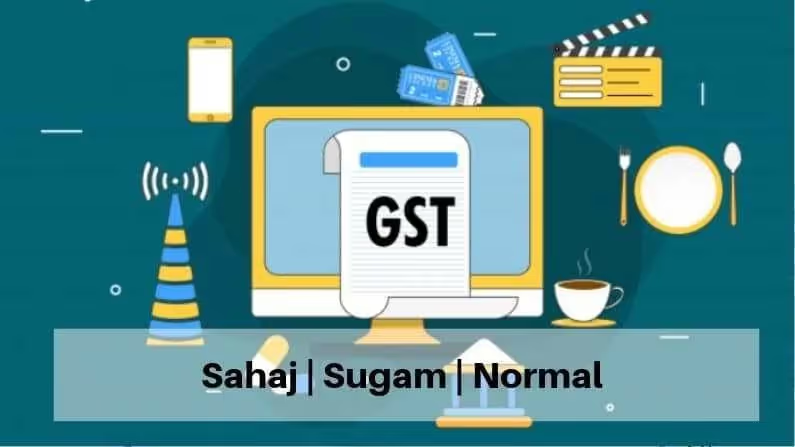
- Declaración (NORMAL) mensual/trimestral - Formulario GST RET-1
- Declaración SAHAJ - Formulario GST RET-2
- Declaración SUGAM - Formulario GST RET-3
2. Antiguas declaraciones del GST que serán eliminadas
- GSTR - 1, es decir, detalle de operaciones de salida
- GSTR - 2A, es decir, detalle autocompletado de operaciones de entrada
- GSTR - 3B, es decir, declaración resumen que contiene el resumen de las operaciones de salida y los detalles de los insumos con el fin de depositar las obligaciones tributarias del GST de forma mensual.
El procedimiento para presentar los formularios de declaración revisados es similar al anterior: primero, el contribuyente debe presentar los detalles de las operaciones de salida en el GST ANX-1 (GSTR-1 en los formatos anteriores), luego debe finalizar la compra basándose en los datos autocompletados en el GST ANX-2 (GSTR-2 y GSTR-2A en el formato anterior) y, finalmente, el contribuyente debe presentar la declaración definitiva en el formulario GST RET 1/GST RET 2/ GST RET 3 (GSTR-3 en el formato anterior) en el portal del GST.
Tenga en cuenta que los cambios se proponen únicamente para los formularios mencionados; sin embargo, no se sugieren cambios para los formularios GSTR-4 a GSTR-11. Por lo tanto, estas declaraciones seguirán presentándose como hasta ahora.
3. Antecedentes de la nueva declaración del GST
Para mejorar y simplificar, el consejo del GST aprobó el concepto de un nuevo formato simplificado de declaración del GST en su 28ª reunión del consejo del GST celebrada el 21 de julio de 2018.
Se propone implementar los formatos revisados a partir del 1 de abril de 2019 a modo de prueba y, si funcionan correctamente, dichos formatos serán obligatorios a partir del 1 de julio de 2019, según lo decidido en la 31ª reunión del Consejo del GST.
El impuesto sobre bienes y servicios ("GST") se implementó a partir del 1 de julio de 2017 con el concepto de 3 declaraciones del GST: GSTR-1 (Declaración de operaciones de salida), GSTR-2 (Declaración de operaciones de entrada) y GSTR-3 (Declaración final).
Sin embargo, debido a la falta de soporte técnico, hasta la fecha solo se ha hecho efectiva la GSTR-1 junto con una declaración resumen, la GSTR-3B.
4. Análisis / comparación de las nuevas declaraciones del GST
- La siguiente tabla contiene un resumen de los puntos principales y otra información sobre los formularios revisados del GST.
- Dicha información le ayudará a determinar qué formulario es aplicable al contribuyente, qué detalles deben declararse al presentar la nueva declaración del GST, la fecha de vencimiento de la declaración, etc.
| Basis |
SAHAJ Return - Form GST RET 2 |
SUGAM Return - Form GST RET 3 |
Normal Return (Quarterly) – Form GST RET 1 |
Normal Return (Monthly) – Form GST RET 1 |
| Periodicity of return where turnover is less than or equal to ₹5 crore |
Monthly (Also quarterly option given) |
Monthly (Also quarterly option given) |
Monthly (Also quarterly option given) |
Monthly |
| Periodicity of return where turnover is more than ₹5 crore |
Monthly |
Monthly |
Monthly |
Monthly |
| Input Tax Credit (“ITC”) on missing invoice |
Not allowed |
Not allowed |
Allowed |
Allowed |
| Payment of Tax |
Monthly |
Monthly |
Monthly |
Monthly |
5. Tipo de operaciones permitidas en la declaración del GST
| Basis |
SAHAJ Return - Form GST RET 2 |
SUGAM Return - Form GST RET 3 |
Normal Return (Quarterly) – Form GST RET 1 |
Normal Return (Monthly) – Form GST RET 1 |
| B2C Supplies |
Allowed |
Allowed |
Allowed |
Allowed |
| B2B Supplies |
Not Allowed |
Allowed |
Allowed |
Allowed |
| Inward Supplies attracting Reverse Charge |
Allowed |
Allowed |
Allowed |
Allowed |
| Zero Rated Supplies i.e. Export Turnover |
Not Allowed |
Not Allowed |
Allowed |
Allowed |
| Supplies through E-commerce Operator |
Not Allowed |
Not Allowed |
Allowed |
Allowed |
| Nil Rated and Exempted Supplies |
Not Allowed |
Not Allowed |
Allowed |
Allowed |
Nota 1: En el caso de las declaraciones del GST Sahaj y Sugam, el proveedor puede realizar 1. Operaciones no sujetas al GST, 2. Operaciones exentas o 3. Operaciones con tasa cero, sin embargo, dichas operaciones no pueden declararse en la declaración del GST Sahaj ni en la declaración del GST Sugam.
Nota 2: El contribuyente que opte por presentar la declaración "Sahaj" o "Sugam" no puede realizar operaciones a través de un operador de comercio electrónico sobre las cuales se requiera recaudar impuestos según la sección 52.
6. Formularios aplicables para la declaración del GST
| Basis |
SAHAJ Return - Form GST RET 2 |
SUGAM Return - Form GST RET 3 |
Normal Return (Quarterly) – Form GST RET 1 |
Normal Return (Monthly) – Form GST RET 1 |
| Annexure for outward and inward supplies attracting reverse charge |
Form GST ANX-1 |
Form GST ANX-1 |
Form GST ANX-1 |
Form GST ANX-1 |
| Annexure for inward supply (Auto-populate) |
Form GST ANX-2 |
Form GST ANX-2 |
Form GST ANX-2 |
Form GST ANX-2 |
| Final Return Form |
Form GST RET-2 |
Form GST RET-3 |
Form GST RET-1 |
Form GST RET-1 |
| Amendment to details of outward supplies and inward supplies attracting reverse charge |
FORM GST ANX-1A |
FORM GST ANX-1A |
FORM GST ANX-1A |
FORM GST ANX-1A |
| Amendment to final return |
FORM GST RET – 2A |
FORM GST RET – 3A |
FORM GST RET – 1A |
FORM GST RET – 1A |
| Non-GST Supplies |
Form PMT 08 |
Form PMT 08 |
Form PMT 08 |
Form PMT 08 |
7. Qué formato de declaración del GST seleccionar
- La periodicidad de la presentación de la declaración será mensual para todos los contribuyentes por defecto. Sin embargo, puede seleccionar la opción de presentar una declaración trimestral según los criterios establecidos.
- No es obligatorio presentar el formulario de declaración según la aplicabilidad. Cualquier persona con derecho a optar por la declaración Sahaj también puede optar por presentar la declaración normal de forma mensual o trimestral.
8. Other important points relevant for new GST return
- Aggregate turnover of newly registered taxable person shall be considered as zero, accordingly, he can opt to file any form, as applicable to him.
- Taxpayer can select periodicity of return filing (i.e. monthly or quarterly) only once at the time of filing first return of financial year and such periodicity shall be applicable for such financial year.
- Please note that shared document doesn't prescribe any due date for filing of GST return in form GST RET 1, GST RET 2 & GST RET 3.
9. Change in form during the year
A person who opts to file a return on a quarterly basis can file a return in any form, namely Sahaj, Sugam or Normal return. However, the option to switch form during the year is available in following manner:
| Opted Form |
Switch to |
Frequency |
| Sahaj i.e. GST Ret 2 |
1. Sugam i.e. GST Ret 3
2. Normal Return i.e. GST Ret 1 |
More than once in a Financial Year - at beginning of any quarter |
| Sugam i.e. GST Ret 3 |
1. Normal Return i.e. GST Ret 1 |
More than once in a Financial Year - at beginning of any quarter |
| Sugam i.e. GST Ret 3 |
Sahaj i.e. GST Ret 2 |
Only once in a Financial Year - At beginning of any quarter |
| Normal Return i.e. GST Ret 1 |
1. Sahaj i.e. GST Ret 2
2. Sugam i.e. GST Ret 3 |
Only once in a Financial Year - At beginning of any quarter |
10. Amendment in GST New Returns
- Amendment return can be filed for a tax period, i.e., month or quarter.
- Amendment in content of GST ANX-1 will be made through GST ANX-1A and GST RET-1/ GST RET- 2/ GST RET-3 will be made through GST RET-1A/GST RET-2A/GST RET-3A.
- Amendment in ITC (upward/downward adjustment) will be made through main return (GST ANX-2) and not to be made through amendment return.
- Amendment in GST ANX-1A can be filed before the due date of furnishing return for the month of September following end of the F.Y. or the actual date of furnishing relevant annual return, whichever is earlier.
- Process of filing of amendment return is similar to original return.
- Amendment can be made as many times as provided in CGST Act.
- If any liability arises due to filing of amendment return then payment is required to be made for such liability. Liability can be made through utilisation of available ITC balance.
- If liability becomes negative then no refund will be granted. However, such excess amount can be used for payment of GST liability of next tax period.
11. Payment of GST Liabilities
- Taxpayer will make payment of self assessment tax through form GST PMT-08.
- Taxpayers are required to make payment on monthly basis. If a taxpayer opts to file return on quarterly basis, he is still required to make payment on monthly basis.
- In case of quarterly filing of return, credit of tax paid during first 2 months of the quarter will be available at the time of filing of quarterly return.
- Due date of GST payment is 20th of the month following the month to which liability pertains.
- GST liability can be settled out of balance in electronic credit ledger or electronic cash ledger.
- Excess availement of ITC or short payment of GST or delay in payment of GST will be subject to interest u/s 50 of central goods and service tax act, 2017
12. Download New GST Return format
Want to know more about Implementation of New GST return, read our post Transition Plan | New GST Return Implementation