

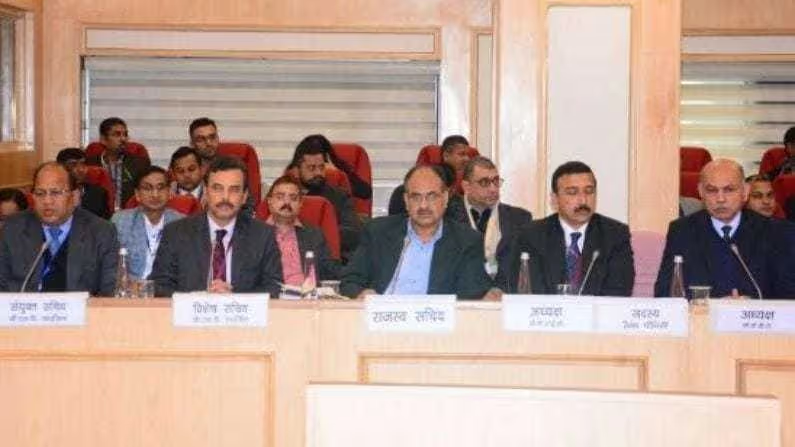
The 2nd National GST Conference of the State Tax Commissioners and the Chief Commissioners of Central Tax held on 7th January 2020 in Delhi. Under the chairmanship of Dr. Ajay Bhushan Pandey, Revenue Secretary, Ministry of Finance, the main motto of this conference was to discuss and streamline the Goods and Service Tax system. The key focus of the was to find 2nd National GST Conference out and plug revenue leakages.
This was only the 2nd edition of all India Conference. Both central and states' tax administrations were present to build the synergy by sharing their inputs with each other. The officials took some important measures to bring the uniformity of the whole tax administrations. Thus, we can say, the conference has been a great success. Agencies like GSTC, CBIC, CBDT, DoR, FIU, DGGI alongside the State Tax Administrations have participated. They talked about the use of machinery and mechanism to disseminate inter-departmental data.
Officials made several presentations. Commissioner, CBIC presented the most influential one. He represented a clear overview of fraudulent ITC. Alongside, DG and DRI also presented a few cases one of which consists of a Pan-India operation. They also discussed several methodologies to restrict the misuse of refund of ITC or IGST.DG and ARM have talked about the early identification of fraudulent practices.
They have spoken on how the use of machine learning, data analytics, and artificial intelligence can play an instrumental role.The CBDT and FIU India made a clear approach through their presentation. They talked about disseminating STR and the exchange of data for braking evasion. Whereas, the GST Policy Wing, CBIC talked about enhancing revenue through crossing over the compliance gap. As per their opinion, by cutting down the compliance gap it is possible to recover unmatched credit, manage non-fillers, and review refunds.
The Central Tax Zonal office of Mumbai and Vadodara have also participated in the conference. They showed how they proceed through compliance management and revenue enhancement in their tax administrations. Alongside Gujrat and Andhra Pradesh tax officials also represented their practices.
The all-day-long conference ended with some essential precautionary measures taken by the officials. Here have a look at them,
The officials decided to constitute a committee of centre and state officers to examine and implement quick measures to restrict fraudulent refund claims. The implementation of the committee is supposed to be done by the end of January.
It was being decided that all the major cases involving fake Input Tax Credit, fraudulent refund cases will be compulsorily investigated.
Considering the huge number of illegal IGST refund claims officials have decided that joining the foreign exchange remittances with IGST refunds is the need of the hour.
The GST-Network (GSTN), Central Board of Direct Taxes (CBDT), and Central Board of Direct Taxes and Customs (CBIC) have agreed to sign a Memorandum of Understanding to confirm data exchange through API(Application Program Interface).
In consultation with the RBI and NPCI the exploration of access to banking transactions and bank account details through the GST system will be made available. Apart from that, a few suggestions were also given to make GST System aligned with FIU.
Los funcionarios también sugirieron compartir los datos de los casos de evasión y devoluciones fraudulentas detectados por la CBDT y la CBIC. De este modo, será mucho más fácil elaborar un perfil adecuado de estos defraudadores.
También se recomendó establecer una cuenta bancaria única para la recepción de remesas extranjeras y el desembolso de devoluciones.
Es evidente que el enfoque de los funcionarios gubernamentales para agilizar el sistema del Impuesto sobre Bienes y Servicios es encomiable. La introducción de DevOps en forma de software de cumplimiento y un sistema de seguimiento basado en IA es algo que podemos considerar para mejorar todo el proceso fiscal. Además, las medidas adoptadas durante la conferencia tienen suficiente potencial para hacer que el proceso de tributación en nuestro país sea mucho más transparente. A la larga, esto puede reducir el margen de maniobra para los defraudadores fiscales.
Leer más: Ley de Enmienda del GST de 2018 y su impacto: 20 cambios principales




