GSTR- 9/9C is made available for filing for FY 2024-25. These forms are updated to address shortcomings in the existing forms. In this line, the GSTN has issued a detailed list of FAQs. FAQs issued by the GSTN, along with explanations and examples, are given below. These FAQs will assist the Taxpayer in better understanding of various Tables of GSTR-9/9C.
Frequently Asked Questions:
1. When will GSTR 9/9C be enabled for filing for FY 2024-25?
GSTR-9/9C shall become enabled once all the due GSTR 1 and GSTR 3B are filed for FY 2024-25.
GSTR 9 will not be enabled where any GSTR 1 and GSTR 3B are pending for FY 2024-25.
All the relevant cells of Tables 4,5,6,8, and 9 of GSTR 9 will auto-populate based on the information furnished in GSTR-1/ 1A/ IFF or GSTR 2B or GSTR 3B.
2. What value shall auto-populate in table 8A of GSTR 9?
Table 8A of GSTR 9 for FY 2024-25 computes the ITC in the following manner:
ITC on all the inward supplies on FY 2024-25 appearing in GSTR 2B of FY 2024-25;
Shall include the invoices on FY 2024-25 appearing in GSTR 2B of next year 2025-26 between April 2025 to October 2025; and
Shall exclude invoices on the previous FY 2023- 24 appearing in GSTR 2B between April 2024 to October 2024.
3. Will actions taken on the IMS dashboard have any impact on GSTR-9?
IMS does not have a direct impact on GSTR 9.
Only the documents forming part of GSTR-2B shall form part of GSTR 9 for FY 2024-25.
4. Will the supplies added/amended through GSTR 1A be considered for auto population of value in Table 4/5 of GSTR 9?
Table 4 contains “Details of Advances, Inward and outward supplies made during the Financial Year on which tax is payable”;
Table 5 contains “Details of outward and inward supplies made during the financial year on which tax is not payable”
Yes, from FY 2024-25, the supplies added/amended through GSTR 1A will also be considered along with GSTR-1 and IFF for auto population in Table 4, 5 of GSTR 9.
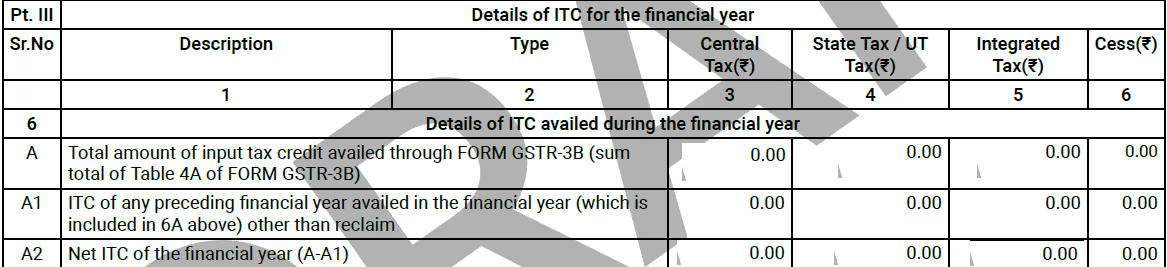
5. What is table 6A1, and which amount is required to be reported?
Table 6A1 of GSTR 9 for FY 2024-25 captures the ITC of the preceding FY (2023-24) claimed by the recipient in the current FY (2024-25) till the specified time period.
Such ITC is already included in the ITC availed in GSTR-3B during the year.
However, any ITC about FY 2023-24 or any other preceding financial years, which has been reclaimed during the current FY (2024-25) on account of rule 37 / 37A, will not be reported in Table 6A1 of GSTR 9.
Therefore, Net ITC of the Financial Year in Table 6A2 is the ITC for the current FY (2024-25).
As the ITC of the preceding FY has been excluded through Table 6A1, it will not create the difference in Table 6J of GSTR 9, as was the case with GSTR-9 till FY 2023-24.
6. Whether there are any changes in the reporting for table 6M, as the label has been changed from FY 2024-25?
Table 6M represents “ITC availed through ITC-01, ITC-02, and ITC-02A (other than GSTR-3B and TRAN Forms)
The label change to Table 6M has aligned it with the instructions of the notified form. However, such a label change does not have any impact on reporting.
7. Whether Table 8A can be downloaded in Excel?
For the amount autopopulating in table 8A online, invoice-wise details are provided in an Excel sheet on the GSTR 9 dashboard AS ‘DOWNLOAD TABLE 8A DOCUMENT DETAILS’.
The taxpayer can download and refer to the invoices/DN/CN, based on which the amount is auto-populated in Table 8A online.
8. Whether in any case, ITC auto-populating in Table-8A of GSTR-9 and ITC reflecting in Excel are different?
Yes. In the following scenarios, ITC as per Table 8A downloaded in Excel and ITC reflecting in Table 8A of GSTR-9 for FY 2024-25 can have different:
Outward supplies covered under RCM will appear in Table 8A Excel but not appear in the autopopulated figure.
Outward supplies reported as Normal charge and later on amended to RCM will reflect in Table 8A Excel as B2B and B2BA. However, such an amount shall not form part of the auto-populated ITC;
Outward supplies where the recipient and supplier belong to different states, but PoS for the same is Supplier state, and hence CGST and SGST were charged.
This record is ineligible for ITC due to the PoS Rule.
Outward supplies amended from FY 2024-25 to FY 2025-26, then it will appear in Table 8A Excel (B2B sections of the Excel sheet), but will not appear in Table 8A online
Outward supplies amended from FY 2025-26 to FY 2024-2,5, then it will appear in Table 8A Excel (B2BA sections of Excel sheet) and will appear in Table 8A online
Therefore, ITC auto-populating in Table 8A of GSTR-9 is correct. However, there are some additional records that may be present in Table 8A Excel on account of the above-mentioned points.
9. Will any amendment by the supplier in GSTR 1/1A/IFF, will the changes ITC auto-populate in my Table 8A (Excel and Online) of GSTR 9?
Sí, cualquier modificación en GSTR 1/1A/IFF se verá reflejada en la población automática de la tabla 8A según el registro modificado, siempre que dichos suministros modificados correspondan al ejercicio fiscal 2024-25.
Ej.:
Fecha de factura: 30.03.2025;
Mes de presentación del GSTR-1: abril de 2025;
Al ser un registro elegible para el ejercicio fiscal 2024-25, aparecerá en el ITC según la Tabla 8A (Excel y en línea).
P. ej.
Modificación de dicho registro: GSTR 1 de mayo de 2025;
Fecha de factura cambiada al 30.04.2025;
Ahora el documento corresponde al ejercicio fiscal 2025-26 y, por lo tanto, no se considera para la Tabla 8A (en línea) del GSTR 9 para el ejercicio fiscal 2024-25.
Sin embargo, este registro seguirá apareciendo en la Tabla 8A Excel (Sección B2B) del GSTR 9 para el ejercicio fiscal 2024-25.
10. Si una factura del ejercicio fiscal actual se declara en el GSTR-1 del ejercicio fiscal siguiente hasta octubre de 2025, ¿cómo se completará automáticamente en la tabla 8A?
En tal caso, la factura/DN/CN del ejercicio fiscal actual se completará automáticamente en la Tabla 8A para el ejercicio fiscal 2024-25 una vez que el destinatario presente el GSTR 3B correspondiente al periodo fiscal, como ITC que el destinatario debe reclamar en su GSTR 3B.
Ej.:
La factura del ejercicio fiscal 2024-25 se declara en el GSTR-1 de mayo de 2025;
Dicha factura formará parte del GSTR 2B del destinatario como ITC elegible;
Dicha factura se completará automáticamente en la tabla 8A del GSTR 9 para el ejercicio fiscal 2024-25 una vez que el contribuyente presente el GSTR 3B de mayo de 2025.
11. ¿Qué es la Tabla 8C del GSTR 9?
La Tabla 8C contiene datos sobre el ITC del ejercicio fiscal actual que se utiliza en el ejercicio fiscal siguiente dentro del periodo de tiempo especificado.
Esta tabla no incluirá ningún ITC que se haya reclamado durante el ejercicio fiscal 2024-25, se haya revertido en el ejercicio fiscal 2024-25 y se haya vuelto a reclamar en el ejercicio fiscal siguiente.
Por lo tanto, solo contiene el ITC omitido del ejercicio fiscal actual (2024-25) que se reclama en el GSTR 3B del ejercicio fiscal siguiente hasta el periodo de tiempo especificado.
12. ¿La tabla 8C incluirá el ITC que se reclama y revierte en un ejercicio fiscal (2024-25) y se vuelve a reclamar en el ejercicio fiscal siguiente (2025-26)?
No, dicho ITC reclamado nuevamente no debe declararse en la Tabla 8C del GSTR 9 del ejercicio fiscal 2024-25.
Ej.:
ITC reclamado en marzo de 2025 (Tabla 4A5 del GSTR 3B) y revertido en marzo de 2025 (Tabla 4B2 del GSTR 3B) porque los bienes no habían llegado a la fábrica.
Ahora, en el mes de abril de 2025, dicho ITC se vuelve a reclamar en la Tabla 4A5 del GSTR 3B.
Dicho ITC se declarará en la Tabla 6B y la Tabla 7H del GSTR 9 para el ejercicio fiscal 2024-25.
Tabla 6B: Suministros recibidos (distintos de importaciones y suministros recibidos sujetos a cargo inverso, pero incluye servicios recibidos de SEZ)
Tabla 7H: Detalles del ITC revertido y ITC no elegible para el ejercicio fiscal - Otras reversiones
La Tabla 8A tendrá el ITC correspondiente y la tabla 8B se completará automáticamente desde la Tabla 6B del GSTR 9 para el ejercicio fiscal 2024-25.
Como resultado, no hay diferencia en la Tabla 8D.
Por lo tanto, dicho ITC no debe declararse en la tabla 8C, ya que crearía una discrepancia en la Tabla 8D. Este reclamo solo debe declararse en la Tabla 13.
13. ¿En qué casos se debe declarar el ITC en la Tabla 8C del GSTR 9?
El importe se declarará en la tabla 8C solo en los siguientes casos:
ITC correspondiente al ejercicio fiscal 2024-25 que forma parte del GSTR 2B y se completa automáticamente en la Tabla 8A del GSTR 9, pero que no ha sido reclamado por el destinatario durante el ejercicio fiscal 2024-25 y dicho ITC se reclama por primera vez en la tabla 4A5 del GSTR 3B del ejercicio fiscal siguiente (2025-26) hasta el periodo de tiempo especificado.
Facturas del ejercicio fiscal 2024-25 declaradas por el proveedor en el GSTR 1 de abril de 2025 a octubre de 2025. Por lo tanto, dicho ITC se utiliza por primera vez en la tabla 4A5 del GSTR 3B del ejercicio fiscal siguiente (2025-26).
Ej.:
Compra de bienes: enero de 2025;
Sin embargo, no reclamó el ITC en enero de 2025;
Dicho ITC se reclama en mayo de 2025.
Dicho ITC se reflejará en la Tabla 8C.
Ej.:
Compra de bienes: enero de 2025;
El proveedor declaró dicha factura en el GSTR-1 de abril de 2025;
El destinatario reclamó dicho ITC en el GSTR 3B de abril de 2025;
Dicho ITC se completará automáticamente en la Tabla 8A del GSTR 9 del ejercicio fiscal 2024-25 y se ha reclamado por primera vez en el año siguiente hasta el periodo de tiempo especificado;
Dicho ITC se declarará en la Tabla 8C y la Tabla 13 del GSTR 9 del ejercicio fiscal 2024-25.
14. Los bienes se importaron en el ejercicio fiscal 24-25, sin embargo, el ITC se tomó en el ejercicio fiscal 2025-26. ¿Cómo se declarará esto en el GSTR 9?
Dicho ITC se declarará en la nueva fila insertada Tabla 8H1 (Crédito IGST utilizado en la importación de bienes en el ejercicio fiscal siguiente) y no se declarará en la Tabla 6E (Importación de bienes (incluidos suministros de SEZ)) del GSTR 9.
El IGST pagado por la importación de bienes se declarará en la Tabla 8G;
El ITC reclamado en el ejercicio fiscal siguiente se declarará en la Tabla 8H1;
Este ITC se declarará en la Tabla 13 del GSTR 9 de 24-25.
15. ¿Qué valor se completa automáticamente en el impuesto a pagar en la Tabla 9 del GSTR 9 para el ejercicio fiscal 2024-25, dado que se han insertado tablas de pasivos negativos en el GSTR 3B?
La columna de Impuesto a pagar se obtiene del GSTR 3B a partir del pasivo neto.
Si el pasivo declarado en la Tabla 6.1 del GSTR 3B es positivo (bruto menos pasivo negativo), dicho pasivo fiscal neto positivo se completará automáticamente en la Tabla 9 bajo el impuesto a pagar.
Sin embargo, si el importe neto en la tabla 6.1 aparece en negativo, no se completará ningún importe en la columna de Impuesto a pagar de la Tabla 9.
Además, la columna de impuesto a pagar de la Tabla 9 del GSTR 9 se mantiene editable y, por lo tanto, el contribuyente puede cambiar el valor si es necesario.
16. ¿El cambio de etiqueta en la Tabla 12 y la Tabla 13 supone algún cambio en la declaración?
El cambio en la etiqueta de la Tabla 12 y la Tabla 13 no supone ninguna diferencia en la declaración en comparación con los ejercicios fiscales anteriores.
La Tabla 12 captura el ITC del ejercicio fiscal (2024-25) revertido en el ejercicio fiscal siguiente.
La Tabla 13 captura el ITC del ejercicio fiscal (2024-25) utilizado en el ejercicio fiscal siguiente.
17. ¿Habrá alguna facilidad adicional para presentar los detalles HSN en la Tabla 17 del GSTR 9 para el ejercicio fiscal 2024-25?
GSTN ha facilitado ahora una opción para descargar una hoja de Excel adicional llamada 'DESCARGAR TABLA 12 DE DETALLES HSN DE GSTR 1/1A';
Dicho Excel consolida los detalles de la Tabla 12 del GSTR-1;
Las hojas adicionales en dicho archivo de Excel también proporcionan los datos en el formato de la Tabla 17 del GSTR 9.
Esto facilitará al contribuyente el uso del archivo descargado y su declaración en la Tabla 17 del GSTR 9 para el ejercicio fiscal 2024-25.
18. If GST under RCM for FY24-25 is paid in GSTR3B of FY25-26. Should this liability and ITC of RCM be reported in GSTR 9 of FY 2024-25 or FY 2025-26?
This RCM Liabilities and ITC on said RCM transaction should be reported in GSTR-9 of FY 2025-26.
Explanation- As clarified by CBIC vide Press release dated 3rd July 2019, the RCM Liability may be reported in the year, in which it was paid along with applicable interest (if any).
Relevant extract of the said press release -
“g) Reverse charge in respect of Financial Year 2017-18 paid during Financial Year 2018-19: Many taxpayers have requested for clarification on the appropriate column or table in which tax which was to be paid on reverse charge basis for the FY 2017-18 but was paid during FY 2018-19. It may be noted that since the payment was made during FY 2018-19, the input tax credit on such payment of tax would have been availed in FY 2018-19 only. Therefore, such details will not be declared in the annual return for the FY 2017-18 and will be declared in the annual return for FY 2018-19. If there are any variations in the calculation of turnover on account of this adjustment, the same may be reported with reasons in the reconciliation statement (FORM GSTR-9C)”
Conclusion:
GSTR-9 and GSTR-9C are essential returns as they provide a summary of all GST returns submitted throughout the year, necessitating a comparison with the books of accounts. GSTR-9 and 9C represent the final opportunity to make any corrections and to disclose any additional information. It is important to highlight that taxpayers do not have the option to revise these Forms. Consequently, it is advisable for taxpayers to seek professional guidance to ensure that accurate information is provided in GSTR-9/9C. We, at V J M Global, are a team of GST experts ready to assist you in filing GSTR-9/9C correctly.
CA Sachin Jindal
Explore las perspectivas, consejos y actualizaciones de expertos del CA Sachin Jindal