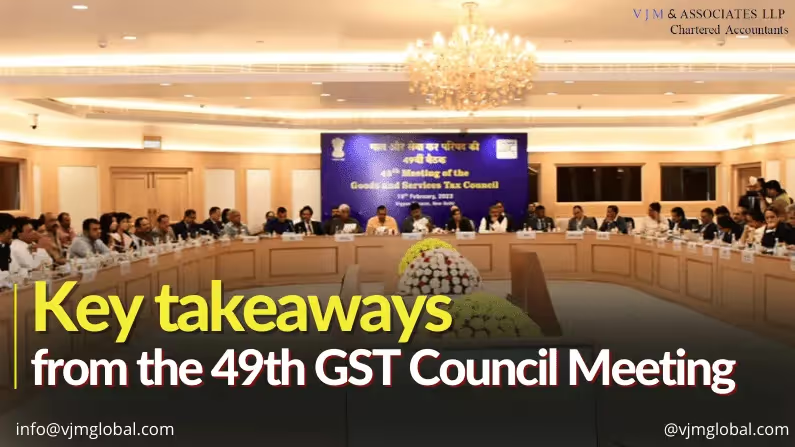
The GST Council meeting was held for the 49th Time on 18th February 2023 under the chairmanship of the Hon’ble Union Finance & Corporate Affairs Minister. Key points of discussion were Clearance of Compensation cess dues to States, revision of GST rates of a few items, GST appellate tribunal and its structure, Capacity-based taxation and special composition scheme for certain sectors, and additional trade facilitation measures.
Key Takeaways from the 49th GST Council Meeting:
1. Measures for facilitation of trade
a. Extension of time limit for application for revocation of cancellation of registration.
- Presently, as per Section 30 of the CGST Act read with Rule 23 of CGST Rules, 2017, the time limit for filing applications for revocation of cancellation of GST registration is 30 days from the date of cancellation of GST registration.
- GST council has recommended enhancing such a time limit to 90 days.
- Further, such a period of 90 days can be further extended by the commissioner or any other person authorized by him. The extension can be granted for a period not exceeding 180 days.
b. One-time amnesty for GST registration canceled earlier
- GST Council has recommended that an amnesty may be provided for cases where registration has been canceled on account of non-filing of the returns, but the application for revocation of cancellation of registration could not be filed within the time specified in section 30 of the CGST Act.
- Registered persons will be allowed to file an application for revocation by a specified date, subject to certain conditions.
c. Extension of filing of GST returns after best judgment assessment order under Section 62(2) of CGST Act, 2017
- As per Section 62(1) of the CGST Act, is a registered person fails to furnish the GSTR-3B even after the service of a notice under section 46, the proper officer may determine the tax liability of such person to the best of his judgment considering all the relevant material which is available.
- However, as per Section 62(2), if a registered person furnishes a valid return within 30 days from the date of the service of such assessment order then such assessment order shall be deemed to have been withdrawn. However, the liability of interest and late fee shall continue.
- GST Council has recommended enhancing the time period of filing of valid returns from 30 days to 60 days. Such a period may also be further extended by another 60 days, subject to certain conditions.
d. Amnesty Scheme for filing of valid returns in case of best judgment assessment orders
- The Council has also recommended providing an amnesty where the concerned GST return could not be filed within 30 days of the assessment order but has been filed along with due interest and late fee up to a specified date, irrespective of whether the appeal has been filed or not against the assessment order, or whether the said appeal has been decided or not.
e. Rationalization of Late fee for Annual Return
- As per the present structure, a late fee for the filing of an Annual return (GSTR-9) is the least of the following, irrespective of turnover :
- INR 200 per day (INR 100 CGST & 100 SGST);
- 0.5% of turnover in the state or Union Territory (0.25% CGST + 0.25% SGST)
- However, GST Council has recommended a revision in the Late fee of GSTR-9 from FY 2022-23 onwards based on Aggregate Turnover:
| Aggregate Turnover in the concerned Financial Year |
Proposed Late Fee |
| Upto INR 5 Crores |
Late fees shall be the least of the following:
• Rs. 50/day (Rs 25 CGST + Rs 25 SGST)
• 0.04% of turnover in the state or UT (0.02% CGST + 0.02% SGST) |
| More than 5 Crores but upto INR 20 Crores |
Late fees shall be the least of the following:
• Rs. 100/day (Rs 50 CGST + Rs 50 SGST)
• 0.04% of turnover in the state or UT (0.02% CGST + 0.02% SGST) |
| More than 20 Crores |
Late fee shall be the least of the following:
• Rs. 200/day (Rs 100 CGST + Rs 100 SGST)
• 0.5% of turnover in the state or Union Territory (0.25% CGST + 0.25% SGST) |
f. Amnesty Scheme for Pending returns in FORM GSTR-4, FORM GSTR-9, and FORM GSTR-10
- To provide relief to a large number of taxpayers, the Council recommended amnesty schemes in respect of pending returns in FORM GSTR-4 (Return for Composition Vendors), GSTR-9 (Annual return) & GSTR-10(Final Return).
- Relief shall be provided in the form of conditional waiver or reduction of late fee.
g. Change in Place of supply in case of transportation of goods
- As per Section 13(9) of the CGST Act, where the location of the supplier or location recipient is outside India, the place of supply for the transportation of goods is the place of destination of goods.
- GST Council has recommended deleting this clause.
- Therefore, the place of supply shall be the location of the recipient of the service.
2. Amendment in GST Rates
- GST Council has recommended changing the GST rate on the following goods:
| Goods |
Existing GST Rate |
Proposed GST Rate |
| Rab (Liquid Jaggery) |
18% |
5% – if sold pre-packaged and labeled
Nil – if sold otherwise |
| Pencil Sharpener |
18% |
12% |
- Otros cambios relacionados con bienes y servicios
- El GST sobre dispositivos de seguimiento fijados en contenedores duraderos se reducirá a cero, sujeto a condiciones.
- El Consejo también ha decidido regularizar el pago del GST sobre el 'rab' durante el período anterior "tal cual", debido a dudas legítimas sobre su clasificación y la tasa de GST aplicable.
- La exención otorgada a las instituciones educativas y a las juntas educativas centrales y estatales se extiende a la realización de exámenes de ingreso por parte de cualquier autoridad, junta u organismo establecido por el Gobierno central o estatal, incluida la Agencia Nacional de Pruebas (NTA) para exámenes de admisión a instituciones educativas.
- Se extiende la exención a tribunales y cortes para el mecanismo de carga inversa (RCM) respecto a servicios sujetos a impuestos prestados por ellos, como el alquiler de locales a empresas de telecomunicaciones para la instalación de torres, el alquiler de despachos a abogados, etc.
3. Otras recomendaciones
- El Gobierno de la India ha tomado una de las decisiones más importantes al liquidar el saldo pendiente total de la compensación del GST correspondiente a junio de 2022, por un valor de 16.982 millones de rupias adeudadas a los estados.
- Tribunal de Apelaciones del GST y su estructura
Para evitar la fuga de ingresos de productos como el pan masala, el gutkha y el tabaco de mascar, el Consejo aprobó las siguientes recomendaciones del Grupo de Ministros (GoM):
- las exportaciones de dichos productos solo se permitirán contra LUT con el consiguiente reembolso del crédito fiscal (ITC) acumulado.
- no se prescribirá el gravamen basado en la capacidad;
- se tomarán medidas de cumplimiento y seguimiento para evitar fugas/evasiones
- El impuesto de compensación aplicado a dichos productos cambiará de un gravamen ad valorem a uno basado en impuestos específicos.