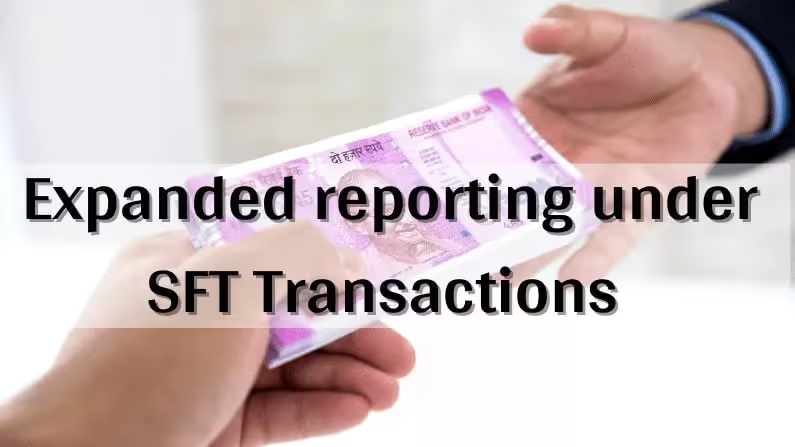
Ampliación de la declaración de transacciones SFT (Transacciones Financieras Especificadas) | Honrar a los honestos

Publicado el:
September 7, 2020

Tabla de contenido

Hable con nosotros
¡Gracias! Hemos recibido su envío.
¡Vaya! Algo salió mal al enviar el formulario.

Una firma,
soluciones globales

Apoyamos los negocios internacionales con confianza y claridad.
Agendar una llamada

La erradicación del dinero negro siempre ha sido uno de los pilares fundamentales de todo gobierno. El dinero negro se genera principalmente entre un gran grupo de personas en el país con el fin de evitar la carga de pagar grandes sumas en impuestos sobre la renta. El Gobierno de la India ha tomado la iniciativa de frenar el alcance del dinero negro mediante numerosas medidas al respecto. Una de las actividades más importantes emprendidas por el gobierno es la declaración de las transacciones SFT (transacciones financieras especificadas).

Ahora bien, la primera pregunta que surge es: ¿cómo ayuda esta declaración al gobierno a frenar el dinero negro y a reducir la ocultación de ingresos imponibles?

La responsabilidad del impuesto sobre la renta es una obligación autoliquidada por el contribuyente, quien a menudo intenta subestimar sus ingresos imponibles al no declarar diversas transacciones, terminando así por pagar menos impuestos.

Por lo tanto, el departamento ha trasladado la responsabilidad de informar a la contraparte de las transacciones. Ahora, el departamento enumera a las personas designadas que deben informar periódicamente sobre transacciones específicas. Dado que el departamento ya dispone de información importante, un contribuyente no puede eludir su responsabilidad fiscal sobre dichos ingresos.

Aquí surge la duda de qué transacciones financieras específicas deben declararse y quién es el responsable de informar sobre este tipo de operaciones.

1. Transacciones financieras especificadas: Transacciones SFT

La Sección 285BA de la Ley del Impuesto sobre la Renta estableció la responsabilidad de declarar las transacciones financieras especificadas, conocidas popularmente como SFT. Según la Sección 285BA de la Ley del Impuesto sobre la Renta, cualquiera de las siguientes operaciones puede ser prescrita como transacción financiera especificada:

  • transacción de compra/venta/intercambio de bienes o propiedades, o derechos o intereses sobre una propiedad; o
  • prestación de cualquier servicio; o
  • transacción bajo un contrato de obra; o
  • transacción mediante una inversión realizada o un gasto incurrido; o
  • obtención o aceptación de cualquier préstamo o depósito

Bajo cualquiera de las categorías anteriores, el departamento puede prescribir diferentes valores para distintas transacciones que deban ser declaradas por diferentes personas.

Las disposiciones para la declaración de SFT han estado vigentes desde hace mucho tiempo. De acuerdo con los escenarios y requisitos cambiantes, se han añadido diversas transacciones a esta lista a lo largo del tiempo para evitar que los contribuyentes subestimen sus ingresos imponibles.

2. Cambios propuestos en las transacciones SFT (13.08.2020)

El Gobierno ha lanzado una nueva plataforma para la "Fiscalidad Transparente: Honrando a los Honestos" bajo la ley del impuesto sobre la renta, y bajo ella se han realizado diversos cambios hacia la implementación de procedimientos de evaluación sin rostro y apelaciones electrónicas para aumentar la transparencia en el sistema del impuesto sobre la renta.

Además, con el objetivo de mejorar el control de las transacciones, el Gobierno también ha propuesto ampliar el alcance de la declaración de SFT. Esto se ha hecho añadiendo diversas transacciones nuevas y exigiendo a nuevas personas que declaren las SFT para garantizar un mejor cumplimiento y transparencia.

Tenga en cuenta que no se ha emitido ninguna notificación formal ni comunicado de prensa para informar sobre los cambios en el alcance de las SFT. Sin embargo, la información se ha difundido a través de folletos publicados en diferentes páginas gubernamentales de Twitter.

Como parte de la expansión propuesta de las transacciones declarables bajo las SFT, las siguientes operaciones estarán bajo escrutinio:

  1. Pago de impuestos sobre la propiedad superior a 20.000 rupias anuales
  2. Prima de seguro médico superior a 20.000 rupias
  3. Pagos a hoteles superiores a 20.000 rupias
  4. Prima de seguro de vida superior a 50.000 rupias
  5. Consumo de electricidad superior a 1 lakh de rupias anuales
  6. Pago de tasas educativas/donaciones superiores a 1 lakh de rupias anuales.
  7. Compra de joyas, electrodomésticos, pinturas, mármol, etc., superior a 1 lakh de rupias
  8. Depósitos/créditos en cuentas corrientes superiores a 50 lakh de rupias
  9. Depósitos/créditos en cuentas no corrientes, como cuentas de ahorro, superiores a 25 lakh de rupias
  10. Viajes aéreos nacionales en clase ejecutiva/viajes al extranjero
  11. Transacciones de acciones/cuentas desmaterializadas/cajas de seguridad bancarias

Además, se propone que las siguientes personas adicionales presenten obligatoriamente su declaración en el formulario de Informe de Información Anual (AIR):

  1. Una persona con transacciones bancarias superiores a 30 lakh de rupias
  2. Todos los profesionales y empresas con una facturación superior a 50 lakh de rupias
  3. Pago de alquiler superior a 40.000 rupias.

Aparte de estos cambios propuestos, existen diversas transacciones que ya deben ser declaradas bajo las SFT.

3. Naturaleza y valor de la transacción que debe ser declarada por las personas designadas

Section 285BA authorizes the Central Board of Direct Taxes (CBDT) to prescribe different values with respect to specified financial transactions in respect of different specified persons having regard to the nature of such transactions. 

Accordingly, list of specified transactions required to be reported by specified persons is provided in Rule 114E is given below:

  1. Cash payment made for purchase of bank drafts or pay orders or banker’s cheque where aggregate payment made during a year is INR 10 Lacs or more.
  2. Cash payments for purchase of prepaid instruments issued by RBI where aggregate payment made during a year is INR 10 Lacs or more.
  3. Cash deposits or withdrawals in one or more current accounts of a person aggregating INR 50 Lacs or more during a Financial Year.
  4. Cash deposits in one or more accounts, other than a current account and time deposit,(e.g. Savings accounts) of a person of INR 10 Lacs or more during a Financial year.
  5. One or more time deposits (other than renewed time deposit of another time deposit) of a person aggregating INR 10 lacs or more during a Financial year.
  6. Credit card payments made by any person either in cash or by any other mode in a FY where aggregating of payment is INR 1 lakh or more in cash or INR 10 lakh or more by any other mode.
  7. Receipt from any person for acquiring bonds or debentures issued by the company or institution (other than renewal) aggregating of INR 10 Lacs or more in a Financial year.
  8. Receipt from any person for acquiring shares (including share application money) issued by the company where Aggregating payment is Rs 10 lakh  or more in a FY
  9. Payment made for Buyback of shares from any person (other than the shares bought in the open market) for aggregating INR 10 lacs or more in a Financial year.
  10. Receipt from any person for acquiring units of one or more schemes of a Mutual Fund (other than transfer from one scheme to another) aggregating INR 10 Lacs or more in a Financial year.
  11. Receipt from any person for sale of foreign currency including any credit of such currency to foreign exchange card or expense in such currency through a debit or credit card or through issue of travellers cheque or draft or any other instrument where aggregate amount received or incurred during the FY is INR 10 Lacs or more.
  12. Purchase or sale of immovable property by any person where Transaction value or valuation of stamp duty, as determined under Section 50C, is Rs 30 lakhs or more.
  13. Cash receipt by any person for sale of goods or services of any nature (other than those specified at Sl. Nos. 1 to 10) exceeding INR 2 Lacs.
  14. Cash deposits during the period 09th November, 2016 to 30th December, 2016 aggregating to Rs 12,50,000 or more in one or more current account of a person or Rs 2,50,000 or more in one or more accounts.

Different persons are specified for reporting above mentioned transactions such as Financial Institutions, Banks, Post Offices etc.

4. Due date of filing of SFT Transactions

SFT shall be furnished in Form 61A on or before 31st May immediately following the financial year in which transaction is registered or recorded.

Such specified persons were required to submit ‘Annual Information Return (AIR)’ introduced in 2003 with respect to specified financial transactions under Section 285BA.

5. Changes made in 26AS with effect from 01.07.2020

With an objective of ensuring better compliances, various changes are made in Form 26AS over the period of time. Major changes are also made recently with effect From 01 July 2020 wherein various new transactions and information has been added in Form 26AS itself. Government has launched a revised form 26AS which included high value transactions from SFTs from this assessment year, which would be now directly visible to the taxpayer at time of filing of Income Tax return.

Details of changes made in Form 26AS can be accessed.

6. Consequences of Not filing information regarding SFT under section 285BA

  • Where a person failed to furnish a statement under section 285BA on or before 31st May immediately following the financial year then the concerned income tax authority can issue a notice requiring him to furnish a statement within a period of 30 days from date of service of notice.  
  • If a furnished statement is defective, then the concerned income tax authority can require him to rectify such defect within a period of 30 days or extended period.
  • If such return is not rectified within time permitted by concerned Income tax authority then it shall be presumed that such person has furnished inaccurate information in the statement.

7. Failure to furnish SFT Transactions

  1. If a person fails to furnish SFT report under section 285BA by the due date then penalty shall be levied of Rs.500 per day till such failure continues. 
  2. Further, if a notice is served on a person requiring him to furnish SFT Transactionsstatement and such person fails to file the same within time allowed in notice then penalty of INR 1000 per day will be levied from the day immediately following the day mentioned in notice.

For Example: An assessee fails to file a statement of financial transactions till 31st May 2020. Notice is received from Income Tax Authority u/s 285BA to file till 31st July 2020 for which the notice is served on 1st July 2020. Now there are two possibilities:

a.   Return filed on 31st July 2020: Ankur will have to pay penalty of Rs.30500 (61days*Rs500 per day i.e. from 1st June to 31st July)

b.  Return filed on 31st August 2020: Penalty will be Rs.30500 plus additional 31000 (31 days* Rs.1000 per day i.e. from 1st August to 31st August).

8. Inaccurate information in SFT Transactions

As per section 271FAA, if a person who is required to furnish specified financial report, provides incorrect information in the statement due to any of the following reasons:

  • inaccuracy is due to a failure to comply with the prescribed due diligence requirement or is deliberate on the part of that person; or
  • the person knows of the inaccuracy at the time of furnishing the report, but he fails to inform the concerned income-tax authority about such default; or
  • where the person found inaccuracy after furnishing the statement and fails to inform and furnish the correct information within 10 days of filing.

En ese caso, la autoridad fiscal correspondiente podrá imponer a dicha persona una multa de 50.000 INR.


CA Kavit Vijay
Kavit Vijay, socio de la firma, cuenta con 15 años de experiencia en Auditoría y Aseguramiento. Dirige la división de Auditoría y Aseguramiento de la firma y está especializado en:
Conozca más sobre el autor

Blogs recientes

