Accurately identifying which entities fall under ASC 740 is key to implementing tax accounting properly:
Public business entities under U.S. GAAP must follow ASC 740 for income tax accounting. This includes the asset/liability method for deferred taxes and detailed disclosure requirements introduced under ASU 2023-09.
Private companies and not-for-profit organizations preparing GAAP-compliant financial statements must also follow ASC 740. However, some disclosure mandates differ from public entities (FASB Improvements to Income Tax Disclosures and FASB Project Summary).
Foreign entities that report under U.S. GAAP, such as subsidiaries of U.S. firms or multinational firms listed in the U.S., must comply with ASC 740 (SEC Filing Example).
Partnerships are generally excluded unless taxed at the entity level rather than pass-through.
Pro Tip: Even private companies should maintain strong ASC 740 processes to prevent tax provision errors and reduce audit risk.
Knowing where your business fits under ASC 740 should be the ideal starting point for accurate and dependable tax reporting.
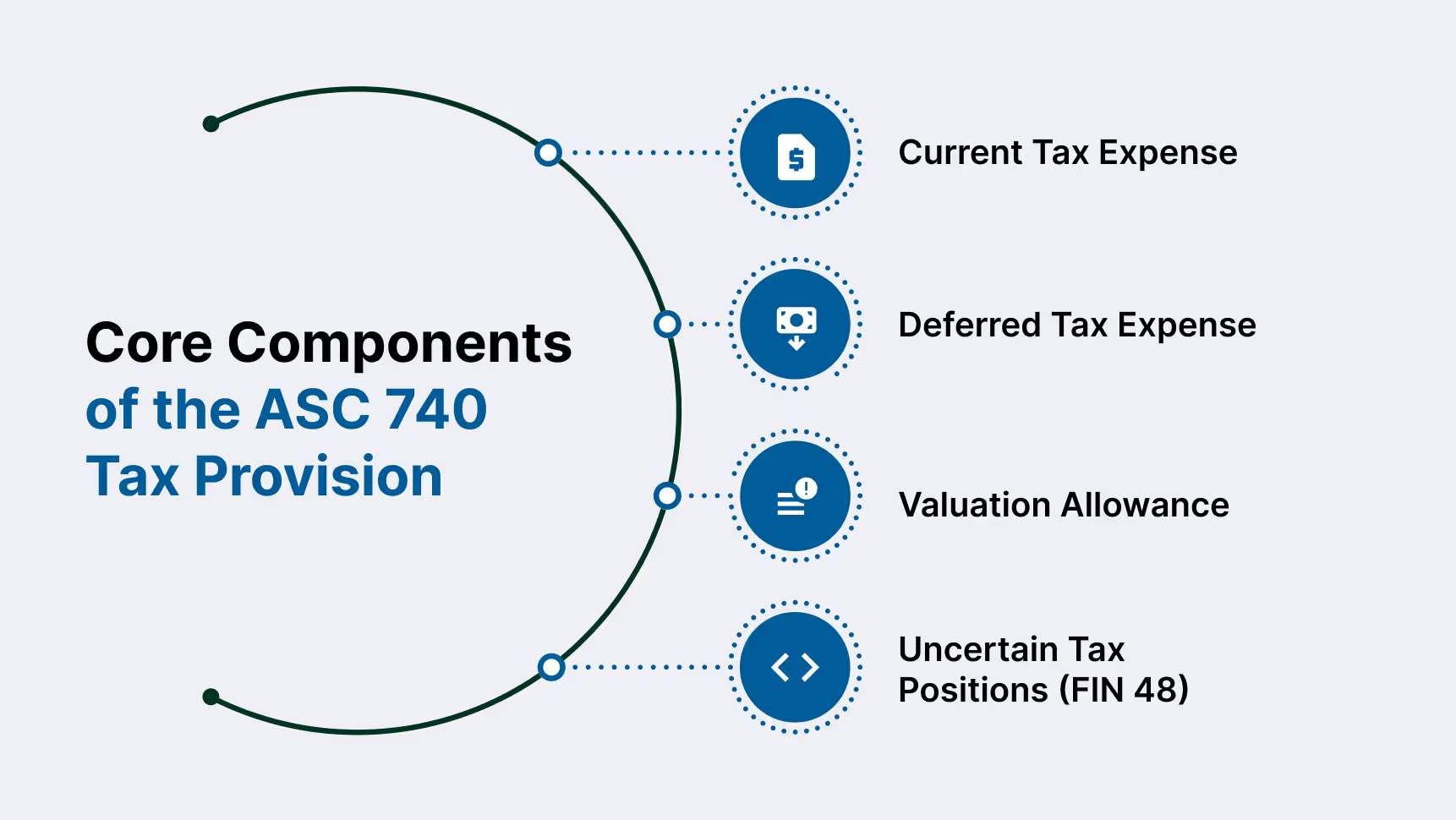
Core Components of the ASC 740 Tax Provision
[Infographic Here: Breaking Down the Key Elements of ASC 740]
The tax provision under ASC 740 is comprised of Current Tax, Deferred Tax, and Valuation Allowance, along with the specialized framework for Uncertain Tax Positions (FIN 48).
1. Current Tax Expense
Based on taxable income for the current year as reported on filed returns.
Adjusted for permanent differences, such as non-deductible expenses like fines or penalties that impact GAAP versus tax income.
2. Deferred Tax Expense
Arises from temporary differences between book and taxable income (for example, accelerated depreciation under tax rules).
Uses the asset/liability method outlined in ASC 740:
Deferred Tax Assets (DTAs): Represent future deductions, such as net operating loss carryforwards (NOLs).
Deferred Tax Liabilities (DTLs): Represent future taxable amounts created by differences like accelerated depreciation.
3. Valuation Allowance
A valuation allowance offsets DTAs that are unlikely to be realized, following the "more-likely-than-not" test in ASC 740-10-30.
Both positive and negative evidence (such as past profitability trends) must be evaluated objectively (RSM Valuation Allowance Guide).
4. Uncertain Tax Positions (FIN 48)
FIN 48 (codified in ASC 740-10) governs how companies recognize uncertain tax positions:
Recognition Step: Determine if a tax benefit meets the more-likely-than-not threshold.
Measurement Step: Record the most significant benefit that is more than 50% likely to be sustained.
Requires disclosure of tabular rollforwards, interest and penalty accruals, and positions under audit.
A well-structured tax provision under ASC 740 not only ensures compliance but also strengthens financial transparency and builds confidence with auditors, regulators, and investors alike.
ASC 740 Disclosure Updates (ASU 2023‑09)
[Infographic: Key Changes in ASC 740 Disclosures]
Starting in fiscal 2024 for public business entities and 2025 for private entities, ASU 2023‑09 introduces substantial enhancements to income tax disclosures under ASC 740. Its purpose is to improve transparency and provide investors and regulators with clearer insight into income tax metrics (FASB ASU 2023‑09 PDF).




.avif)


