By Hon’ble Patna High Court
事案:
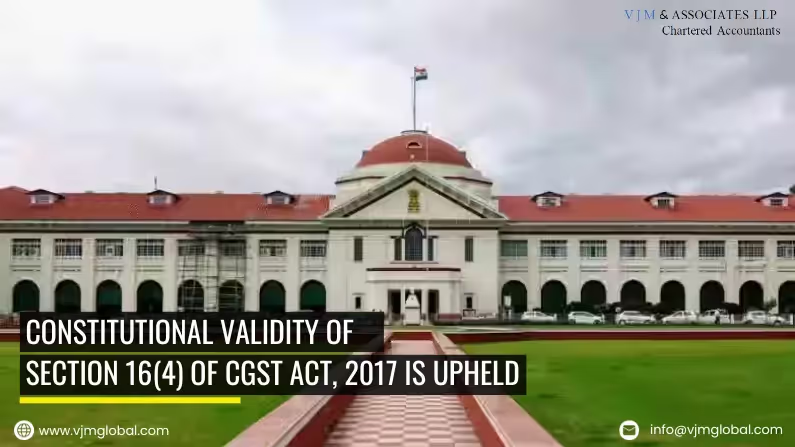
Gobinda Construction Vs Union of India through the Secretary (Patna High Court) (Civil Writ Jurisdiction Case No. 9108 of 2021)
The Petitioner filed GSTR-3B for the month of Feb, 2019 and March, 2019 on 23.10.2019 and 07.11.2019 respectively. The respondent disllowerd the ITC claimed in GSTR-3B due to condition given under Section 16(4) of CGST Act, i.e., ITC can’t be claimed beyond the due date of filing of return for the month of September of following year. The Petitioner challenged that Section 16(4) is volatile of Article 300-A of Constitution of India as it takes way right to property.
Hon’ble High Court held that Section 16(4) if The language of Section 16 of the CGST Act suffers from no ambiguity and clearly stipulates grant of ITC subject to the conditions and restrictions put thereunder. Section 16(4) prescribes one of the conditions to make a registered person entitled to take ITC. Therefore, right of a registered person to take ITC under Section 16(1) becomes a vested right only if such condition is fulfilled. ITC is not unconditional and a registered person becomes entitled to ITC only if the requisite conditions given are fulfilled and restrictions given under Section 16(4) does not apply.Therefore, Section 16(4) of CGST Can’t be said to be violative of Article 300-A of the Constitution of India.
1. 事案の概要
- The petitioner filed the GSTR-3B for the month of Feb, 2019 and March, 2019 on 23rd October, 2019 and 7th November, 2019 respectively.
- The Petitioner received the SCN proposing to disallow ITC for the tax period of February and March 2019 on the ground of late filing of return in Form GSTR-3B.
- The petitioner replied that disallowance of ITC in terms of Section 16(4) of the Act was not justified. The petitioner claimed that it filed the return in prescribed Form GSTR-3B and had made necessary disclosures in the form.
- As per SCN, the petitioner had availed ITC for the tax period February 2019 and March 2019 in breach of Section 16(4) of the CGST Act.
- Aggrieved by the order, the petitioner preferred an appeal before the Additional Commissioner of State Tax (Appeal). However, appeal got dismissed on the ground that ITC availed by the petitioner was inadmissible as per Section 16(4) of CGST Act.
- The authorities disallowed ITC availed by the petitioners for delayed filing of their return by invoking Section 16(4) of CGST Act.
2. Issues Before Hon’ble High Court
Common challenge before Hon’ble High Court is:
- Constitutional validity of Section 16(4) of the CGST Act which denies entitlement of Input Tax Credit (ITC) for invoice or debit note after the due date of furnishing of returns of September Month of the following year. Section 16(4) is violative of Articles 14 and 300A of the Constitution of India.
- Further, Conditions given u/s 16(4) of CGST Act are merely procedural in nature and cannot override substantive conditions prescribed under Section 16(1) and Section 16(2) of CGST Act.
- There is no non obstante clause given under Section 16(2) and therefore, the same shall prevail over Section 16(4) of the Act.
- Also, return in GSTR-3B cannot be treated to be a return prescribed under Section 39(1) of the CGST Act as it does not satisfy the parameters of a return contemplated under Section 39(1) of the said Act. Further, retrospective amendment, prescribing Form GSTR-3B as a return under Section 39(1) of the CGST Act, is ultra vires Section 39(1) of the CGST Act itself.
3. Legal Extracts
Relevant Extracts of the law is reiterated below for ease of reference:
- Section 16(4) of CGST Act:
“16. Eligibility and conditions for taking input tax credit.-
…
(4) A registered person shall not be entitled to take input tax credit in respect of any invoice or debit note for supply of goods or services or both after the due date of furnishing of the return under section 39 for the month of September following the end of financial year to which such invoice or debit note pertains or furnishing of the relevant annual return, whichever is earlier.
…”
Section 16(4) has been amended by the Finance Act, 2022, with effect from 01.10.2022, whereby the words and figures "due date of furnishing of the return under Section 39 for the month of September" stand substituted by "30th day of November".
4. Contention of the Petitioner
The Petitioner has contented that;
- ITC is a vested right under Article 300A of the Constitution of India and such protected and vested right cannot lightly be taken away due to belated filing of return.
- Further, Restrictions given under Section 16(4) would apply only to ITC of invoices or debit notes which are received after the end of the financial year beyond September month and not ITC Claimed in a belated return filed after such date.
- Also, ITC under Section 16(4) is the nature of tax paid at the stage of purchase of goods or services are vested rights under Article 300A of the Constitution of India and, therefore, to be adjusted with the tax payable on sale of goods or services both in computing the tax liability.
- Conditions given under Section 16(4) of the CGST Act are merely procedural in nature and cannot override the substantive conditions given under Section 16(1) and 16(2) of the said Acts.
- Provision of Section 16(4) imposes unreasonable and disproportionate restriction on the right to freedom of trade and profession guaranteed under Article 19(1)(g) and it, therefore, violates Article 300A of the Constitution.
- Further, disallowing ITC under Section 16(4) of the CGST Act amounts to double taxation and, thus, violates the principle of taxation on value addition.
5. Contention of the Respondent
被申立人は以下の通り主張した:
- ITC is a benefit extended to a registered person under the CGST which can be availed only as per the scheme of the CGST Act.
- Further, conditions given under Section 16(4) of the CGST Act is mandatory in nature for availing ITC under Section 16 of the Act.
- Payment of ITC at the time of purchase and supply to its supplier remains in the credit ledger of the dealer until the dealer discloses the transaction by way of filing return in Form GSTR- 3B. The amount of ITC is credited into the dealer’s electronic ledger and the same does not reach the Government until the dealer files its return and once the dealer files its return in Form GSTR-3B the amount of input tax lying in the credit ledger of the dealer reaches the Government Treasury.
- This is the reason why the Legislature has made such a provision under Section 16(4) of the CGST Act to prevent a dealer from filing the delayed return.
6. Analysis and Findings by the Hon’ble High Court
Hon’ble Patna High Court made following discussion and interpretations:
a. Section 16(4) is not validation of Article 300-A of Constitution of India
- 根本的な問いの一つは、ITC(入力税額控除)自体が既得権であるか否か、そしてCGST法第16条(4)によるその否認が憲法第300条Aに基づく憲法上の権利の侵害にあたるか否かという点です。
- 憲法第300条Aに基づく財産権は、人権であると同時に憲法上の権利でもあります。これは法律に従う場合を除き、奪われることはありません。
- 最高裁判所は、Jilubhai Nanbhai Khachar & Ors. vs. State of Gujarat & Anr.事件(1995 Supp (1) SCC 596)において、次のように解釈しています。
- 財産とは、法律によって保証され保護される権利の集合体である。
- それはあらゆる種類の価値ある権利および利益に及び、特に所有権、物に対する排他的権利、法律で認められたあらゆる方法で物を処分する権利、所有する権利、使用する権利、そして他者の干渉を排除する権利が含まれる。
- さらに、解釈の基本原則として、立法者の意図を汲み取ることが挙げられます。文言が明確で曖昧さがなく、立法者の意図がはっきりと伝わっている場合、裁判所が法規定を修正または変更する余地はないというのが、法定解釈の基本原則です。
- CGST法第16条の文言によれば、すべての登録事業者は、自身の事業の遂行に関連して使用される、または使用される予定の物品やサービスの供給(あるいはその両方)に対して課されたITCを受ける権利を有し、当該金額は当該事業者の電子クレジット元帳に貸方記入されるものとされています。ただし、このITCの受給資格には以下の条件が課されます。
- 規定される条件および制限、ならびに
- 第49条に規定される方法
- 第16条(2)は非 obstante(優先)条項であり、登録事業者が同条(a)から(d)に規定される要件および条件を満たさない限り、ITCを受ける権利を有しないことを明確に述べています。
- CGST法第16条(4)は、登録事業者がいかなる請求書またはデビットノートに関しても、翌会計年度の11月30日(改正後)または関連する年次申告書の提出日のいずれか早い日を過ぎた場合、ITCを受ける権利を有しないことを明確に規定しています。
- CGST法第16条の文言には曖昧さはなく、その下に置かれた条件および制限に従ってITCを付与することを明確に規定しています。
- さらに、ITCは無条件ではなく、登録事業者は規定された要件を満たし、かつ第16条(4)に基づく制限が適用されない場合にのみ、ITCを受ける権利を得ます。
- 第16条(4)は、登録事業者がITCを受ける権利を得るための条件の一つを規定しています。したがって、第16条(1)に基づく登録事業者のITC受給権は、当該条件が満たされた場合にのみ既得権となります。
- 憲法第300条Aを援用するためには、以下の二つの状況が同時に存在する必要があります。
- Jayam and Company vs. Assistant Commissioner & Anr.事件((2016) 15 SCC 125)において、最高裁判所はタミル・ナードゥ州付加価値税法(2006年)第19条(20)の憲法上の妥当性を支持し、次のように判示しました。
- 法令によって譲歩が与えられる場合、その譲歩を受けるためには、付随する条件を厳格に遵守しなければならない。
- ITCは「事業者」の権利ではなく、第19条の規定により付与される譲歩である。
- CGST法第16条(1)に基づき、第16条(4)の規定は、登録事業者がITCを受ける権利を得るための条件の一つである。
- したがって、CGST法第16条(4)がインド憲法第300条Aに違反しているとは言えません。
b. 第16条(4)はCGST法の第302条(憲法第19条(1)(g)に基づく職業選択の自由を制限するもの)に違反しない
- 申立人は、第16条(4)が憲法第19条(1)(g)で保証されている職業選択の自由に対して不合理かつ不均衡な制限を課していると主張しました。
- したがって、これは憲法第302条に違反し、憲法第13条に抵触するものです。
- すべての登録事業者に一律に適用される法律は、憲法第19条(1)(g)に違反するものとはみなされません。
7. 結論
高等裁判所は、CGST法第16条(4)は憲法上有効であり、インド憲法第19条(1)(g)および第300条Aに違反しないと判示しました。



.avif)


