Transfer Pricing (TP) has become a crucial aspect of financial management for businesses operating in the GCC region, which includes countries like the UAE, KSA, Qatar, Oman, Bahrain, and Kuwait.
The UAE's Federal Tax Authority now mandates that businesses with revenues exceeding AED 200 million, or those part of multinational groups with consolidated revenues over AED 3.15 billion, must prepare comprehensive TP documentation.
For businesses engaged in intercompany transactions, understanding and complying with these regulations is essential to avoid hefty penalties and ensure smooth operations.
This blog provides a comprehensive overview of the existing TP regulations in GCC member states, recent developments in the UAE and KSA, and the financial impacts of non-compliance.
Key Takeaways
Stricter TP Regulations in GCC: Countries like the UAE, KSA, and Qatar have tightened transfer pricing rules to prevent tax base erosion and profit shifting, with documentation requirements like Master Files, Local Files, and Country-by-Country Reporting (CbCR).
KSA’s Expanded Scope: From January 2024, Zakat payers are included under KSA’s TP regulations, applying to transactions between related parties and Permanent Establishments (PEs).
Phased TP Documentation in KSA: KSA introduces phased documentation for Zakat payers, with compliance becoming mandatory for transactions over SAR 48 million from FY 2027.
Financial Impact & Compliance: TP adjustments affect VAT and customs duties, potentially increasing VAT liabilities and customs costs. Non-compliance can result in severe penalties, including fines and tax adjustments.
What are the Transfer Pricing (TP) Regulations in the GCC Region?
The tax dynamics across GCC countries have changed significantly, leading to increased focus on Transfer Pricing (TP), especially since most of the region has joined the Base Erosion and Profit Shifting (BEPS) framework.
Here are the Transfer Pricing regulations for each GCC region
1. United Arab Emirates (UAE)
Country-by-Country Reporting (CbCR): Since 2019
TP Regulations: Effective from June 1, 2023.
Expert Services: Assistance with Corporate Tax, Transfer Pricing, and International Tax.
2. Saudi Arabia (KSA)
Country-by-Country Reporting (CbCR): Since 2018
Applicability: TP regulations apply to all juridical persons, including mixed companies.
Documentation: Local File, Master File, controlled transaction disclosure form, and general documentation required.
Tax Return: TP disclosure must be included.
Advanced Ruling: Permissible.
Penalties: Non-compliance penalties apply as per the IT Law.
3. Qatar
Country-by-Country Reporting (CbCR): Since 2018
Applicability: Applies to transactions between Qatar resident entities and foreign entities in preferential tax regimes or cooperative/non-cooperative countries.
Pricing Methods: Preferably, the use of the Comparable Uncontrolled Price (CUP) method, but OECD methods are also allowed.
Documentation: Local and Master files required.
Tax Return: TP declaration must accompany the annual tax return.
Advanced Ruling: Permissible.
Penalties: Non-compliance penalties apply as per the IT Law
4. Oman
Country-by-Country Reporting (CbCR): Since 2020
Applicability: No specific TP regulations, but related party transactions are monitored through IT Law measures.
Pricing Methods: OECD guidelines recommended.
Documentation: Recommended but not mandatory. Documentation must be available upon request.
Advanced Ruling: Permissible.
Penalties: Imposed for non-compliance.
5. Bahrain
Country-by-Country Reporting (CbCR): Since 2021
Applicability: No specific TP regulations in place.
Pricing Methods, Documentation, Ruling, Penalties: Not applicable due to the absence of a formal TP regime.
6. Kuwait
Country-by-Country Reporting (CbCR): Not applicable (Kuwait has not joined BEPS).
Applicability: TP regulations apply to transactions between domestic and foreign entities at arm’s length.
Documentation: Requires documentation for contracts and declared costs/expenses with related parties.
Advanced Ruling: Not applicable.
Penalties: Not applicable unless a tax treaty applies.
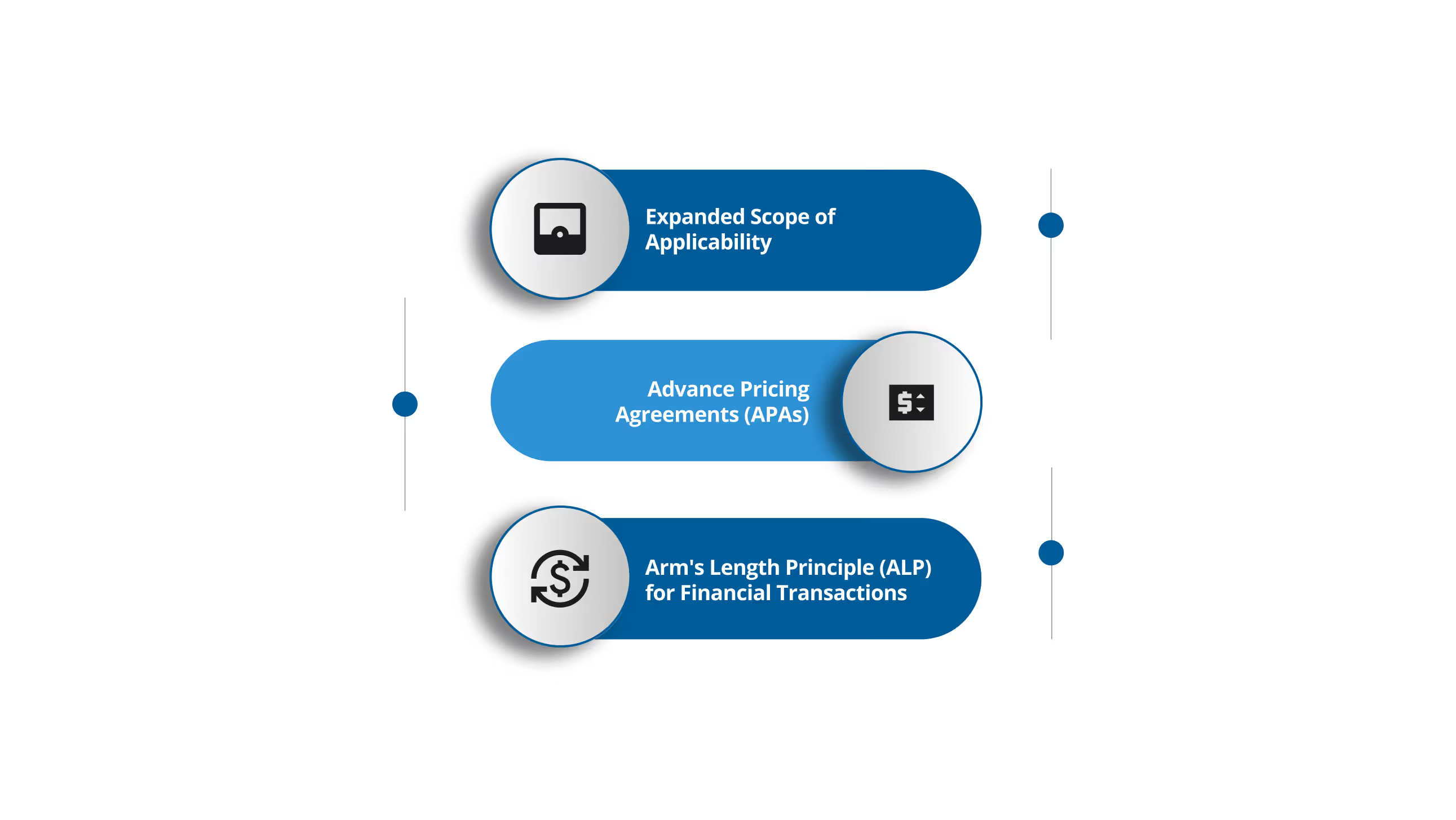
In June 2024, the Kingdom of Saudi Arabia (KSA) released the 3rd edition of its Transfer Pricing (TP) Guidelines, issued by the Zakat, Tax, and Customs Authority (ZATCA). These updates introduce changes, including an expanded scope of applicability and the introduction of a formal Advance Pricing Agreement (APA) program.
Below is an analysis of the key KSA Transfer Pricing updates:
1. Expanded Scope of Applicability
The updated TP provisions extend the regulations to a broader range of entities and transactions:
Zakat Payers Included: Starting from fiscal years beginning on or after January 1, 2024, TP provisions are extended to Zakat-paying entities. This includes anyone considered a taxpayer under the Income Tax system, Zakat Regulations, or both.
Transactions Covered: TP regulations apply to all taxpayers, including Permanent Establishments (PEs). The provisions cover transactions between related parties or entities under common control (defined as ≥50% ownership) or effective control (via governance, funding, or business). Both international and domestic transactions are now included.
2. Advance Pricing Agreements (APAs)
A major development is the introduction of a formal APA program, which is aimed at increasing tax certainty and reducing disputes:
APA Program Launch: ZATCA has launched an APA program for both taxpayers and Zakat payers for financial years beginning on or after January 1, 2024. A new section detailing APAs has been added to the guidelines.
Eligibility and Duration: APAs are available for transactions valued at no less than SAR 100 million. Once approved, an APA is effective for 3 financial years, during which the agreed-upon TP policy cannot be challenged by the tax authority.
Application Requirements: Multinational groups must submit their applications at least 12 months before the start of the relevant financial year. The application must include information on the group structure, transaction descriptions, financial statements, functional analyses, and competitor studies.
3. Arm's Length Principle (ALP) for Financial Transactions
Saudi Arabia’s Transfer Pricing framework guidelines also provide detailed guidance on applying the Arm’s Length Principle (ALP) to financial transactions.
Debt vs. Equity Characterization: The guidelines emphasize the need to properly define whether transactions should be classified as loans or equity. This distinction determines the treatment of the transaction under Saudi tax regulations.
Debt Capacity Analysis: A debt-to-equity ratio analysis is required to assess whether the company can bear the proposed debt, as third-party lenders may not lend excessive amounts. This is important for Zakat payers, as it impacts the Zakat Base when a transaction is reclassified from a loan to a capital contribution.
ALP Factors: To comply with the ALP for loan agreements, taxpayers are required to analyze several factors, including:
Characteristics of the financial instruments involved.
Economic conditions and the company’s business strategy.
Intangibles: The guidelines also require businesses to assess transactions involving intangible assets to determine which party within the multinational group benefits from the returns generated by those assets.
These policy shifts have direct implications for how businesses structure their compliance processes. The documentation expectations have evolved, particularly for entities subject to Zakat, requiring careful attention to new thresholds and timelines.
What Are the Revised Documentation and Reporting Requirements for KSA Transfer Pricing?
The updated KSA Transfer Pricing guidelines introduce new documentation obligations, with a phased approach, particularly for Zakat payers. Here’s a breakdown of the key changes:
Mandatory Documentation Threshold: Taxpayers must maintain Master and Local Files if their related-party transactions exceed SAR 6 million annually. Exemptions apply to small businesses and natural persons.
Affidavit Requirement: In addition to the Disclosure Form, which must be filed with the annual income tax/Zakat declaration, taxpayers must submit an Affidavit (Chartered Accountant Certificate). This certificate must confirm that the multinational enterprise (MNE) group’s TP policy is consistently applied to the taxpayer in KSA.
Zakat Payer Phased Documentation Requirements
Below is a summary of the implementation phases, detailing the compliance thresholds and the point at which documentation becomes mandatory.
Phase
Aggregated Value of Related Party Transactions
Compliance Status
Phase 1 (Effective 1 January 2024)
≤ SAR 48 million
Not Applicable
> SAR 48 million and < SAR 100 million
Voluntary
≥ SAR 100 million
Mandatory
Phase 2 (Effective 1 January 2027)
≤ SAR 48 million
Not Applicable
> SAR 48 million
Mandatory
≥ SAR 100 million
Mandatory
Exemptions:
Wholly state-owned companies are exempt from Zakat, and investment funds are not required to comply with specific documentation requirements.
Group companies filing a consolidated Zakat return are exempt from TP reporting for internal transactions involving entities where they hold less than 100% ownership.
Transfer Pricing (TP) regulations across the GCC region have become increasingly complex, with significant developments in countries like the UAE, KSA, Qatar, Oman, and Bahrain.
As businesses comply with these regulations, it is essential to understand the documentation requirements, such as the Master File, Local File, and CbCR, along with the financial implications and compliance challenges that arise from managing transfer pricing in conjunction with VAT and customs duties.
Companies must adopt proactive measures, ensuring compliance with the arm’s length principle to avoid severe penalties and optimize their tax positions.
As the regulatory landscape becomes more stringent, partnering with experts like VJM Global can provide invaluable support. Their services, including accounting outsourcing, international tax planning, audit support, and business setup, are tailored to help businesses effectively navigate these complexities.
Transfer pricing refers to the pricing of goods, services, or intellectual property exchanged between related entities within a multinational company. It ensures that transactions between these entities reflect market-based pricing.
2. What are the objectives of transfer pricing?
The primary objectives of transfer pricing are to allocate profits fairly across different jurisdictions, ensure compliance with tax laws, and prevent tax avoidance by applying the arm's length principle.
3. How can transfer pricing be avoided?
Transfer pricing itself cannot be avoided, but businesses can minimize risks by adhering to local regulations, maintaining accurate documentation, and using appropriate pricing methods.
4. What are the advantages and disadvantages of transfer pricing?
Advantages include tax optimization and profitability allocation. Disadvantages include the complexity of compliance, potential penalties for non-compliance, and the administrative burden of documentation.
5. What are the risks of transfer pricing?
The risks include tax audits, penalties for non-compliance, reputational damage, and financial adjustments if tax authorities find discrepancies in the pricing or documentation.



.avif)

.avif)


